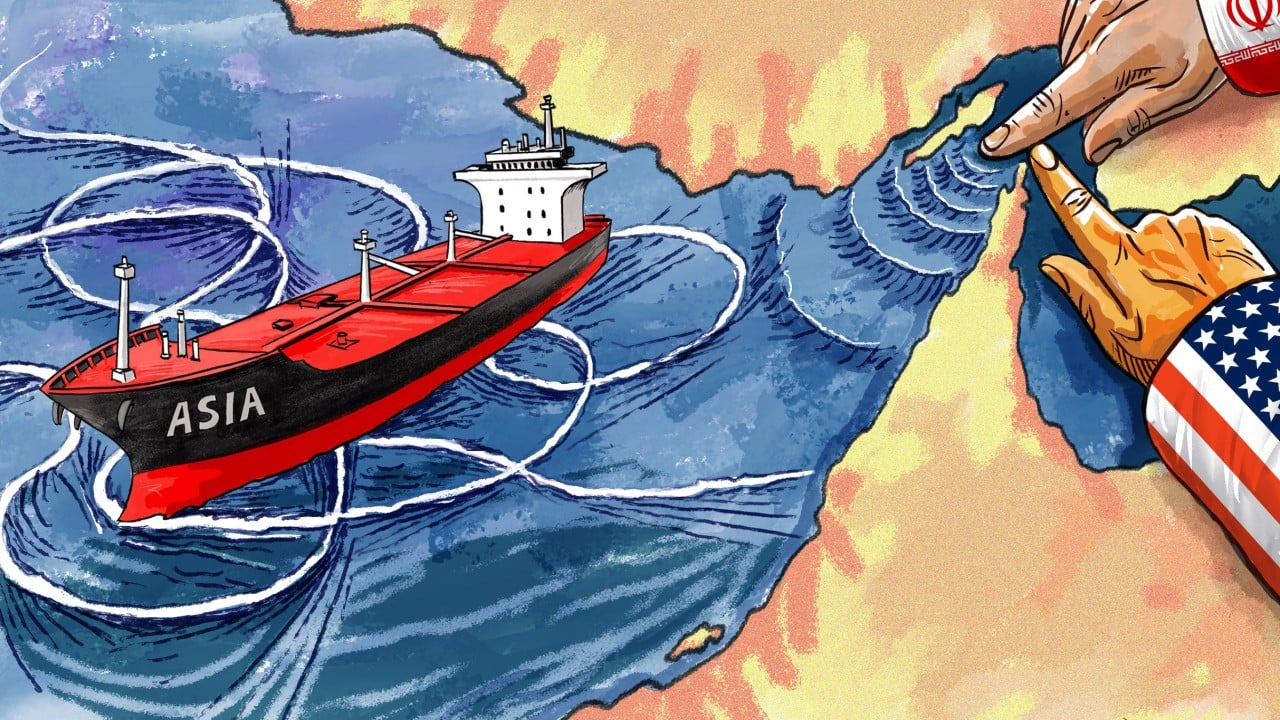
Asia is currently betting its industrial future on a geographic miracle that is starting to look like a curse. While policymakers in Beijing, Tokyo, and New Delhi talk about "diversification," the cold reality remains that the Strait of Hormuz remains the single most critical artery for the continent's survival. Any prolonged disruption to this waterway would not just raise prices; it would effectively dismantle the economic models that have fueled Asian growth for thirty years.
The current geopolitical climate has introduced a dangerous new theory: the idea of "managed disruption." This suggests that world powers can tolerate a certain level of friction in the Gulf—small-scale tanker seizures or drone threats—without triggering a global meltdown. This is a fantasy. For Asian economies, there is no such thing as a "managed" crisis in the Strait. Even a 5% drop in throughput triggers a cascade of insurance hikes and refinery shutdowns that the region is fundamentally unprepared to handle. You might also find this related coverage interesting: Russia and the OPEC Plus Mirage.
The Physical Reality of the Chokehold
The Strait of Hormuz is a narrow passage, only about 21 miles wide at its tightest point. More importantly, the shipping lanes used by massive tankers are even narrower, consisting of two two-mile-wide channels separated by a two-mile buffer zone.
Every day, roughly 20 million barrels of oil pass through this gap. That represents about a fifth of global liquid petroleum consumption. For Asia, the numbers are even more stark. Over 70% of the crude flowing through the Strait is destined for Asian markets. China, India, Japan, and South Korea are the primary dependents. They aren't just buying oil; they are buying the stability of their domestic social contracts. If the lights go out or the factories stop, the political consequences in these nations become unpredictable. As reported in detailed articles by Investopedia, the implications are worth noting.
Why Asia Cannot Simply Pivot
The most common counter-argument is that Asia is moving toward renewables or sourcing oil from Russia and the Americas. This misses the technical constraints of the global refining system.
Refineries are not generic kitchens. They are highly specialized chemical plants designed to "crack" specific types of crude. Much of the Middle Eastern supply is "sour" or "heavy," containing more sulfur. Asian refineries, particularly those in India and China, have spent billions optimizing their hardware to process this specific grade of oil. You cannot simply swap Saudi Light for American WTI (West Texas Intermediate) without losing efficiency or damaging equipment.
The Infrastructure Gap
Pipelines that bypass the Strait exist, but they are insufficient. Saudi Arabia’s East-West Pipeline and the UAE’s Habshan-Fujairah line can move some volume to the Red Sea or the Gulf of Oman, but their combined capacity covers less than 40% of the usual flow. Furthermore, these pipelines are themselves vulnerable to sabotage or regional conflict.
For a country like Japan, which possesses almost no domestic fossil fuel resources, the Strait is a literal lifeline. Japan maintains significant strategic petroleum reserves, but these are designed for short-term shocks, not a fundamental shift in the security of the Persian Gulf.
The Insurance Trap
When we talk about disruption, we often focus on missiles and mines. The more immediate threat is the "paper blockade."
The maritime insurance market is centered in London. When a region is declared a high-risk zone, "war risk" premiums skyrocket. In previous periods of tension, these costs have jumped tenfold in a matter of days. For a Long Range (LR) tanker carrying a million barrels, an extra $200,000 or $500,000 in insurance per voyage gets passed directly to the buyer.
Asia operates on thin manufacturing margins. The "China Price" or the competitiveness of Vietnamese textiles depends on cheap energy and predictable logistics. When insurance costs make shipping untenable, the entire supply chain vibrates. We saw a preview of this during the recent Red Sea tensions, where diverted ships added weeks to transit times and millions to fuel bills. Multiply that by the volume of the Hormuz traffic, and you have a recipe for stagflation across the Pacific.
The Shadow of the Tanker War
History provides a grim blueprint. During the 1980s "Tanker War" between Iran and Iraq, over 400 vessels were attacked. While the world eventually adjusted, the context was different. Back then, the United States was the primary guarantor of maritime security.
Today, the U.S. posture has shifted. Washington is now a net exporter of energy. While it still cares about global price stability, the existential sting of a Hormuz closure is felt in Beijing, not Houston. This creates a security vacuum. If the U.S. Navy scales back its "policing" of the Gulf, who steps in?
China has established its first overseas base in Djibouti and increased its naval presence in the Indian Ocean, but it lacks the carrier strike groups and the regional alliances required to secure a 2,000-mile supply line from the Gulf to the South China Sea. India, similarly, has the local naval power but lacks the reach. This leaves the world’s largest oil consumers relying on a security architecture that the provider is increasingly reluctant to fund.
The Strategic Petroleum Reserve Myth
Many analysts point to the Strategic Petroleum Reserves (SPR) of Asian nations as a cushion. China’s reserve is estimated at over 90 days of imports. India is building its own capacity. However, an SPR is a defensive tool, not an offensive solution.
If the Strait of Hormuz is blocked or severely restricted for more than a month, an SPR becomes a psychological burden. Governments become terrified of depleting the reserve, leading to hoarding and domestic rationing. We have seen this behavior in grain markets; energy is no different. The moment a government restricts supply to "protect the future," the current economy begins to seize up.
The Role of the Dollar
A hidden layer of this crisis is the currency of trade. Almost all oil passing through the Strait is priced in U.S. Dollars. A disruption causes the price of oil to spike, which simultaneously increases the demand for dollars.
For emerging Asian economies with high debt loads, this is a double blow. Their currency depreciates exactly when they need more of it to buy essential energy. This "dollar squeeze" has historically triggered balance-of-payments crises in places like Pakistan and Sri Lanka. A "managed disruption" in the Gulf could inadvertently trigger a debt default wave across South and Southeast Asia.
The Myth of Neutrality
Asian nations often try to maintain "neutrality" in Middle Eastern conflicts to protect their energy interests. They buy from everyone—Iran, Saudi Arabia, Iraq, the UAE. This strategy works during peacetime.
In a hot conflict or a period of intense "managed disruption," neutrality becomes an impossible position. Pressure to choose sides regarding sanctions or naval coalitions increases. If a nation like South Korea joins a maritime security force, it risks its relationship with one side. If it stays out, it loses the protection of the other. The "middle path" that has served Asian diplomacy for decades is narrowing to a point of disappearance.
The Technological Counter-Wait
Is there a way out? Some argue that the rapid acceleration of the "Electric Vehicle" (EV) transition in China will solve the problem.
China is indeed the world leader in EV adoption. But the industrial sector—steel, cement, chemicals—cannot run on batteries yet. Neither can the massive commercial shipping fleets that carry Asian goods to the world. Even under the most optimistic decarbonization schedules, Asia’s reliance on Middle Eastern hydrocarbons will remain a structural vulnerability through the 2040s.
The Logistics of a Siege
Imagine a scenario where "managed disruption" involves the constant boarding of vessels for "inspections." This does not require a single shot to be fired.
The delay of three days for every tanker would create a massive backlog at Asian ports. Modern manufacturing relies on "just-in-time" delivery. Refineries operate with very little on-site storage. A three-day delay in the Gulf translates to a week of lost productivity in a Japanese industrial cluster. The friction alone is enough to erode the GDP growth that Asian leaders rely on for domestic legitimacy.
The Irrelevance of "Alternative" Routes
We hear much about the Northern Sea Route through the Arctic or the International North-South Transport Corridor (INSTC) through Russia and Iran.
For the sheer volume required to power Asia, these are rounding errors. The Northern Sea Route is seasonal and treacherous. The INSTC involves complex rail-to-ship transfers that cannot handle the millions of barrels a day that Asia requires. There is no physical substitute for the deep-water efficiency of the Strait of Hormuz.
The Reality Check
The era of "managed disruption" is a dangerous gamble being played by those who don't have to live with the consequences of its failure. For the West, it is a geopolitical headache. For Asia, it is a potential death blow to the "Asian Century."
Leaders in the region need to stop viewing the Strait of Hormuz as a distant waterway and start seeing it as a domestic infrastructure component. If it breaks, the factory of the world stops.
The only way to mitigate this is a massive, coordinated investment in domestic energy independence that goes far beyond current targets. This means nuclear, this means radical efficiency, and it means accepting that the current reliance on the Gulf is a structural flaw that no amount of clever diplomacy can fix. The safety of the Strait is an illusion maintained by a security arrangement that is currently fraying at the seams.
Asia must prepare for a world where the Strait of Hormuz is no longer a guaranteed passage.