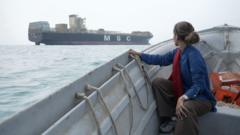
The global energy supply chain relies on a 21-mile-wide choke point where structural vulnerability is frequently misdiagnosed as temporary geopolitical friction. While casual observation conflates short-term maritime standoffs with localized incidents like the tracking of seized vessels or the activity of small-scale artisanal fishing fleets, the reality is governed by hard economic and tactical mechanics. The Strait of Hormuz functions under a strict operational cost function. Any disruption to this corridor immediately alters global trade architecture, insurance underwriting, and sovereign naval deployment strategies.
To understand the superficial calm currently observed in the strait, one must decouple human-interest narratives from the cold operational variables driving maritime transit. The equilibrium of this waterway is not maintained by goodwill or shifting political moods; it is enforced by a precarious matrix of military blockades, asymmetric threat vectors, and commercial risk thresholds.
The Three Pillars of Choke-Point Vulnerability
The operational continuity of the Strait of Hormuz rests upon three interconnected variables. When any single pillar is stressed, the entire system experiences an immediate escalation in cost and operational drag.
- Underwriting and Risk Premium Elasticity: The primary mechanism restricting traffic during periods of tension is not physical destruction, but financial starvation. Marine insurers utilize War Risk Additional Premiums (WRAPs) to price the probability of vessel hull damage or seizure. When a commercial vessel is struck or detained, hull premiums can spike multi-fold within 48 hours, rendering transit economically unviable for un-escorted or independent operators.
- Asymmetric Denial Capabilities: State and non-state actors in the region utilize low-cost, high-leverage tools to disrupt commercial shipping. This includes the deployment of fast attack craft (FACs), sea-skimming anti-ship cruise missiles (ASCMs), drifting naval mines, and loitering munitions. The cost asymmetry is severe: a $20,000 drone or a basic unguided projectile can structurally compromise or freeze the operations of a $150 million Very Large Crude Carrier (VLCC).
- Sovereign Enforcement and Escort Infrastructure: Passivity in the strait is heavily reliant on the presence of external naval coalitions or aggressive unilateral blockades. When sovereign nations deploy active destroyer escorts or enforce restrictive coastal blockades, they temporarily suppress the efficacy of asymmetric attacks. However, this shifts the burden of security from market forces to state budgets, creating a highly unsustainable long-term defense posture.
The Cost Function of Maritime Disruption
When commercial shipping lines assess whether to route vessels through the Persian Gulf or bypass the region entirely, they operate under a rigid optimization formula. The decision matrix is dictated by the total cost of transit ($C_T$), which can be mathematically modeled as:
$$C_T = C_O + C_I + C_S + P_D(C_D)$$
Where:
- $C_O$ represents baseline operational costs (fuel, crew wages, vessel depreciation).
- $C_I$ represents the volatile war risk insurance premium assigned to the zone.
- $C_S$ represents the direct cost of security measures, including private armed guards or rerouting delays.
- $P_D$ is the quantified probability of an attack, interception, or seizure.
- $C_D$ is the financial damage incurred by a disruption event, encompassing hull repair, cargo loss, and supply chain delays.
The first limitation of conventional media reporting is the failure to realize that even when $P_D$ (the probability of attack) appears low during an "uneasy calm," the value of $C_I$ (insurance) remains elevated because underwriters calculate risk on trailing 90-day event windows rather than real-time optics. Consequently, an absence of active kinetic strikes does not equal economic normalization.
This creates a systemic bottleneck. While local artisanal fishermen continue their operations because their capital expenditure is negligible and their local footprint exempts them from international insurance mandates, commercial shipping entities cannot absorb these systemic costs. The co-existence of small fishing vessels and seized international tankers in the same waters is not a poetic paradox; it is a direct reflection of completely different risk tolerances and regulatory exposures.
The Friction of Unilateral Escort Regimes
The introduction of sovereign naval escorts—such as coordinated convoy systems or aggressive coastal blockades—alters the variables within the maritime cost function. While these interventions artificially suppress the probability of attack ($P_D$), they introduce severe logistical inefficiencies.
The second limitation of relying on naval power to mandate peace is the formation of transit bottlenecks. Commercial vessels are forced to aggregate in designated staging areas, waiting for military assets to clear international transit lanes or provide close-proximity defense. This structural delay drives up operational costs ($C_O$) due to increased fuel burn during idling and missed delivery windows at destination ports.
Furthermore, a naval blockade designed to starve a disruptive actor's ports can inadvertently trigger desperate, asymmetric retaliation. When a state's economic baseline is systematically choked by a naval perimeter, its rational strategic pivot shifts from conventional deterrence to high-frequency, deniable maritime disruption. The enforcement of a tight blockade decreases the target's opportunity cost for breaking the peace, transforming the surrounding international waters into an active danger zone despite any declared ceasefires.
The Failure of the UN Corridor Framework
Recent international attempts to stabilize the region via UN-supported shipping routes off the coast of Oman highlight the structural weakness of multi-lateral diplomatic solutions devoid of hard tactical enforcement. The blueprint assumed that designating a specific geographic corridor would provide a safe zone for the transfer of stranded vessels and continued commercial flow.
This assumption collapsed due to a fundamental misunderstanding of geographic reality and sovereign leverage. The Strait of Hormuz is too narrow to accommodate a risk-free corridor that completely avoids the projection of regional state power. When an unidentified projectile strikes a cargo vessel within a UN-supported route, it exposes a critical flaw: international designations hold zero deterrent value against actors possessing localized asymmetric strike capabilities.
The immediate suspension of operations by international bodies following an incident demonstrates that the threshold for risk tolerance among global regulators is incredibly low. A single successful strike nullifies months of diplomatic negotiation, reverting the system back to its baseline state of high insurance premiums and restricted traffic.
Strategic Allocation Matrix
Shipping operators must abandon passive monitoring of regional news and instead adopt an active operational framework based on empirical risk tiers.
| Risk Level | Underwriting Status | Primary Threat Vector | Tactical Recommendation |
|---|---|---|---|
| Tier 1: Latent Friction | Standard WRAP applied; predictable escalation paths. | Localized boarding actions; minor maritime harassment. | Utilize standard international transit lanes; maintain high-readiness visual overwatch. |
| Tier 2: Active Kinetic Friction | Spiking premiums; short-term insurance suspensions. | Unidentified projectiles; precision loitering munitions. | Route exclusively via military-escorted convoys; implement strict night-transit protocols. |
| Tier 3: Systemic Blockade | Complete underwriting withdrawal; market closure. | State-level naval engagement; saturation mine laying. | Divert all un-escorted tonnage to alternative pipelines or longer routes bypassing the cape. |
The optimal strategic play for global energy logistics firms is to completely decouple from reliance on regional maritime stability. Operators should systematically shift fixed-tonnage contracts to multi-modal land-based pipelines where possible, while pricing an automated 15% risk premium buffer directly into any spot-market freight agreements requiring transit through the Persian Gulf. Relying on the visual illusion of an "uneasy calm" is an operational failure; physical security in this corridor will remain volatile so long as the underlying economic blockades and sovereign disputes remain unresolved.