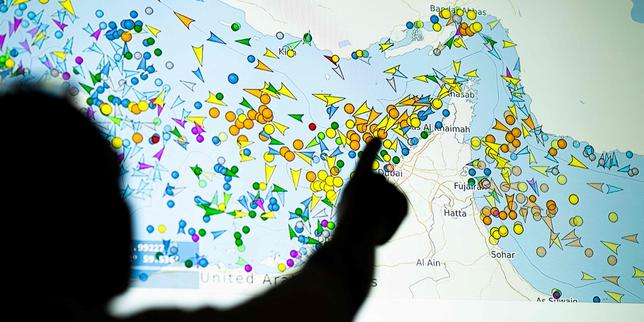
The headlines are screaming again. The Iranian Revolutionary Guard Corps (IRGC) issues a "firm response" threat to any vessel deviating from prescribed shipping lanes in the Strait of Hormuz. Pundits rush to television studios to map out $200-a-barrel oil scenarios. The "lazy consensus" dictates that we are one bad afternoon away from a global economic cardiac arrest.
They are wrong.
The obsession with the "chokepoint" narrative ignores the fundamental reality of modern asymmetric warfare and the desperate economic codependency that keeps the water moving. We treat the Strait of Hormuz like a fragile glass neck. In reality, it is a theater of performance art where both sides are terrified of actually breaking the stage.
The Myth of the Total Blockade
Mainstream media loves the visual of a "closed" Strait. It suggests a physical gate being slammed shut. This is a tactical impossibility. The Strait is 21 miles wide at its narrowest point. While the shipping lanes themselves are narrow—two miles wide with a two-mile buffer—the idea that the IRGC can "stop" traffic without triggering their own national suicide is a fantasy sold to keep defense budgets high and oil futures volatile.
If Iran actually blocked the Strait, they don't just starve the West. They starve themselves. Iran’s economy, already suffocating under sanctions, relies on the very maritime stability they threaten. China, Iran’s primary customer and only real diplomatic lifeline, would not tolerate a 20% hit to the global oil supply. Teheran isn't stupid. They are loud. There is a massive difference between tactical harassment—seizing a tanker here, buzzing a destroyer there—and a strategic blockade.
The "firm response" mentioned in recent reports isn't a military directive; it’s a marketing campaign for internal consumption.
Logistics vs. Limpet Mines
I’ve watched analysts panic over "asymmetric threats" for twenty years. They point to fast-attack craft and limpet mines as if these tools are enough to reshape global trade permanently. They aren't.
What the "experts" miss is the sheer resilience of global logistics. When a tanker is hit, insurance premiums spike. That is a fact. But the ships keep moving. Why? Because the profit margins on a cargo of 2 million barrels of crude are high enough to absorb almost any risk short of a nuclear exchange.
The IRGC’s power lies entirely in the threat of disruption, not the disruption itself. Once you actually fire the shot and close the lane, you lose your leverage. You become the target of a coordinated global coalition that has every legal and economic justification to erase your naval capabilities in 72 hours.
The Failed Logic of "Shipping Lane Enforcement"
The IRGC claims they are "enforcing" trajet (pathway) rules. This is a clever bit of linguistic judo. By framing their aggression as "maritime policing," they attempt to claim the mantle of international law while violating the spirit of "innocent passage" defined by the UN Convention on the Law of the Sea (UNCLOS).
- Innocent Passage: Ships have the right to pass through territorial waters as long as they aren't a threat to the coastal state.
- Transit Passage: Specifically for straits used for international navigation, this right is even broader and cannot be suspended.
Iran knows it cannot legally stop these ships. So, they create "administrative" reasons to board them. They cite environmental concerns or "safety violations." It’s the maritime equivalent of a corrupt cop pulling you over for a broken taillight so he can search your trunk. If the West continues to treat this as a "security crisis" rather than a "legal harassment campaign," we continue to play into the IRGC’s hands.
The Real Winner: The Risk Industry
Follow the money. Who benefits when the IRGC shakes its saber? Not the Iranian people. Not the oil consumers in Europe or Asia.
The winners are the Lloyd’s of London underwriters and the private maritime security companies (PMSCs).
- War Risk Surcharges: These can jump 10x overnight on a single headline.
- Security Details: Hiring a team of former SBS or SEAL operators to stand on your deck costs a fortune.
We are subsidizing a fear-based economy. The "Mideast War" tag is a goldmine for the financial sector. If we admitted that the Strait is actually quite difficult to close and that Iran is largely bluffing, the volatility—and the profit—evaporates.
The Nuance of the "Firm Response"
When the IRGC speaks of a "firm response" to ships departing from their path, they are actually signaling weakness. They are admitting that they cannot control the entire body of water, so they are trying to micromanage the lanes.
It is a desperate attempt to assert sovereignty where they have none. The Strait is international water in every sense that matters for trade. By focusing on the "firm response" rhetoric, the media ignores the fact that US, UK, and French naval assets are constantly in the region, usually within visual range of these "menacing" Iranian crafts.
I have spoken with merchant mariners who have navigated these waters during periods of "high tension." Their biggest concern isn't a missile; it’s the bureaucracy. It's the radio chatter. It’s the three-hour delay while some IRGC official tries to look important on a megaphone.
The Energy Transition Fallacy
There is a common argument that we need to "secure" the Strait to ensure the transition to green energy isn't derailed by an oil shock. This is backward logic.
Every time the IRGC threatens the Strait, they provide the strongest possible argument for the immediate abandonment of fossil fuels. If your entire civilization depends on a 21-mile wide strip of water controlled by a fundamentalist militia, your civilization is poorly designed.
The threat to the Strait isn't a reason to double down on Mideast presence; it’s a reason to decouple. The IRGC is doing more for the solar and wind industry than any climate accord ever could. They are making the "unreliability" of oil a daily news item.
Why the "Escalation" Narrative is a Trap
We are told that we are on the "brink of war." This narrative serves the IRGC because it grants them the status of a peer competitor to the United States. They aren't.
If we look at the actual data of engagements in the Persian Gulf over the last five years, we see a pattern of "calibrated irritation." Iran does exactly enough to get a headline, but never enough to trigger a Tomahawk missile strike on their command centers.
- Step 1: Issue a vague threat about "foreign interference."
- Step 2: Seize a small tanker under a flimsy legal pretext.
- Step 3: Use the seizure as a bargaining chip for frozen assets or sanction relief.
- Step 4: Release the ship three months later once the news cycle has moved on.
This isn't war. It's a protection racket.
Stop Asking if the Strait Will Close
The question "Will Iran close the Strait?" is the wrong question. It assumes a binary state of "Open" or "Closed."
The real question is: "How much are we willing to pay to maintain the illusion of absolute security?"
The cost of patrolling the Gulf, insuring the ships, and maintaining a massive carrier presence is a hidden tax on every gallon of gas and every plastic product on earth. We are paying a "bluff tax."
If we want to disrupt this cycle, we have to stop reacting to every IRGC press release as if it’s a formal declaration of hostilities. We need to call the bluff.
Route the ships. Ignore the megaphones. Let the "firm response" turn out to be the empty air it has always been.
The IRGC doesn't want a war they will lose in an afternoon. They want a seat at the table they haven't earned. Stop giving them the chair.