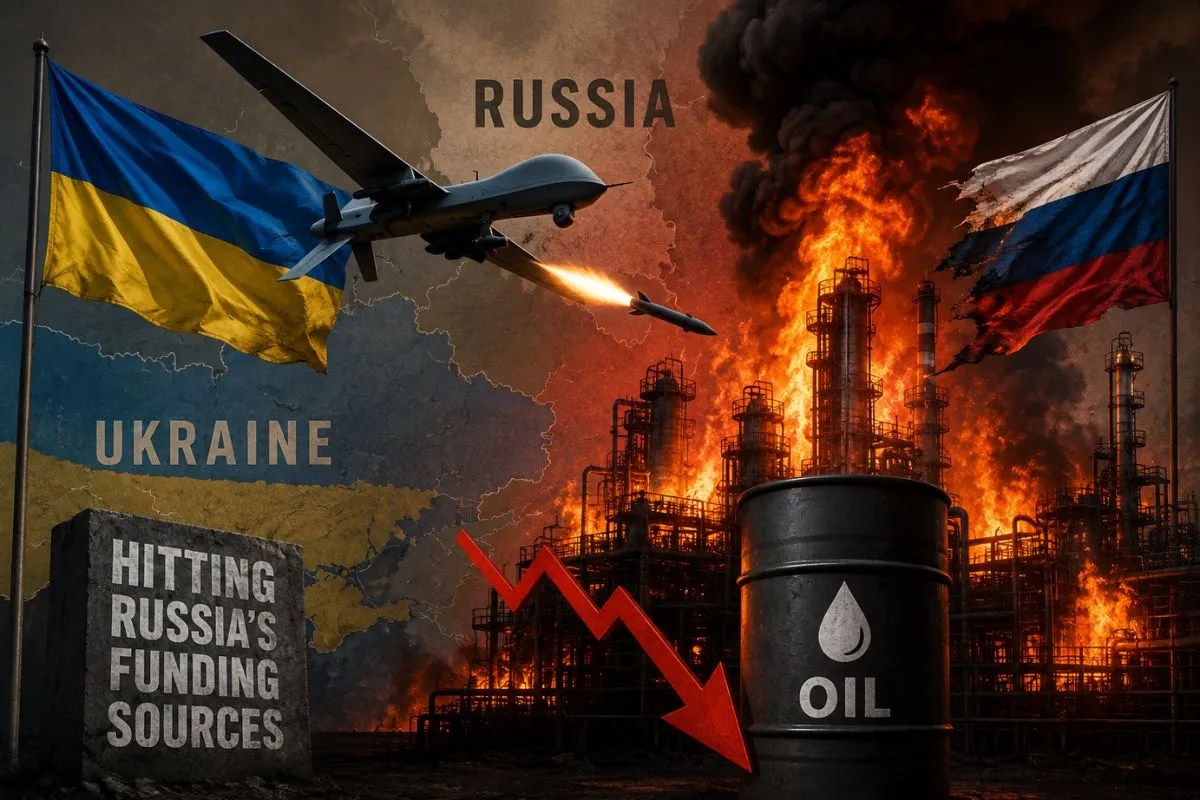
The recent long-range engagement against Russian refining capacity 1,300 kilometers from the Ukrainian border signals a transition from tactical interdiction to systemic economic warfare. By bypassing traditional frontline combat to strike at the nexus of production and revenue generation, Kyiv is attempting to impose a severe cost-benefit imbalance on the Russian defense budget. This maneuver operates on the principle of force multiplication, where a low-cost, expendable drone capability disrupts high-value, fixed-site industrial assets.
The Economic Logic of Kinetic Infrastructure Strikes
Targeting oil refineries serves as a mechanism to degrade two distinct but interconnected revenue streams: immediate export earnings and internal logistical functionality. The Russian state derives a significant percentage of its federal budget from petroleum taxation and duties. When a refinery is neutralized, the state suffers a triple-hit: the loss of tax revenue from processed fuels, the cost of emergency infrastructure repair, and the inflation of internal fuel prices.
The logistical impact is often overlooked in favor of headline production figures. Russia operates on a vast geographic scale where fuel transport is energy-intensive. By targeting refineries in the interior, the strikes introduce friction into the distribution chain. When localized production drops, the state must redirect fuel from other regions to maintain essential services and military logistics. This movement creates a secondary bottleneck, taxing the already strained railway and pipeline infrastructure.
Operational Constraints and the Cost of Defense
Defending critical infrastructure requires an asymmetric allocation of resources. A single long-range, low-cost drone system forces the defender to deploy high-cost, limited-stock interceptor missiles or sophisticated electronic warfare suites. The math here is unsustainable for the defender over a prolonged timeline. If the defense of a multibillion-dollar facility relies on interceptors that cost multiple times the value of the incoming drone, the attrition rate favors the attacker regardless of the percentage of drones intercepted.
Furthermore, the physical geography of Russia complicates the defensive posture. Covering 1,300 kilometers of airspace necessitates a distributed, layered air defense network. Fixed assets are inherently vulnerable; they cannot move, and their signatures in the electromagnetic and thermal spectrums are well-documented. Once the strike capability matures to include autonomous navigation that avoids known radar envelopes, the defender’s reactive window shrinks to near zero.
Evaluating the Industrial Impact
The structural damage to a refinery extends beyond the visible fire or blast damage. Modern oil refining relies on complex cracking units, hydrocrackers, and catalytic reformers. These are highly specialized components with long lead times for replacement, often requiring international technical expertise and custom manufacturing.
- Direct Damage: Immediate cessation of operations due to kinetic impact.
- Collateral Degradation: Damage to auxiliary systems, such as power supply, control centers, or storage tanks.
- Systemic Downtime: The extended period required for procurement, transit, and installation of specialized parts, which is exacerbated by current international trade restrictions on dual-use technology.
The effectiveness of these strikes is measured by the duration of the downtime rather than the intensity of the explosion. If a strike necessitates a three-month outage for repairs, the revenue loss far exceeds the nominal value of the facility damage. This creates a cumulative drag on the national economy that compounds quarterly.
Geopolitical and Market Implications
Global energy markets respond to uncertainty. While Russia remains a major exporter, internal refining constraints force a choice: prioritize domestic consumption or maintain export quotas to fulfill international obligations. A sustained campaign against refining capacity forces the Russian leadership to choose between political stability—which relies on affordable domestic fuel—and foreign currency accumulation.
Historically, state actors utilize oil prices as a lever for geopolitical influence. When refining capacity is constrained, the state’s ability to manipulate the market is weakened. This reduces the margin of error for fiscal policy. The reliance on centralized, large-scale refineries is a structural weakness that was acceptable during periods of stability but becomes a critical failure point under persistent, long-range aerial campaigns.
Strategic Outlook and Defensive Limitations
The primary limitation of this campaign is the total inventory of long-range strike assets. Sustained pressure requires not just a single successful strike, but a consistent operational tempo. If the frequency of strikes is too low, the defender can consolidate resources and prioritize the protection of the most critical hubs. If the frequency is high, the cost-imbalance continues to erode the defender’s economic base.
Future volatility in the energy market will be driven by the effectiveness of drone swarm tactics against point-defense systems. As the sophistication of these autonomous systems increases, the ability of traditional air defense to provide comprehensive coverage will be challenged. The objective of the attacker is to push the operational cost of the war to a level that forces a recalibration of military spending. The current trajectory suggests that infrastructure vulnerability is now a primary variable in the broader conflict, shifting the burden of the war from the frontline trenches into the heart of the industrial rear.
Strategic planners must anticipate that as the efficacy of these strikes continues to impact the state budget, the reliance on, and subsequent fortification of, dispersed, small-scale modular refining—or the shifting of storage to hardened, subterranean locations—will become the next phase of the industrial power struggle. Those controlling the skies will dictate the viability of the resource-extraction economy.