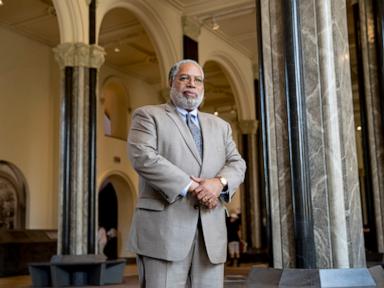
The announcement that Lonnie Bunch III is stepping down as Secretary of the Smithsonian Institution arrives at the apex of a prolonged structural conflict over public narrative control. While public discourse frames this departure through the personalized lens of executive exhaustion and presidential friction, a rigorous systemic deconstruction reveals a textbook case of ideological pressure applied against a nominally independent trust. The intersection of federal funding dependencies, executive orders targeting historical interpretation, and institutional governance models creates a predictable vulnerability matrix for public-private hybrid entities.
To understand the mechanics of this transition, one must map the operational pressures that have defined the institution since early 2025. The Smithsonian operates under a unique governance structure: a federal establishment created by an 1846 act of Congress, managed by a Board of Regents comprising the Chief Justice of the United States, the Vice President, members of Congress, and nine citizen regents, yet heavily reliant on annual federal appropriations supplemented by private fundraising and endowments. This structural hybridity is its greatest strength during periods of political consensus and its most severe vulnerability during periods of hyper-polarization. Learn more on a similar issue: this related article.
When an executive branch utilizes funding leverage and personnel challenges to contest the curation of national history, the administrative cost function for leadership spikes exponentially. The strategic variables driving this dynamic can be categorized into three distinct vectors:
The First Vector is Fiscal Leverage. Federal appropriations form the baseline operational bedrock for the Smithsonian's nineteen museums, research centers, and the National Zoo. Threats to curtail this funding stream or restrict budgetary flexibility impose immediate constraints on long-term capital projects and operational continuity, forcing institutional leadership into a defensive posture. More analysis by MarketWatch delves into comparable views on this issue.
The Second Vector is Curation Governance. Executive interventions targeting specific ideological frameworks within exhibits—particularly those addressing race, gender, and national identity—test the legal boundaries of the Smithsonian's trust status. Because the institution is not a standard executive agency, direct executive firing authority over museum directors or the secretary does not formally exist. However, indirect pressure via board appointments, public campaigns, and legislative threats achieves a functional equivalent of administrative compliance.
The Third Vector is Human Capital Retention. High-profile departures, such as the indefinite leave and subsequent exit of National Museum of African American History and Culture director Kevin Young and the contested status of other museum leadership, demonstrate how external political friction degrades internal organizational stability. When the cognitive load of defending baseline scholarship outweighs the functional capacity to execute long-term vision, executive burnout becomes an operational certainty.
Despite these vectors, attributing the departure solely to political duress oversimplifies the institutional lifecycle. At age seventy-three, and following a thirty-eight-year career that included founding the National Museum of African American History and Culture, Bunch reached the natural conclusion of a tenure originally extended to shepherd the institution through its milestone anniversaries, including the nation's 250th. The strategic reality, however, is that his exit removes a seasoned political operator capable of navigating bipartisan congressional dynamics and shielding curatorial staff from external interference.
The vacancy at the helm initiates a high-stakes succession calculus for the Board of Regents, chaired by Chief Justice John Roberts. The next secretary will inherit an institution structurally altered by ideological contestation. The primary mandate for incoming leadership will not merely involve administrative management or fundraising prowess, but the fortification of institutional firewalls against future political incursions.
To secure long-term operational autonomy, the Smithsonian must decouple its core scholarly output from shifting executive mandates by aggressively expanding its private endowment base, thereby reducing its elasticity to federal budgetary coercion. Simultaneously, the Board of Regents must formalize explicit defensive protocols that protect curatorial independence without inviting legislative retaliation. The resilience of the world's largest museum complex now depends entirely on whether its governance structure can codify neutrality as an enforceable operational standard rather than an aspirational norm.