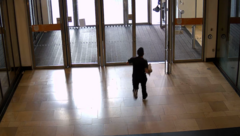
Public safety outcomes depend entirely on the operational friction engineered into high-density retail environments. When a conviction for non-consensual visual recording, commonly termed upskirting, occurs following closed-circuit television intervention, it exposes specific mechanics of modern municipal and commercial surveillance. Modern retail hubs function as high-frequency transactional spaces where anonymity directly conflicts with regulatory enforcement. Analyzing the mechanics of detection, evidence capture, and evidentiary transition to law enforcement reveals why traditional security architecture often fails to deter predatory behavior until post-hoc prosecution occurs.
The Tripartite Failure of Passive Retail Monitoring
Surveillance systems deployed in shopping complexes rely on a continuous feedback loop comprising three distinct stages: optical capture, human or automated observation, and intervention execution. Most commercial ecosystems break down at the second stage due to structural bottlenecks in operator attention span and system latency.
- Optical capture density determines the resolution and angular coverage of human movement. Wide-angle perimeter cameras capture crowd flow but fail to resolve micro-behaviors occurring in semi-private zones like escalators, stairwells, and narrow retail corridors.
- Cognitive load distribution creates a systematic blind spot. Security personnel monitoring multi-channel video grids suffer from sustained attention fatigue within twenty minutes of continuous observation, meaning anomalous behavioral patterns frequently go unnoticed in real time.
- Intervention latency bridges the temporal gap between detection and physical apprehension. If an observer identifies a violation, the physical transit time of security guards to the precise coordinates often exceeds the duration of the dynamic event.
When a conviction emerges from a retail security context, it almost invariably relies on retrospective forensic extraction rather than proactive prevention. The system functions as a recording archive rather than an active control barrier.
The Mechanics of Forensic Recovery and Evidentiary Chain Integrity
Securing a legal conviction for clandestine visual recording requires an unbroken chain of digital custody and unambiguous visual confirmation. Security teams must isolate specific timestamps from terrabytes of continuous video data. This process exposes the friction between commercial storage retention policies and prosecutorial evidentiary thresholds.
Commercial CCTV networks typically overwrite local storage arrays within fourteen to thirty days depending on compression codecs and storage allocation limits. When an incident is reported retroactively, investigators operate under a strict temporal decay curve. The primary vector for successful prosecution shifts from real-time intervention to post-event video mining.
Investigators deploy spatial-temporal tracking across disparate camera angles to reconstruct the offender's trajectory. This involves mapping vector coordinates from the initial point of contact to the termination of the act. The digital file must then be exported without compression artifacts that could compromise facial recognition clarity or motion articulation. Courts require absolute synchronization between time-stamped video logs and physical device records to establish intent and opportunity beyond reasonable doubt.
Behavioral Typologies and Environmental Vulnerabilities
Offenders operating in enclosed retail spaces exploit predictable architectural vulnerabilities. Multi-level shopping centers feature vertical transit vectors, specifically escalators and glass-balustrade walkways, which create vertical stratification of vision. An individual positioned at a lower elevation gains a structural optical advantage over subjects situated above or below them.
Retail designers prioritize open-sight lines to maximize commercial visibility for storefronts, inadvertently creating architectural canyons that lack acoustic or physical privacy barriers while simultaneously offering concealment through crowd density. Perpetrators leverage crowd occlusion to mask proximity violations. The probability of detection decreases as pedestrian traffic density increases, creating an inverse relationship between foot traffic and situational awareness.
Systemic Optimization Vectors for Commercial Security
To transition retail security from a post-hoc investigative tool to a proactive risk-mitigation framework, facility operators must restructure their monitoring parameters. Relying on passive human observation of high-resolution feeds is mathematically proven to yield high error rates under load.
Deploying algorithmic anomaly detection layers can mitigate human fatigue. These systems do not monitor for specific criminal acts, which present too many variable signatures, but instead flag persistent loitering patterns, irregular spatial tracking vectors that mirror trailing behavior, and device positioning anomalies.
Simultaneously, architectural hardening of vertical transit corridors remains a prerequisite for risk reduction. The installation of solid opaque skirting beneath escalators and the elimination of transparent balustrades in high-risk zones remove the environmental enablers that facilitate visual intrusion.
Integrating real-time alert dispatching with localized security staff cuts response latency below the threshold required to interrupt transient offenses. By shifting the operational focus from archival data harvesting to predictive spatial monitoring, commercial real estate operators can alter the risk-reward calculus for offenders before legal intervention becomes the sole mechanism of recourse.