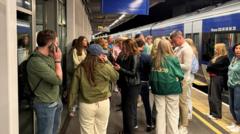
Railway network disruptions frequently manifest as sudden station closures that trap passengers inside terminal perimeters or leave commuters stranded on platforms without egress pathways. When a station is locked unexpectedly, the failure is rarely a singular operational error; rather, it represents the systemic breakdown of crowd management protocols, asset access control mechanisms, and communication cascades between transport operators and local station staff. Resolving or analyzing these incidents requires moving beyond emotional narratives of being stranded and examining the operational bottlenecks, liability parameters, and logistical friction points that govern passenger containment during emergency or administrative overrides.
The Operational Triad of Station Access Control
Access control within mass transit environments relies on a delicate balance between revenue protection, security enforcement, and emergency egress safety. Under standard operating conditions, physical barriers such as automated ticket gates, turnstiles, and security shutters regulate the directional flow of human traffic. When an incident triggers a lockdown protocol, these assets transition from a fluid filtering state to a static containment state.
The primary driver behind unexpected station lockouts is risk aversion by frontline personnel. Faced with signals failures, medical emergencies, or security threats on the line, station supervisors often prioritize perimeter integrity over continuous evacuation flow. This decision creates a critical conflict between two competing priorities:
- Containment Priority: Preventing unauthorized access to active tracks, preserving crime scenes, or managing platform overcrowding by halting inbound entry.
- Egress Priority: Ensuring unimpeded dispersal paths for individuals already inside the station envelope to prevent crush incidents and panic.
When infrastructure fails to isolate these two priorities, inbound and outbound passengers merge into a single bottleneck. Automated gates stuck in a default fail-safe locked position or staff executing manual shutter drops without verification of internal volume will immediately trap individuals between closed street-level doors and inactive platforms.
The Cost Function of Communication Failures
The psychological distress reported by stranded commuters correlates directly with the latency and accuracy of information dissemination. In transit analytics, information asymmetry represents a measurable friction cost. When a station locks its doors, the physical barrier is compounded by an immediate information vacuum.
Standard public address systems and digital departure boards rely on centralized telemetry. If a localized operational failure severs communication lines between the control center and the local station manager, automated announcements cease, and staff resort to ad-hoc, verbal instructions. This introduces three distinct failure modes:
- Information Latency: The time delta between an operational stoppage and the broadcast of an explanatory message to affected passengers. High latency increases anxiety and aggressive crowd behavior.
- Channel Fragmentation: Discrepancies between mobile application updates, website alerts, and physical announcements inside the station. Conflicting data paralyzes individual decision-making, keeping passengers clustered near locked exits rather than seeking alternative transit nodes.
- Ambiguity of Duration: The absence of a bounded time horizon for the disruption. When passengers are told a delay is "indefinite" rather than estimating restoration milestones, alternative transport utilization drops, exacerbating platform congestion.
The Mechanics of Egress Bottlenecks and Safety Compliance
Building codes and transit safety regulations mandate specific clearance capacities for high-occupancy transport hubs. These calculations assume a steady-state coefficient of discharge, meaning the speed at which humans can exit a defined space through open doors and stairwells.
When a station is locked manually, the effective width of the egress path is reduced to zero at the perimeter, while internal corridors continue to receive passengers arriving from concourses or delayed trains. This dynamic reverses the normal pressure gradient of human traffic. Instead of a linear flow toward the street, a counter-flow or stationary accumulation occurs.
Safety regulations typically require that electronic access control systems fail open during a power outage or fire alarm. However, administrative lockouts—such as those initiated to manage overcrowding during severe weather or track maintenance overruns—often involve physical padlocks, manual deadbolts, or override codes that bypass automated fail-open defaults. This operational override places the burden of safety compliance onto human operators who may lack the training or situational awareness to execute a synchronized mass release.
Liability and Risk Mitigation Frameworks for Transit Authorities
From a legal and administrative perspective, locking passengers inside a transit facility exposes operators to specific liability vectors. While containment is sometimes justified under the doctrine of necessity to protect public safety, false imprisonment claims and negligence assertions arise when operators fail to provide basic provisions, clear exit alternatives, or timely remediation.
Transit authorities manage this exposure through standard operating procedures that dictate the exact sequence of events required for a station closure:
- Verification Phase: Confirming that the threat or obstruction requires full or partial station closure rather than localized platform isolation.
- Perimeter Notification: Deploying physical signage and digital alerts at all street-level entrances before pulling down shutters or securing turnstiles.
- Internal Clearance Sweep: Mandating that staff physically inspect concourses, restrooms, and platforms to ensure no passengers remain trapped behind locked perimeter barriers.
- Egress Maintenance: Ensuring that at least one designated emergency exit path remains operable under staff supervision for individuals seeking to leave the facility.
Failures at any step in this sequence invalidate the risk mitigation defense of the transport operator, transforming a routine operational delay into a severe regulatory and public relations crisis.
Operational Redesign for Resilient Station Management
Preventing future passenger containment incidents requires a transition from reactive perimeter locking to dynamic crowd throttling. Transit networks must decouple revenue protection systems from safety egress pathways, ensuring that no administrative command can override the physical ability of individuals to exit a station environment.
Furthermore, integrating decentralized override controls allows regional control centers to remotely unlock specific security gates during local staff shortages or communication blackouts. By treating station exits as critical safety valves rather than simple revenue checkpoints, transit networks can eliminate the structural conditions that turn temporary transport delays into acute confinement events.

/cdn.vox-cdn.com/uploads/chorus_asset/file/22155007/doc_ock.jpg)