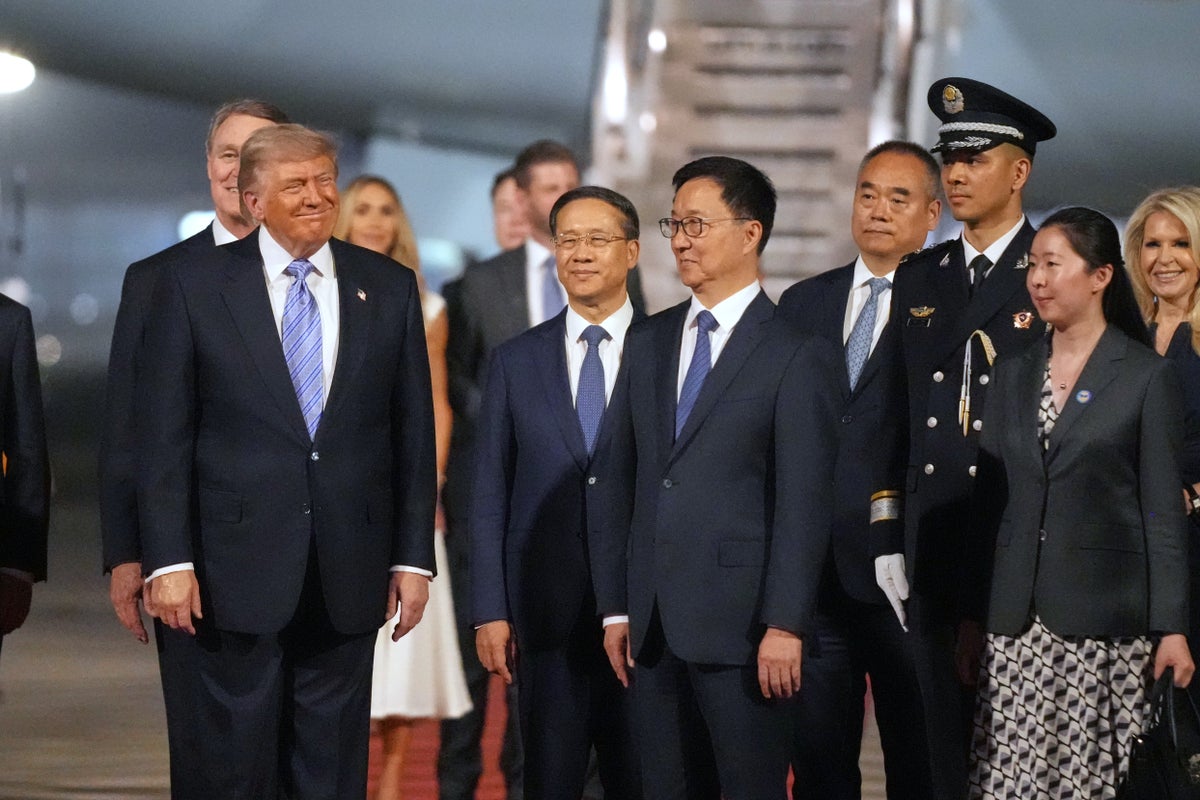
The Xi-Trump summit represents a desperate attempt to reconcile two fundamentally incompatible economic architectures: a state-directed industrial policy and a protectionist-mercantilist resurgence. While media narratives focus on the optics of diplomacy, the actual value of this engagement is found in the friction between trade liberalization and national security imperatives. This summit does not signal a return to "business as usual" but rather defines the boundaries of a permanent, managed rivalry.
The Tripartite Framework of US-China Friction
To analyze the current state of relations, one must look beyond individual tariffs or specific diplomatic statements. The relationship is governed by three distinct structural pillars that dictate every negotiation outcome.
1. The Security-Trade Paradox
The primary bottleneck in US-China relations is the shrinking "neutral zone" of trade. Previously, consumer electronics and basic manufacturing were viewed as purely commercial. Today, the integration of AI, dual-use technologies, and data-gathering capabilities means that almost every high-value trade item is now categorized under national security.
The United States utilizes a "Small Yard, High Fence" strategy, which aims to protect specific critical technologies while maintaining broad trade in non-sensitive sectors. However, China views this as a containment mechanism designed to cap its technological development. When Xi issues warnings regarding Taiwan, he is not merely discussing territorial integrity; he is signaling a willingness to disrupt the global semiconductor supply chain, the literal backbone of the modern economy.
2. Market Access vs. State Capitalism
The American side demands "reciprocity," a term that masks a deeper conflict between two different economic engines. The US operates on a shareholder-value model driven by private capital. China operates on a state-led model where capital is allocated to strategic sectors—such as EVs, batteries, and green energy—to ensure social stability and global dominance.
This creates an "Overcapacity Loop." China’s domestic consumption remains too low to absorb its massive industrial output. To keep its factories running and its population employed, it must export this excess capacity at prices that undercut Western manufacturers. This is the "Cost Function of Social Stability" for Beijing, and it is the "Threat Vector of Deindustrialization" for Washington.
3. The Taiwan Sovereignty Constraint
Taiwan is the ultimate geopolitical variable. For Trump, Taiwan is often viewed through the lens of a "deal"—a piece of leverage in a larger trade negotiation. For Xi, Taiwan is a non-negotiable "core interest" linked to the legitimacy of the Communist Party. The summit’s focus on business links is an attempt to create enough economic interdependency to make a military conflict over Taiwan too expensive for either side to contemplate. This is "Economic Deterrence," and its efficacy is currently being tested by the rapid decoupling of sensitive supply chains.
The Mechanics of the Tariff Engine
Tariffs are frequently misunderstood as simple taxes. In the context of this summit, they function as a complex signaling mechanism.
- Defensive Tariffs: These are designed to protect domestic industries (e.g., US steel or automotive) from being wiped out by Chinese subsidies.
- Offensive Tariffs: Used as leverage to force concessions on intellectual property (IP) or market access.
- Retaliatory Tariffs: China’s primary tool for targeting politically sensitive American industries, such as agriculture, to exert pressure on US domestic politics.
The Trump administration’s reliance on universal or high-percentage tariffs shifts the cost of the trade war from Chinese producers to American consumers and manufacturers who rely on Chinese inputs. This creates an internal US inflationary pressure that complicates the Federal Reserve’s mandate, illustrating the "Domestic Feedback Loop" of protectionist policy.
The Semiconductor Bottleneck and Strategic Autonomy
The most critical battleground identified during the summit is the control of high-end silicon. The US maintains a dominant position in chip design and the software used to create chips, while China is the world's largest consumer of these components.
China’s "Big Fund" and its push for domestic self-reliance are direct responses to US export controls. The "Time-to-Obsolescence" for Chinese technology is the key metric here. If China can develop indigenous 7nm or 5nm production capabilities before US restrictions cripple their AI development, the "High Fence" strategy fails.
The strategic reality is that the US is attempting to freeze China’s technological progress at its current state while the US continues to advance. This is not a sustainable equilibrium. It forces China into a corner where its only options are radical innovation or aggressive geopolitical expansion to secure resources and markets.
Deconstructing the Business Links Narrative
The summit emphasized "business links" as a stabilizer. However, the nature of these links has fundamentally changed. We are seeing a transition from "Offshoring" to "Friend-shoring" and "Near-shoring."
- Supply Chain Redundancy: Multinational corporations are no longer seeking the lowest cost; they are seeking the lowest risk. This "China Plus One" strategy involves keeping some manufacturing in China for the Chinese market while moving export-oriented production to Vietnam, India, or Mexico.
- The Capital Flight Variable: Xi’s biggest internal threat is the exodus of private capital. By meeting with American CEOs, he is attempting to project an image of stability to stop the "Confidence Erosion" within China’s own private sector.
- The IP Enforcement Gap: Despite promises of better protection, the structural incentive for China to acquire foreign IP through any means necessary remains high. As long as China is in a "catch-up" phase, the cost of IP theft is lower than the cost of R&D.
The Geopolitical Risk Equation
The outcome of this summit can be quantified through a simplified risk equation:
$$Risk = (Incentive \times Vulnerability) - Deterrence$$
- Incentive: China’s need to secure its "Place in the Sun" and resolve the "Taiwan Question."
- Vulnerability: The high dependence of both nations on a single, fragile global supply chain.
- Deterrence: The mutual assured destruction of the global financial system if a full-scale conflict erupts.
The summit was an exercise in increasing "Deterrence" by reminding both sides of the "Vulnerability." It did nothing to reduce the "Incentive." This means the underlying risk remains constant; only the perception of that risk has been temporarily managed.
The Failure of "Engagement" Theory
For decades, Western policy was built on the "Engagement Theory": the idea that as China became wealthier, it would liberalize politically and integrate into the rules-based international order. This summit is the final nail in the coffin of that theory.
China has successfully integrated into the global economy without adopting Western political norms. It has created a "Synthetic Modernity"—high-tech infrastructure and wealth paired with an authoritarian, surveillance-state governance model. The US has finally acknowledged that China is not a "stakeholder" in the existing system, but a "competitor" looking to build a parallel one.
Strategic Realignment: The Path Forward
The "Masterclass" takeaway from the Xi-Trump summit is that we have entered an era of "Transactional Hostility." There will be no grand bargain that solves all issues. Instead, we should expect a series of tactical "truce" agreements followed by periods of intense escalation.
Businesses must operate under the assumption that the "China Discount"—the low cost of manufacturing—is gone, replaced by a "Geopolitical Premium." This premium includes the cost of supply chain diversification, the risk of sudden regulatory changes, and the potential for overnight asset freezes.
Strategic positioning now requires:
- Decoupling of Critical Nodes: Removing any single point of failure within China for essential components.
- Geopolitical Hedging: Investing in emerging markets that can act as intermediaries between the two giants.
- Regulatory Intelligence: Deep monitoring of "dual-use" definitions, as these will be the primary triggers for future trade restrictions.
The summit confirms that while the leaders are talking, the systems they lead are pulling apart. The goal of future summits will not be "cooperation," but the prevention of an accidental, catastrophic "Collision of Systems." The only winners in this scenario are the entities that can navigate the volatility of the "Middle Ground" without becoming fully dependent on either pole.


