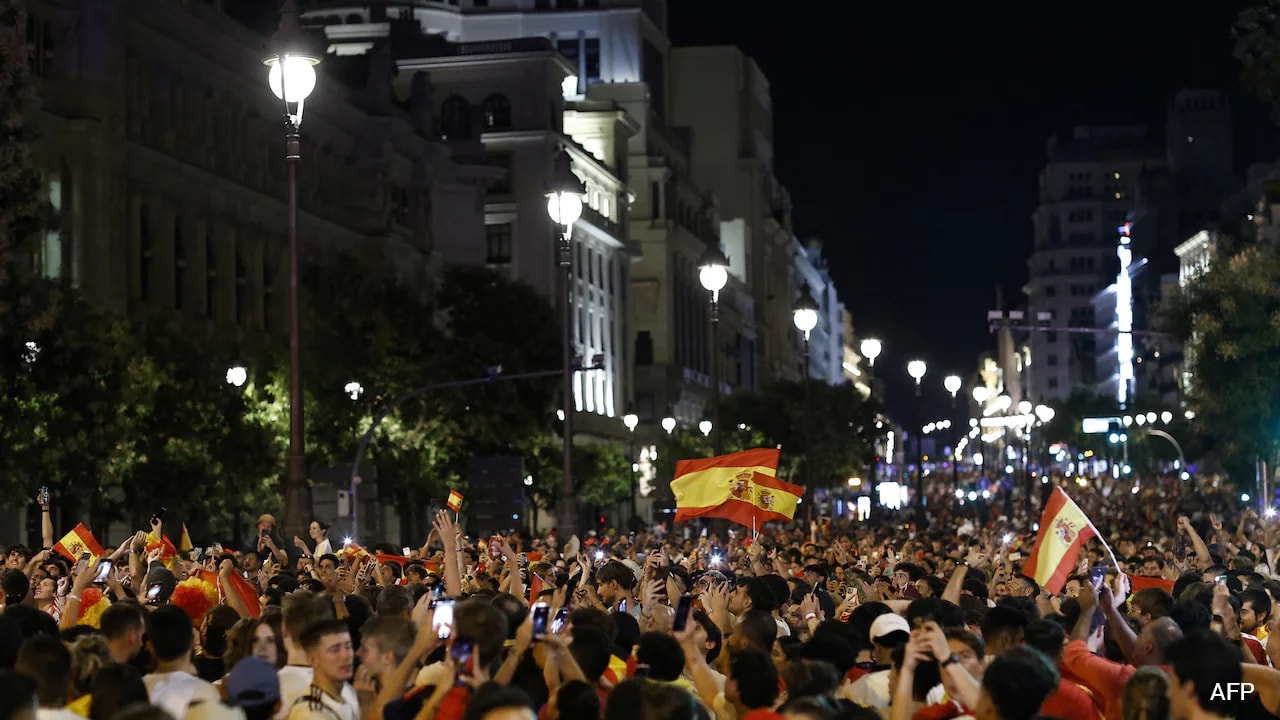
Mass urban celebrations present a predictable convergence of extreme crowd density, dynamic structural loading, and delayed emergency response capability. When national athletic victories trigger unplanned public gatherings, municipal infrastructure designed for static civil use is subjected to mechanical stress states far exceeding design thresholds. The fatal fountain collapse following Spain's World Cup victory illustrates the critical friction point where civic architecture meets unmanaged crowd dynamics.
To analyze urban celebration fatalities accurately, the event must be decomposed into three underlying vectors: structural capacity variance, dynamic load amplifications, and human behavioral cascades. For another perspective, consider: this related article.
Structural Integrity under Non-Design Dynamic Loadings
Public monuments, ornamental fountains, and decorative urban masonry are engineered under strict assumptions of non-occupancy. Their primary structural design parameters optimize for self-weight, wind friction, hydrostatic pressure, and minor seismic events. They explicitly lack the live-load tolerance standards mandated for grandstands or civic plazas.
Structural failure in decorative masonry during mass gatherings follows a distinct physical sequence: Related reporting regarding this has been provided by The Washington Post.
- Static Load Exceedance: A decorative fountain structure typically possesses a static load boundary calibrated solely for its own dead weight and internal fluid volumes. When multiple individuals scale the feature, localized point loads quickly surpass the structural material's yield strength.
- Point-Load Concentration: Unreinforced stone, decorative tile, and aged concrete exhibit low tensile strength. Scale attempts concentrate force onto dynamic point loads rather than distributing weight across load-bearing foundations.
- Dynamic Resonance and Oscillations: Rhythmic jumping or synchronized movement by celebrants introduces cyclic loading. This frequency often matches the natural resonant frequency of the compromised structure, compounding shear stress exponentially.
- Catastrophic Brittle Shear Failure: Unlike steel structures that undergo visible ductile deformation prior to collapse, aged masonry and stone fail catastrophically without preliminary yield warnings. Structural collapse occurs in milliseconds, turning structural fragments into high-mass impact hazards.
The structural failure in Madrid or secondary Spanish plazas during national celebrations highlights a fundamental blind spot in municipal risk assessment: civil infrastructure is rarely audited for structural resilience against active human climbing.
The Physics of Spontaneous Density and Flow Cascades
Spontaneous civil gatherings differ fundamentally from planned stadium events. Planned events control input flows via turnstiles, maintain fixed exit capacity, and enforce localized spatial limits. Spontaneous victory celebrations operate with open boundary conditions, leading to rapid, exponential density spikes around focal monuments.
When physical density in a civic square exceeds four individuals per square meter, fluid crowd dynamics take over. Individual agency declines, and structural interactions become physical imperatives.
Crowd Density Thresholds and Dynamic Behaviors

Density (P/m²)   Physical Movement Characteristics           Risk Vector
----------------------------------------------------------------------------------
< 2.0            Free lateral movement; velocity unhindered  Low
2.0 - 4.0        Restricted walking speed; forced contact   Moderate crowd pressure
4.0 - 6.0        Loss of physical autonomy; dynamic pushes  Structural climbing
> 6.0            Fluid shockwave propagation; crush risk    Mass failure/collapse
As density surrounding central fountains escalates, participants experience extreme physical pressure. Climbing elevated urban structures becomes both a celebration impulse and a subconscious escape mechanism from ground-level crowd compression. This migration drives rapid weight accumulation on elevated, non-rated architectural elements.
Emergency Response Latency and Urban Grid Failure
The mortality rate in municipal structural collapses during victory celebrations correlates directly with emergency response latency. A severe traumatic injury caused by structural masonry crushing requires medical stabilization within the primary gold standard timeframe of ten minutes. Mass celebratory events systematically impair every node of the emergency deployment sequence.
The first breakdown occurs in signal transmission. High concentrations of mobile devices within localized cellular sectors cause packet loss and network congestion, delaying initial emergency dispatch notifications.
The second bottleneck involves physical transit impedance. Surface emergency vehicles face blocked access corridors caused by high pedestrian densities and immobilized civilian traffic. A standard response vehicle capable of traversing five kilometers in four minutes under normal conditions routinely experiences transit delays exceeding thirty minutes in dense celebratory zones.
The third failure mode occurs at the point of care extraction. Manual extraction of an injured individual from collapsed stone within a high-density crowd environment requires physical perimeter establishment. In unmanaged environments, crowd inertia resists perimeter formation, directly delaying triage and extrication efforts.
Strategic Mitigation Engineering for Municipal Authorities
Preventing infrastructural fatalities during major national sporting events requires moving from reactive crowd dispersal to proactive structural containment. Civil authorities must apply three operational protocols prior to high-stakes athletic events:
- Preemptive Infrastructure Hardening: Identify all high-risk decorative structures within known celebratory epicenters. Deploy physical perimeter barricades at a minimum radius of fifteen meters, removing access to non-load-bearing architectural elements well before density builds.
- Dynamic Volume Control Gates: Convert open civic squares into managed flow zones using temporary access barriers. Enforce maximum volumetric density limits by metering entry points prior to the conclusion of major events.
- Dedicated Emergency Transit Corridors: Establish clear, hard-barricaded emergency access corridors traversing major urban centers. These channels must remain strictly defended by law enforcement to ensure zero-latency transit for medical extraction teams regardless of total crowd size.
Addressing urban celebratory safety requires treating spontaneous crowds not as unpredictable public behavior, but as fluid dynamic forces acting upon vulnerable physical infrastructure. Failure to account for non-design structural loading during civic gatherings guarantees the recurring conversion of national athletic achievements into fatal infrastructure events.