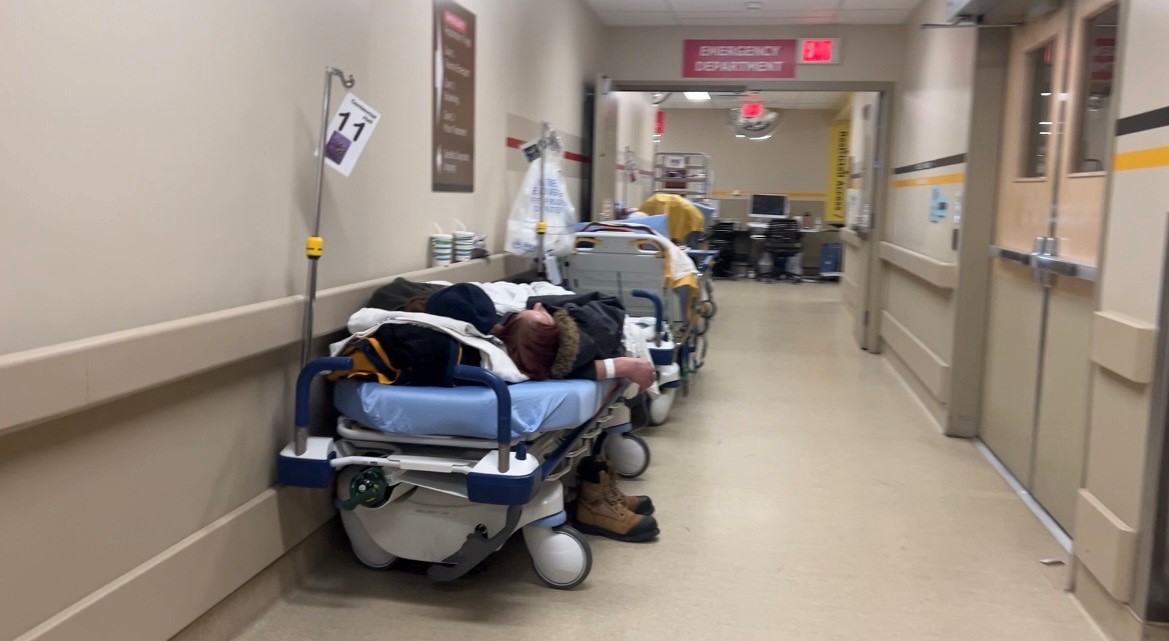
The persistence of patients receiving care in hallways at Kelowna General Hospital (KGH) while entire floor plates remain decommissioned represents a fundamental failure in healthcare capacity management. This is not a simple shortage of physical square footage; it is a breakdown in the synchronization of three critical variables: clinical space activation, specialized labor supply, and patient throughput velocity. When these variables decouple, the result is "hallway medicine," a symptom of systemic institutional friction rather than a mere lack of beds.
The Triple Constraint of Acute Care Activation
To understand why a hospital can simultaneously experience overcrowding and vacancy, one must analyze the facility through the lens of the Triple Constraint of Acute Care. A "bed" in a modern hospital context is not a piece of furniture; it is a fully integrated service unit requiring:
- Infrastructure Readiness: The physical space, including medical gas lines, suction, monitoring telemetry, and infection control protocols.
- Clinical Staffing Ratios: The presence of registered nurses (RNs), licensed practical nurses (LPNs), and allied health professionals at specific, mandated ratios.
- Operational Funding: The recurring budgetary allocation required to activate the utilities and supply chains for that specific unit.
At KGH, the presence of empty floors—specifically within the Interior Heart and Surgical Centre (IHSC) and older wings—suggests that while the first constraint (infrastructure) may be partially satisfied, the latter two are in a state of deficit. An empty floor plate represents sunk capital costs, but an active floor plate represents high variable costs. Without the labor to staff those floors, opening them would result in a dilution of care quality that violates safety standards. Consequently, the hospital administration is forced into a sub-optimal equilibrium: clustering patients in hallways near existing nursing stations where staff can "see" them, rather than distributing them across empty floors where they would be medically isolated and unmonitored.
The Physics of Bed Block and Throughput Failure
The crisis at KGH is driven by Bed Block, a phenomenon where the "Output" stage of the patient lifecycle is obstructed, causing a backflow into the "Input" stage (the Emergency Department).
- Input: Emergency Department (ED) admissions and scheduled surgeries.
- Throughput: Active treatment within acute care wards.
- Output: Discharge to home, long-term care (LTC), or community support.
The "hallway" becomes the overflow reservoir when the Throughput stage is saturated. This saturation is rarely caused by a surge in new patients alone. Instead, it is caused by the inability to move stabilized patients out of acute care beds. These patients, often referred to as Alternative Level of Care (ALC) patients, no longer require the high-intensity resources of KGH but cannot be discharged because there is no capacity in regional nursing homes or home-support programs.
Statistical modeling of hospital flow suggests that when a facility exceeds 85% occupancy, the risk of "gridlock" increases exponentially. KGH frequently operates at or above 100% of its funded capacity. The "empty floors" are a red herring in this specific calculation; if those floors were opened without a corresponding increase in LTC beds in the community, they would quickly fill with ALC patients, and the hallway problem would reappear within weeks. This is the Indisposable Demand Trap: increasing supply in a bottlenecked system only moves the bottleneck to a different stage of the process.
The Labor Scarcity Function
The primary inhibitor to activating KGH’s dormant floors is the labor market. The Okanagan region faces a specialized labor shortage that creates a "hard ceiling" on hospital capacity.
- Nurse-to-Patient Ratios: In acute care, these ratios are strictly governed. Opening a 20-bed unit requires a minimum of five to seven RNs per shift, plus support staff.
- Skill Mix Deficit: Even if generalist nurses are available, specialized units (cardiac, renal, neurological) require specific certifications that have a multi-year lead time to produce.
- Burnout Feedback Loops: As hallway medicine becomes the norm, the "moral injury" to staff increases. Nurses forced to provide care in suboptimal, non-private, and cramped conditions experience higher rates of attrition, which further reduces the hospital's ability to staff new floors.
This creates a negative feedback loop. The inability to staff the empty floors leads to overcrowding in the halls; the overcrowding leads to staff exits; the staff exits further reduce the ability to ever open the empty floors.
The Economic Cost of the Hallway Variable
Managing a patient in a hallway is more expensive and less efficient than managing them in a dedicated room. This counter-intuitive reality is driven by Shadow Costs:
- Increased Length of Stay (LOS): Hallway patients are prone to higher infection rates and slower recovery times due to noise-induced sleep deprivation and lack of privacy. Each extra day a patient stays in the hospital increases the total cost of the episode of care.
- Inefficient Labor Utilization: Nurses must travel further to access supplies, medication rooms, and sinks. The "steps per shift" metric increases, reducing the time spent on direct clinical observation.
- Mediation and Litigation Risk: The lack of privacy and dignity in hallway care increases the probability of patient complaints and legal action, requiring administrative resources to mitigate.
The existence of empty floors at KGH while patients remain in corridors is a physical manifestation of an Asset-Labor Mismatch. The provincial government has funded the "bones" of the building but has failed to fund or recruit the "nervous system" (the staff) required to animate it.
Strategic Optimization of Facility Activation
To resolve the KGH gridlock, the strategy must shift from "opening beds" to "optimizing flow." Simply filling empty floors with beds will fail if the underlying labor and discharge issues are not addressed. A rigorous approach requires a three-phased intervention.
Phase 1: The Transition Unit Model
Instead of attempting to open a full acute care floor, the dormant space should be converted into a Transition and Discharge Lounge. This requires lower staffing ratios than an acute ward. By moving patients who are 95% ready for discharge into a dedicated, low-intensity environment on an "empty" floor, high-intensity acute beds are freed up for hallway patients. This decouples the discharge process from the acute nursing workload.
Phase 2: Regional LTC Integration
The Kelowna healthcare cluster must synchronize its "Output" capacity with KGH's "Input" capacity. This involves a Virtual Ward strategy, where stabilized patients are moved to their homes but monitored via remote telemetry and daily visits from community health workers. This effectively uses the patient’s home as the "empty floor," bypassing the need for physical hospital space entirely for certain demographics.
Phase 3: Targeted Differential Incentives
The labor shortage in the Okanagan is partly a cost-of-living issue. To staff the empty floors at KGH, the regional health authority must implement Locality-Based Stipends or housing subsidies for specialized nursing roles. The cost of these incentives is lower than the aggregate cost of hallway medicine, increased LOS, and ED diversions.
The current state of Kelowna General Hospital is a warning regarding the limitations of infrastructure-first planning. A hospital is a dynamic flow system, not a static warehouse. Until the labor supply and the community discharge capacity are aligned with the physical footprint of the building, the hallway will remain the primary, albeit unintended, ward of the facility. The immediate tactical move is not the procurement of more beds, but the aggressive recruitment of the staff required to make those beds medically viable and the expansion of post-acute care destinations.