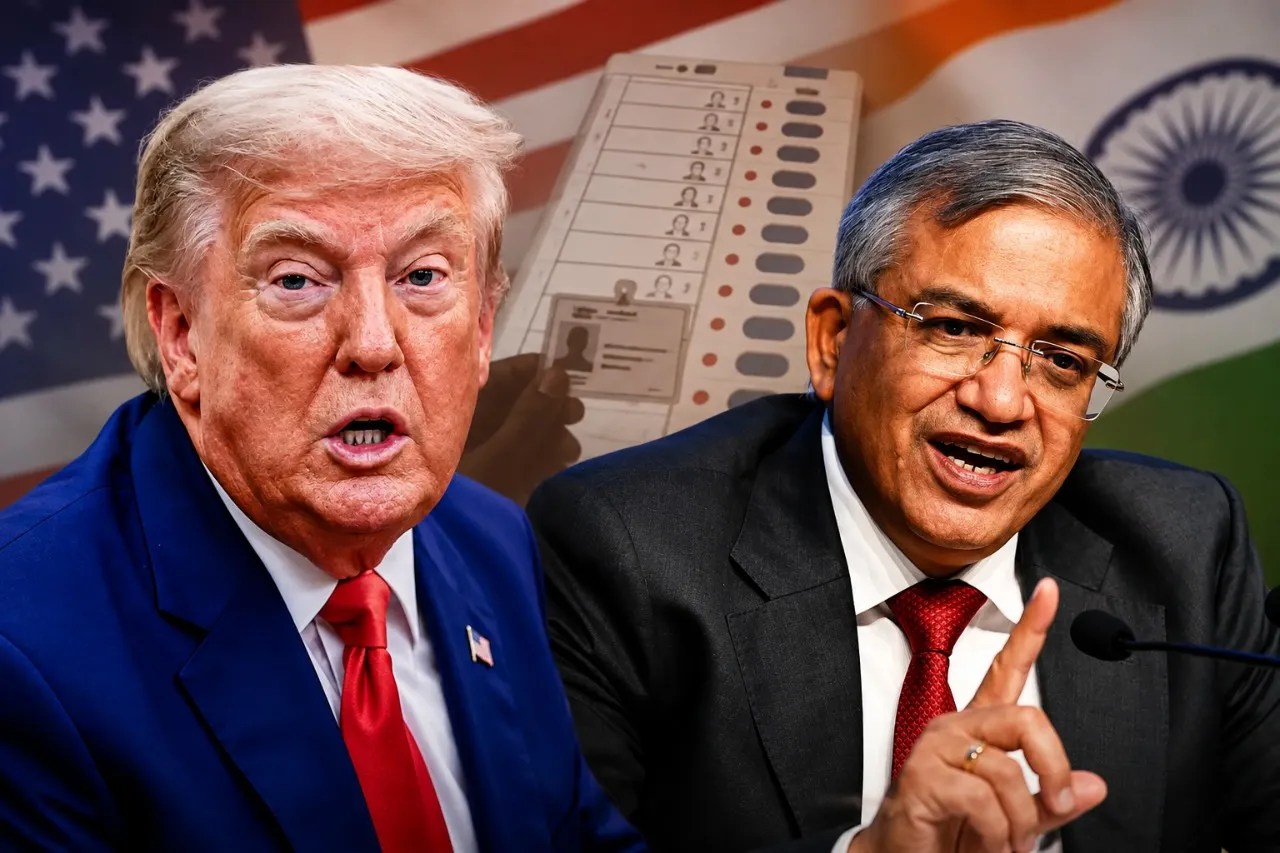
Electoral administration is fundamentally a data verification problem. When scaling verification across hundreds of millions of participants without central identity mandates, the administrative cost function grows exponentially. Recent commentary from United States political leadership highlighting the mechanics of Indian election management exposes a structural vulnerability in Western democracies: the reliance on self-attestation rather than mandatory, cryptographically or biometrically linked credentialing. Analyzing the operational parameters of India's recent electoral cycle alongside proposed domestic legislative frameworks reveals the mechanics of institutional security and the trade-offs inherent in state-level voting architectures.
The Architecture of Mass Verification
The core challenge of democratic execution is balancing universal franchise access against identity verification friction. In the Indian model managed by Chief Election Commissioner Gyanesh Kumar, the system relies on the Electors Photo Identity Card (EPIC) and institutional linkages that establish a deterministic mapping between a physical person and a registry entry. Don't forget to check out our recent post on this related article.
Executing an election for over 640 million participating voters requires an operational framework where discretionary variance at the polling booth is minimized. The structural pillars of this model include:
- Universal Credentialing: Every registered participant possesses a specific, state-issued photographic identifier tied to localized rolls.
- Asymmetric Channel Distribution: Mail-in or postal voting is restricted to narrow operational exceptions, keeping over 99 percent of ballots within supervised, physical polling stations.
- Centralized Standardization: Administrative rules do not vary radically by county or municipality, ensuring uniform enforcement of identity verification parameters.
In contrast, the United States electoral framework operates as a decentralized federation of state-level rules. Decentralization protects against single points of administrative failure, but it introduces massive variance in the cost of fraud prevention. Without a uniform federal standard requiring documentary proof of citizenship and mandatory photo identification at the point of registration—such as the mechanisms proposed in the Safeguard American Voter Eligibility (SAVE) America Act—individual states rely on decentralized databases and disparate validation protocols. If you want more about the background here, TIME provides an in-depth summary.
The Cost Function of Decentralized Self-Attestation
The primary divergence between the American and Indian electoral mechanics lies in the initial entry barrier. The American system largely permits voter registration based on self-attestation of citizenship, backed subsequently by signature matching or disparate state databases.
This creates a specific vulnerability profile:
- Verification Latency: Catching ineligible registrations requires reactive auditing rather than proactive filtering. The administrative burden shifts from pre-registration validation to post-election litigation and list maintenance.
- Administrative Friction vs. Security: Critics of mandatory documentary proof argue that stringent ID requirements impose friction that disenfranchises eligible citizens lacking immediate access to specific civil documents. Conversely, proponents argue that low friction correlates with untracked systemic error, lowering public trust in the aggregate outcome.
- Asymmetry of Mail-In Balloting: High volumes of postal ballots decouple the voter from an administrative officer who can visually inspect identification credentials in real time. By compressing the voting process into asynchronous, remote channels, the verification chain of custody lengthens, multiplying the points where systemic verification can fail.
Operational Realities and Institutional Trade-offs
Replicating a high-certainty framework in a different legal and cultural jurisdiction involves friction. The Indian administrative state utilizes a unified civil registry and deep state-backed biometric linkages (such as Aadhaar) to cleanse rolls and authenticate identities.
Introducing similar mandates into the American political landscape faces structural impediments. The United States lacks a singular, universal national identification card, largely due to historical resistance against federal overreach and privacy concerns. Consequently, any legislative push to mandate strict documentary proof for federal elections forces a collision between federal oversight and state authority under the Elections Clause.
Furthermore, the operational capacity required to verify hundreds of millions of disparate documents under tight legislative timelines creates a bottleneck. If federal law abruptly mandates proof of citizenship for all active rolls without a phased digital infrastructure, state election boards face severe administrative choke points. The transition cost involves massive database harmonization, voter outreach, and potential legal challenges regarding equal protection under the Fourteenth Amendment.
Strategic Implementation Priorities
To secure an electoral registry without collapsing participation rates, systemic reform must follow a precise sequence. Policymakers aiming to bridge the gap between self-attestation and high-certainty verification must deploy a phased institutional rollout rather than a blunt legislative mandate.
The sequencing requires:
- Registry Harmonization: Clean existing state-level voter rolls by cross-referencing death records, change-of-address databases, and non-citizen registries before implementing new verification cutoffs.
- Tiered Credential Phasing: Introduce mandatory photo identification requirements matched with a federally funded program to issue free, secure state-level voter credentials to any citizen lacking a driver's license or passport.
- Channel Constraints: Codify strict, narrow criteria for mail-in voting to re-anchor the majority of volume inside monitored physical infrastructure, thereby reducing chain-of-custody vulnerabilities.