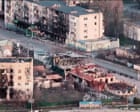
The strategic calculus of localized humanitarian crises under military occupation rarely follows random trajectories; instead, it reduces to a predictable degradation of institutional support networks, supply chains, and basic physiological safety margins. In instances where external access is severed and administrative capacity collapses, populations trapped within contested or occupied zones transition through distinct phases of systemic failure. Analyzing the conditions in Russian-occupied Oleshky, located on the left bank of the Dnipro River in southern Ukraine, reveals the precise operational mechanics of how isolation translates into a severe subsistence crisis.
When a territory becomes logistically bifurcated by a natural barrier such as a wide river, traditional supply routes break down, and the micro-economy shifts from a market-based model to a strict survival-rationing framework. Understanding this transition requires examining three foundational vectors: supply line severance, institutional evacuation, and resource substitution.
The Mechanics of Supply Line Severance
The primary driver of severe civilian hardship in Oleshky is not merely the presence of an occupying force, but the operational disruption of supply logistics. In a functioning regional economy, food, medicine, and fuel flow through centralized distribution networks connecting agricultural production hubs and transport corridors to retail markets.
When combat operations or military controls sever these pathways, the market fails to clear. The cost function of importing goods escalates infinitely due to high security risks, checkpoints, and fuel scarcity. Consequently, the local populace is cut off from external caloric inputs.
In Oleshky, the destruction of the nearby Kakhovka Dam in June 2023 exacerbated this isolation by radically altering the physical and hydrological landscape. The subsequent flooding destroyed local agricultural infrastructure, submerged traditional food storage sites, and disrupted local ecosystems that might otherwise have served as alternative resource buffers. When logistics corridors are choked, human settlements regress from modern supply chains to autarky—an enforced self-sufficiency where populations must extract sustenance directly from their immediate, often depleted environment.
The Institutional Vacuum and Administrative Collapse
Beyond physical logistics, a humanitarian crisis of this magnitude depends heavily on the presence or absence of administrative infrastructure. In stable environments, local governance, municipal services, and humanitarian organizations act as shock absorbers, redistributing resources and organizing emergency relief.
In Oleshky, the imposition of a foreign military administration alongside the departure or neutralization of Ukrainian municipal authorities created an institutional vacuum. Occupying forces frequently prioritize military logistics and political control over civilian welfare, leading to the breakdown of public distribution systems, pension payments, and medical supply chains.
Without a functional administrative apparatus to coordinate relief, individuals are forced to operate as isolated economic agents. The absence of a stable currency, coupled with the devaluation or disappearance of cash reserves, means that even if food exists within a closed market, the mechanism for exchange fails. Barter systems emerge, but they are highly inefficient and limited by the scarcity of tradable assets. As cash liquidity drops to zero, trade halts, leaving vulnerable residents reliant entirely on foraging or ad hoc charity from neighbors who are similarly depleted.
Physiological Degradation and Resource Substitution
When market mechanisms, logistics, and institutional support completely fail, human populations resort to resource substitution. This is the final stage before widespread starvation or systemic medical collapse.
In Oleshky, reports of residents consuming wild weeds and foraging in abandoned gardens illustrate a regression to baseline survival behaviors. From a physiological standpoint, substituting complex macronutrient sources with wild vegetation results in acute malnutrition, caloric deficits, and micronutrient deficiencies. The human body requires a balance of proteins, fats, and carbohydrates; wild greens provide negligible caloric density and lack essential amino acids, leading to rapid muscle catabolism and immune system compromise.
Furthermore, the environmental safety of foraging in a conflict zone is compromised. Areas near active military engagements or flooded regions often harbor unexploded ordnance, chemical runoff, and biological contaminants. Foragers face a high risk of poisoning or trauma, compounding the baseline risk of starvation. This dynamic creates a negative feedback loop: physical weakness reduces the capacity to forage or seek shelter, which accelerates physiological decline and increases mortality rates among the demographic cohorts least able to evacuate—primarily the elderly and disabled.
Strategic Implications and Operational Outlook
The trajectory of occupied zones like Oleshky demonstrates that prolonged military occupation combined with geographic isolation inevitably triggers severe civilian attrition unless external humanitarian corridors are established and maintained. The mechanisms governing this decline are structural, driven by the collapse of distribution networks, the evaporation of institutional safety nets, and the forced reliance on inadequate biological substitutes.
Resolving or mitigating such crises requires more than ad hoc aid delivery; it demands the restoration of secure logistics corridors, the neutralization of administrative barriers, and the re-establishment of basic market liquidity. In the absence of these interventions, populations trapped within isolated pockets will continue to experience accelerated systemic failure, where survival is reduced to daily caloric extraction from a degraded environment.