Electoral outcomes in politically volatile border territories are dictated less by popular enthusiasm than by structural institutional inertia and security state containment capacity. When the Pakistan Muslim League-Nawaz secured a dominant position in the initial phases of the legislative assembly elections in Pakistan-administered Kashmir, mainstream coverage framed the result primarily as a triumph over a localized boycott call led by the Joint Awami Action Committee. This narrative misses the underlying mechanics. The vote demonstrated how centralized party machinery, administrative resource allocation, and a multi-tiered security apparatus override active civil disruption and institutional boycotts.
Analyzing this electoral event requires stripping away standard political commentary to examine the core drivers: the structural design of the regional assembly, the cost function of political mobilization, and the state security apparatus used to maintain administrative continuity.
The Institutional Architecture of Regional Dependency
The structural friction point in regional politics centers on the composition of the legislative assembly itself. The assembly features twelve seats reserved specifically for refugees from Indian-administered Kashmir currently residing in other provinces of Pakistan. This structural design creates a distinct electoral calculus.
The primary critique leveled by the Joint Awami Action Committee is that these refugee seats dilute indigenous political agency. Because these constituencies span across mainland Pakistan, they structurally favor national political parties—such as the Pakistan Muslim League-Nawaz and the Pakistan Peoples Party—which possess the organizational breadth, financial capital, and logistics networks required to campaign outside the immediate regional geography.
From a structural standpoint, this mechanism guarantees that regional elections remain tethered to federal political dynamics. When local actors call for a boycott to protest external political influence, they are fighting an uphill battle against an institutional framework explicitly engineered to integrate the territory into the federal mainstream. The ruling party's success in capturing a vast majority of the initial contested seats is a predictable outcome of an electoral system where national parties hold a structural advantage in logistics and voter outreach.
The Cost Function of Civil Disobedience and Boycotts
Deploying a successful election boycott requires a high-friction strategy from opposition groups. The Joint Awami Action Committee attempted to impose costs on participation through mass protests, street blockades, and direct challenges to state authority. However, the economic and social cost function for individual voters often favors casting a ballot over maintaining compliance with an outlawed civil movement.
When a political grouping is designated as an unlawful organization under anti-terrorism provisions, the state raises the cost of active alignment with that group. Citizens balancing the immediate utility of local governance representation against the abstract goals of a localized reform movement face an asymmetric risk curve. Security deployments—comprising police, paramilitary forces, and military units—effectively establish a baseline physical security zone around polling stations.
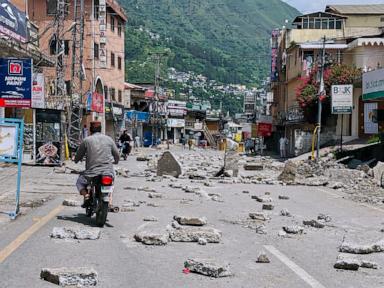
Consequently, despite localized violence, burnt vehicles, and transportation disruptions, voter turnout remained stable enough across the initial phases to validate the administrative process. The boycott failed to reach the critical threshold required to delegitimize the outcome because the state absorbed the disruption through sheer logistical weight and security saturation.
The State Security Matrix and Administrative Continuity
The operational success of multi-phase elections in high-threat environments relies on containment capacity. Organizing a vote across a mountainous terrain during monsoon conditions while managing sustained civil unrest introduces severe logistical variables.
The regional election commission managed these variables by staggering the vote into distinct phases, allowing security forces to concentrate personnel in high-risk zones sequentially. This operational strategy prevents the dispersion of security assets and limits the efficacy of opposition roadblocks or localized uprisings.
When structural instability threatens administrative timelines, the state prioritizes continuity over consensus. The deployment of a multi-tiered security perimeter ensures that even if specific divisions, such as the Poonch division, serve as strongholds for opposition sentiment, the broader political machinery continues to function. The friction between regional grievances and federal control is managed not through political accommodation, but through strict administrative execution.
Strategic Resource Allocation for Future Regional Governance
Future stability in Pakistan-administered Kashmir depends on how the incoming regional administration manages the structural deficit exposed by the Joint Awami Action Committee's mobilization. Addressing economic grievances regarding taxation, utility pricing, and administrative privileges without altering the foundational relationship with federal power structures will remain the primary operational challenge for the incoming government.
To stabilize the administrative zone, the regional government must decouple basic economic service delivery from national party politics. If structural reforms are ignored in favor of hardline security containment, cyclical civil unrest will continue to erupt ahead of every electoral cycle, steadily eroding the long-term legitimacy of regional governance institutions.