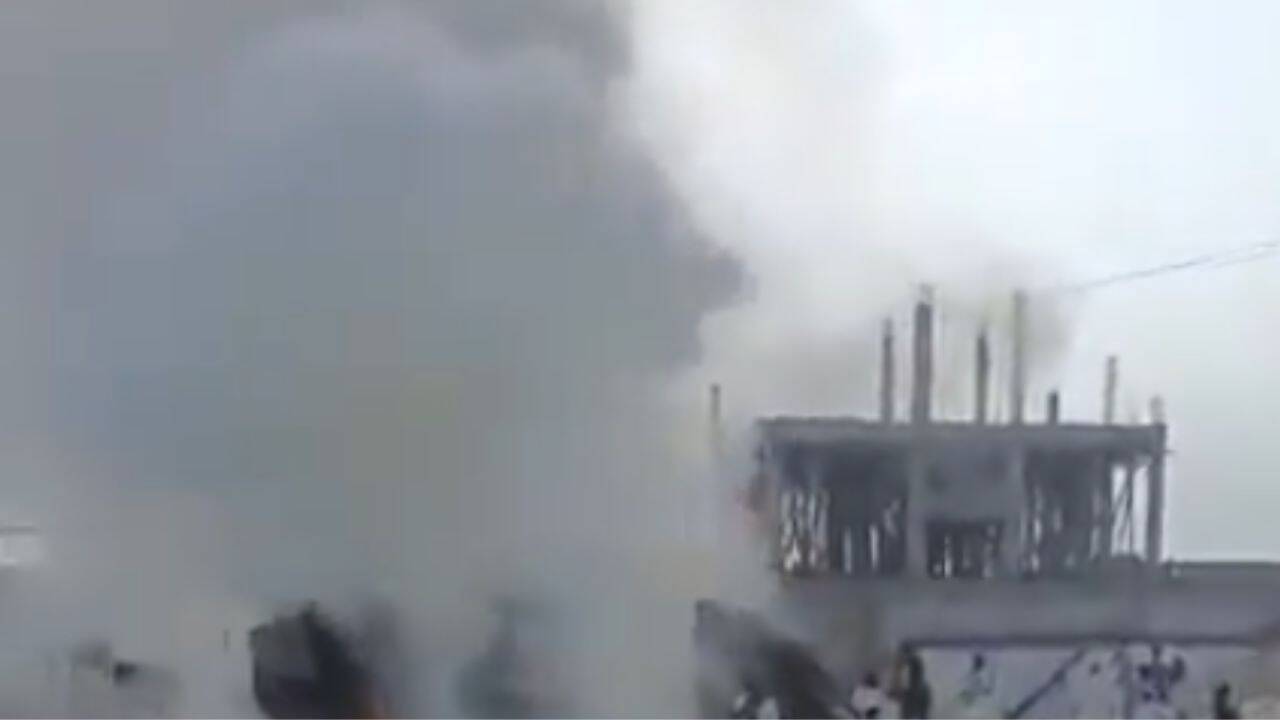
The persistent recurrence of suicide bombings directed at localized security infrastructure in northwestern Pakistan exposes structural vulnerabilities that extend far beyond tactical policing failures. When an operative bypasses hardened perimeters to detonate explosives near a regional checkpoint, the event is routinely misdiagnosed as an isolated security lapse or an intelligence vacuum. This framing obscures the underlying systemic mechanics that sustain insurgent networks in the Khyber Pakhtunkhwa corridor.
The Logistical Cost Function of Asymmetric Operations
Insurgent organizations operating along the border regions do not require conventional parity to impose strategic costs on the state. The economic and operational cost function heavily favors the attacker. While state security architecture demands continuous, capital-intensive resource allocation—hardening checkpoints, maintaining standing garrisons, and securing supply lines—the insurgent network incurs minimal capital expenditure to execute a high-impact asymmetric strike. Expanding on this topic, you can find more in: The Moral Collision Over Assisted Dying And Why The Debate Is Only Accelerating.
The selection of regional police posts and customs checkpoints as primary targets is driven by a calculated cost-benefit matrix:
- Information Asymmetry: Decentralized police posts often rely on static defensive postures, making them predictable targets for reconnaissance.
- Response Latency: Geographic dispersion and rugged terrain delay rapid reaction forces, insulating the attacker during the critical post-detonation window.
- Strategic Compression: Striking local law enforcement erodes the state's lowest tier of administrative control, signaling to the civilian population that civil protection mechanisms are functionally non-viable.
The Geography of Friction and State Authority
The topography of northwestern Pakistan functions as a structural amplifier for insurgent mobility. Porous border boundaries and mountainous terrain create natural safe havens that complicate conventional counter-insurgency doctrine. When state forces attempt to project authority into these borderlands, they encounter severe logistical friction. Experts at Associated Press have also weighed in on this trend.
This friction manifests as a security vacuum. Local police forces are frequently compelled to act as frontline counter-terrorism units despite lacking the tactical intelligence infrastructure, counter-IED capabilities, and fortified urban planning required to withstand dedicated suicide vehicle-borne improvised explosive device assaults. The resulting vulnerability is not a temporary anomaly but a predictable outcome of mismatched institutional design.
Institutional Adaptation and the Deterrence Deficit
Efforts by the state to mitigate these vulnerabilities have historically leaned on kinetic retaliatory cycles—intelligence-based operations and localized cordon-and-search sweeps—following high-casualty incidents. However, kinetic sweeps address symptoms rather than the underlying deterrence deficit. Without a permanent disruption of insurgent recruitment pipelines, financial supply chains, and safe harbor dynamics, retaliatory operations produce temporary displacement rather than structural neutralization.
To alter this trajectory, security architecture must transition from reactive hardening to predictive network disruption. This requires integrating real-time signals intelligence with local human intelligence networks, decoupling static checkpoints from vulnerable civilian zones, and shifting the operational burden from under-equipped municipal police forces to specialized rapid-response formations. Until these structural adjustments are implemented, the recurring vulnerability of regional outposts will remain an immutable characteristic of the security landscape.


