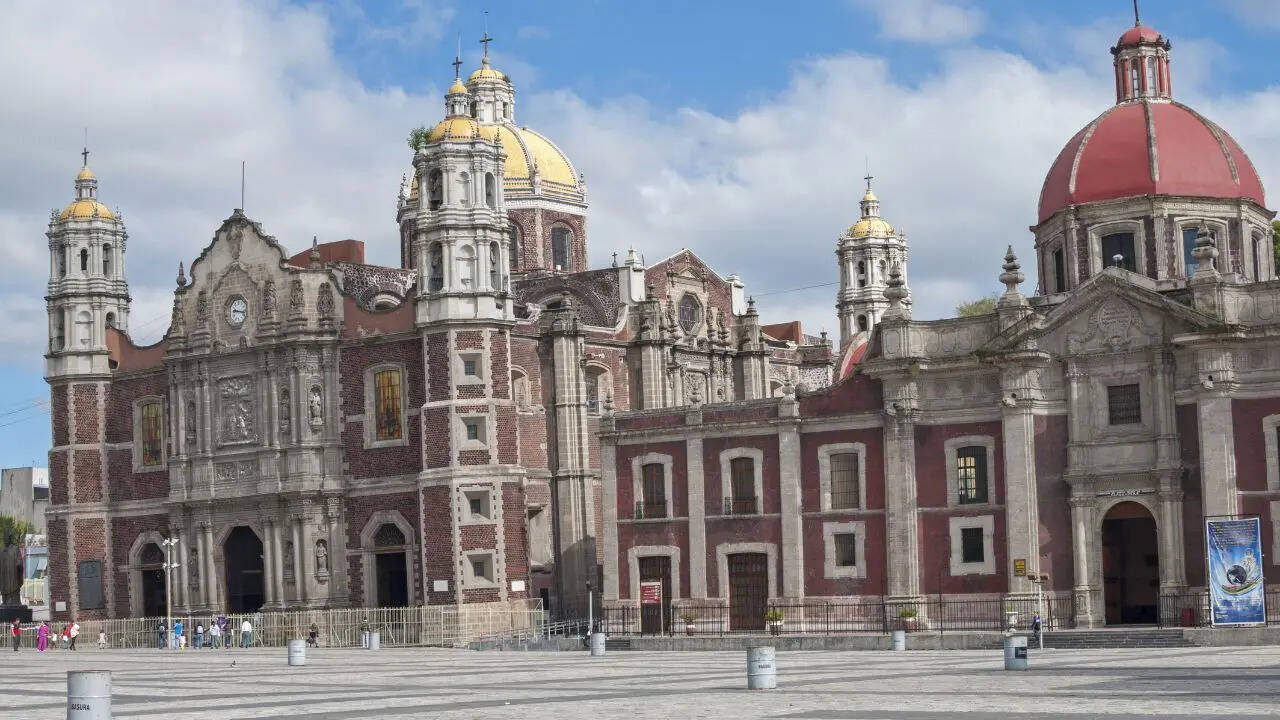
Mexico City is currently a case study in hydraulic structural failure, where the extraction of groundwater from high-compressibility lacustrine clays has triggered an irreversible geological transition known as aquitard consolidation. This is not merely a "sinking" city; it is a geographic entity experiencing vertical displacement at rates exceeding 50 centimeters per year in certain sectors. The mechanism is a feedback loop: as the city extracts water to sustain a population of 22 million, the pore pressure within the soil drops, causing the volcanic clay particles to collapse under the weight of the urban infrastructure. Once these clays compress, they lose their capacity to hold water permanently, rendering the damage to the underlying aquifer irreversible.
The Triad of Geological Vulnerability
The crisis is defined by three distinct structural layers that dictate the rate and severity of the land collapse. Understanding these layers is fundamental to predicting which areas of the city face imminent infrastructure failure.
1. The Lacustrine Clay Foundation
The city is built on the former bed of Lake Texcoco. This soil is composed of highly porous, water-saturated volcanic ash and clay. Under natural conditions, the hydrostatic pressure of the water within these pores supports the structural integrity of the ground. When the water is pumped out, the effective stress on the clay particles increases.
2. Differential Subsidence Gradients
The collapse is not uniform. Because the depth and composition of the clay layer vary across the Valley of Mexico, different zones sink at different velocities. This creates a shear stress on any structure spanning two different zones. While a uniform sink rate of 10 centimeters might be manageable for a building’s foundation, a differential rate—where the north end of a block sinks faster than the south—leads to catastrophic structural shearing of pipelines, metro tracks, and building frames.
3. The Hydro-Social Cycle
The demand for water creates a deficit that cannot be replenished by rainfall. The paved surface of the city acts as an impermeable membrane, preventing runoff from recharging the aquifer. Consequently, 70% of the city’s water is drawn from the ground, ensuring that the rate of subsidence is directly proportional to population density and industrial activity.
Quantifying the Infrastructure Debt
The financial and operational costs of subsidence are often miscalculated because they are viewed as maintenance issues rather than a systemic liquidation of capital. The "Infrastructure Debt" caused by land collapse manifests in three primary systems.
The Hydraulic Paradox
As the city sinks, its drainage systems lose their gravitational efficiency. Mexico City’s main drainage canal, the Gran Canal, originally functioned via gravity. Due to subsidence, parts of the canal have actually risen relative to others, or the slope has reversed entirely. This necessitates the installation of massive pumping stations to move wastewater uphill. The energy cost of fighting gravity to remove water from a sinking basin represents a permanent and increasing tax on the city’s treasury.
The Rupture Constant
The city’s water distribution network loses approximately 40% of its volume to leaks. While some of this is due to age, a significant portion is caused by the constant shifting of the earth, which snaps rigid pipes. The more the city sinks, the more the pipes break; the more the pipes break, the more water must be pumped from the ground to compensate for the loss, which in turn accelerates the sinking. This is a closed-loop system of failure.
Seismic Amplification
The soft, water-logged clays of the valley floor act as an amplifier for seismic waves. During an earthquake, the specific frequency of the clay layers can magnify the shaking by up to 100 times compared to rocky ground. As the clay compacts due to groundwater loss, its resonant frequency changes. This alters the risk profile for every building in the city, rendering historical seismic codes obsolete.
The Inefficiency of Current Mitigation
Traditional engineering responses have focused on localized "fixes"—patching pipes or reinforcing specific foundations. These efforts fail because they do not address the fundamental mass-balance equation of the Valley of Mexico.
- Deep Drainage Tunnels: Projects like the Túnel Emisor Oriente (TEO) are designed to prevent flooding by providing a massive outlet for wastewater. However, these tunnels do not stop subsidence; they merely manage its most visible symptom.
- External Sourcing: Bringing water from the Cutzamala system (a network of reservoirs and pumping stations outside the valley) reduces the reliance on local wells but introduces a massive carbon footprint and creates water insecurity for neighboring regions. It is a temporary relief valve, not a structural solution.
The Cost Function of Inaction
If the current rate of extraction remains constant, the city faces a terminal point in its "Geological Life." This is defined as the moment when the cost of repairing fractured infrastructure exceeds the economic output generated by that infrastructure.
The variable $C_s$ (Cost of Subsidence) can be expressed as a function of the extraction rate $E$ and the structural fragility $F$:
$$C_s = \int (E \cdot F) dt$$
As $t$ (time) increases, the integrity of the soil reaches a point of "Plastic Deformation," where the ground will continue to settle even if pumping stops completely. NASA radar data confirms that parts of the city have already crossed this threshold. The radar interferometry (InSAR) shows that the subsidence is moving beyond the historic center into the surrounding hillsides, threatening the stability of residential zones that were previously considered "safe" ground.
Strategic Realignment: The Decentralized Buffer
The only viable path forward is a radical shift in urban hydraulic management. The focus must move from centralized extraction and disposal to a decentralized, circular model.
Distributed Rainwater Harvesting
The city receives enough rainfall to meet a significant portion of its demand, yet most of it is flushed into the sewer system. Transitioning to building-level harvesting would reduce the $E$ variable in the cost function by lowering the demand on the aquifer.
Injection Wells and Targeted Recharge
The technology exists to treat wastewater to a high standard and inject it back into the aquifer. This would theoretically stabilize the pore pressure in the clay layers. However, the limitation here is the risk of contaminating the remaining groundwater. A pilot program for "High-Pressure Injection Zones" in the most critical subsidence areas is the necessary next step to test if the collapse can be halted mechanically.
Rigid vs. Flexible Infrastructure
Future urban planning must abandon the use of rigid materials for underground utilities. Transitioning to high-density polyethylene (HDPE) piping with telescopic joints allows for ground movement without rupture. This increases the initial capital expenditure but drastically reduces the "Rupture Constant" over a 50-year horizon.
The immediate strategic priority is the mandatory decommissioning of private industrial wells in the central lacustrine zone. These wells extract water at a rate that provides short-term profit for individual entities while generating massive negative externalities for the city’s collective infrastructure. Without a centralized, enforced moratorium on extraction in the highest-subsidence corridors, the city’s foundational integrity will continue to erode until the cost of habitation becomes economically non-viable.