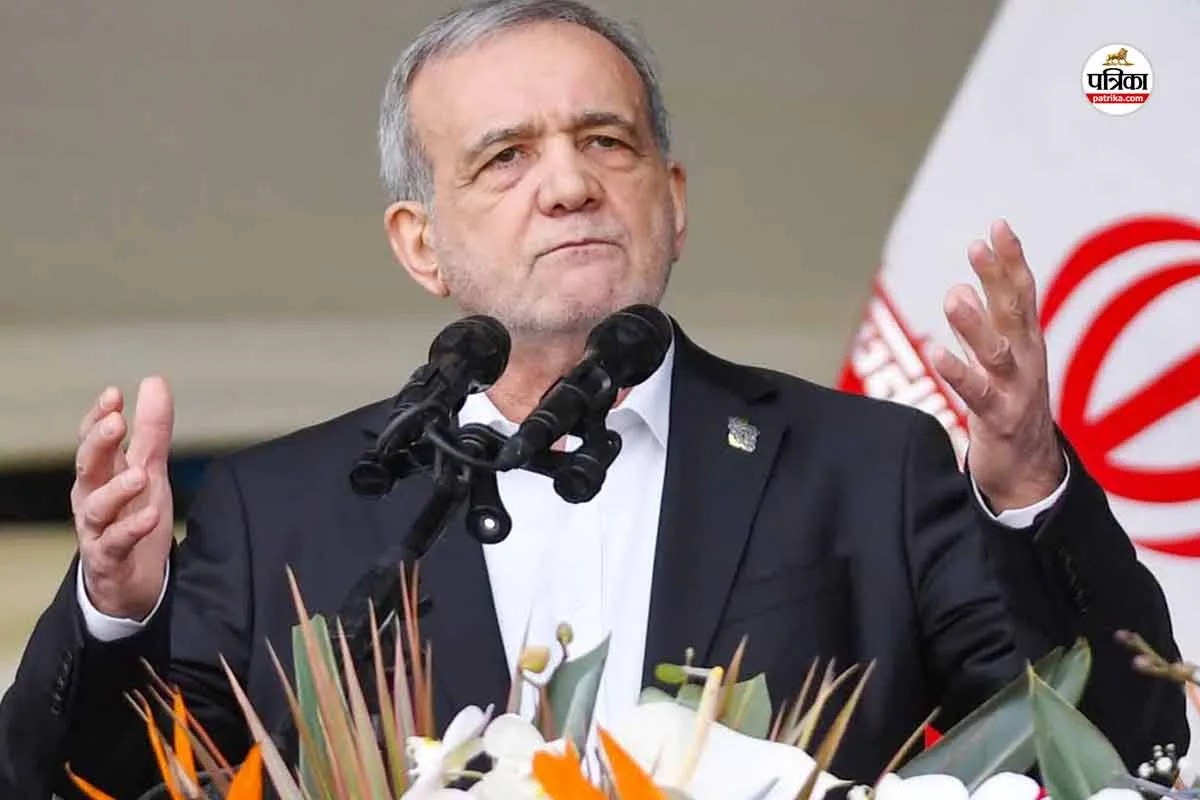
Geopolitical crises rarely escalate through sudden, uncalculated shocks; rather, they grind forward through predictable bargaining failures and misaligned signaling costs. The diplomatic friction between the United States and Iran under the administration of President Masoud Pezeshkian provides a textbook case of an asymmetrical deterrence game where domestic regime survival constraints dictate an uncompromising foreign policy posture. When Iranian leadership signals that economic pressure will fail to alter its state trajectory, analysts must deconstruct this statement not as mere rhetoric, but as a calculated parameter within Tehran's internal cost-benefit function.
Understanding this dynamic requires abandoning surface-level media narratives and examining the structural incentives driving both capitals. Washington relies on maximum pressure frameworks—a strategy engineered to compress an adversary's fiscal runway until state actors are compelled to negotiate under duress. Tehran, conversely, operates under a defensive realism paradigm wherein capitulation to external sanctions is coded as an existential threat to regime legitimacy. This creates a permanent bargaining deadlock: the tool intended to induce flexibility instead triggers absolute rigidity.
The mechanics of this strategic impasse rest upon three distinct institutional pillars.
First is the domestic political economy of resistance. Iranian state architecture, heavily influenced by parallel security apparatuses, is structurally dependent on maintaining an external adversary to justify internal economic mismanagement and suppress political dissidence. Conceding to U.S. financial demands under the current sanctions regime would not merely alter trade balances; it would dismantle the ideological narrative that justifies the ruling elite's monopoly on power. Consequently, the utility of economic relief is heavily discounted by leadership in Tehran, who perceive the long-term risk of political destabilization from perceived weakness as far deadlier than the short-term pain of hyperinflation and resource scarcity.
Second is the calibration of signaling costs in asymmetric conflicts. Traditional deterrence theory assumes that rational actors will back down when the expected costs of defiance exceed the benefits. However, when the actor facing pressure operates with extreme risk-acceptance—driven by the fear of regime collapse—standard deterrence models invert. Threats of expanded secondary sanctions or localized maritime interdictions fail to generate coercive leverage because Tehran calculates that yielding on core strategic dossiers, such as advanced nuclear enrichment or regional proxy network funding, invites iterative demands that ultimately culminate in regime change. The optimal response within this framework is systematic escalation management, maintaining friction just below the threshold of total conventional war while absorbing economic attrition.
Third is the multi-tiered proxy architecture that insulates the core Iranian state from direct kinetic retaliation. By projecting power through decentralized regional militias across Iraq, Syria, Lebanon, and Yemen, Tehran establishes a distributed deterrence network. This network alters the regional cost calculus for the United States and its allies. Any direct strike on Iranian sovereign territory carries a high probability of synchronized asymmetrical blowback against critical energy infrastructure and military assets throughout the Middle East. President Pezeshkian's refusal to bow to external pressure is directly underpinned by this structural insurance policy, which raises the price of American coercion far beyond what domestic or international stability models deem acceptable.
To evaluate how this strategic deadlock resolves, observers must monitor three quantifiable leading indicators rather than relying on diplomatic communiques.
The first indicator is the velocity of foreign exchange reserve depletion coupled with the adaptation rate of alternative trade clearing mechanisms. If Tehran successfully establishes durable bilateral currency swaps and non-dollar trade corridors with major Eurasian partners, the efficacy of unilateral Western financial containment degrades toward zero, entirely neutralizing the primary instrument of American leverage.
The second indicator is the frequency and intensity of tactical signaling within contested maritime chokepoints and airspace. An increase in unsafe intercepts or proxy-driven kinetic actions without crossing the threshold of direct state-on-state warfare indicates that Tehran is actively testing the adversary's threshold for localized escalation, mapping the boundaries of acceptable friction.
The third indicator is internal elite cohesion within the Iranian legislative and security branches. A unified hardline posture signals that institutional competition has been suppressed in favor of collective defense, cementing the uncompromising stance articulated by the executive branch. Conversely, public fractures among political factions would reveal internal vulnerabilities that Washington could exploit through targeted diplomatic or economic incentives.
The operational reality remains stark. As long as the cost of compliance for Tehran is perceived as higher than the cost of defiance, diplomatic frameworks anchored in punitive leverage will yield diminishing returns. Sustainable management of this strategic friction requires moving away from binary coercive models toward long-term containment structures that account for the adversary's domestic survival imperatives.


