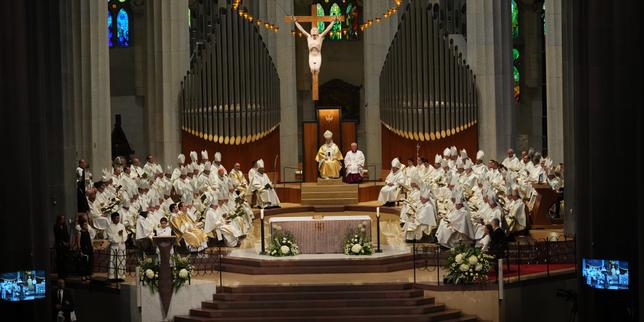
Antoni Gaudí’s Sagrada Família functions less like a traditional cathedral and more like a massive, stone-clad analog computer designed to solve structural and theological equations simultaneously. The common narrative treats the basilica as an eccentric masterpiece of organic art, a collection of "mysteries" or "hidden secrets" left behind by a visionary. This perspective misinterprets the architecture. Every hyper-specific form inside the building—from the twisted columns to the geometric vaults—exists to resolve a precise physical constraint or to execute a specific acoustic, optical, or theological function.
By analyzing the monument through the lens of structural engineering, spatial geometry, and material science, we can deconstruct the hidden logic driving its design. The building relies on a highly integrated system where form follows structural calculation, optimizing load distribution while embedding complex mathematical symbolism directly into the physical matrix of the stone.
The Structural Optimization Framework: Catenary Models and Rule Geometry
The foundational engineering problem of Gothic architecture is the management of lateral thrust. Traditional cathedrals rely on flying buttresses and heavy exterior walls to prevent the outward push of vaulted ceilings from collapsing the structure. Gaudí viewed these classical solutions as mechanical crutches. His alternative system eliminated external bracing by aligning the architecture directly with the vector forces of gravity.
The Inverted Catenary Model
The primary mechanism for this optimization is the catenary curve—the natural shape assumed by a flexible cord suspended between two points under its own weight. When inverted, this curve transforms pure tension into pure compression, eliminating shear stress.
Standard Arch (Generates Lateral Thrust)      Catenary Arch (Pure Compression)
        / \                                             /   \
       /   \  --> outward push                         /     \  --> forces directed
      /     \                                         /       \     straight down
Gaudí calculated these vectors empirically using stereostatic models made of hanging strings weighted with small bags of lead shot. By photographing the suspended network and inverting the image, he obtained the precise trajectory for columns and arches that would experience zero bending moment.
Hyperboloids and Paraboloids as Light Modulators
Rather than carving stone into arbitrary organic shapes, the architectural team utilized ruled surfaces—geometric forms generated by moving a straight line in space. The interior vaults rely on two primary ruled geometries:
- Hyperboloids: These forms act as structural funnels. Located at the intersections of the vaults, they serve a dual purpose. Structurally, they reduce the dead weight of the ceiling matrix. Optically, they act as massive lenses, capturing natural light from exterior windows and diffusing it downward into the nave.
- Paraboloids: Utilized primarily in the linking elements between vaults and columns, these surfaces create smooth, mathematically continuous transitions between disparate structural planes, preventing stress concentrations that could cause fractures.
Column Evolution Dynamics: The Bifurcated Tree System
The interior of the Sagrada Família resembles a stone forest, but this design is driven by a strict load-bearing hierarchy. The central nave columns must support the weight of the massive central towers, a dead load that increases exponentially as construction ascends.
To manage this weight without expanding column diameters to a point that would choke the floor plan, Gaudí developed a system of branching, or bifurcated, columns.
                       [ Vault / Roof Load ]
                            /    |    \
                           /     |     \  (Load split into branches)
                          /      |      \
                         [  Main Column  ]
                                 |
                                 | (Direct vertical compression)
                                 v
This structural bifurcation mimics the load distribution of trees, splitting the weight of the ceiling into smaller vectors that travel down distinct branches into a single trunk.
The Double-Rotation Geometric Profile
The cross-section of each column undergoes a geometric metamorphosis as it ascends, transitioning from a polygon at the base to a circle at the juncture where it branches. This is achieved through a double-rotation profile, where two base polygons rotate in opposite directions.
- The Structural Core: At the floor level, columns feature sharp, star-shaped polygonal bases (e.g., a 12-sided star for the main transept columns). This configuration provides maximum stability against lateral seismic or wind forces at the foundation.
- The Ascent and Multiplicity: As the column rises, the number of vertices multiplies (from 12 to 24, then to 48). With each division, the edges soften.
- The Circular Termination: By the time the column reaches the branching node, it has transformed into a perfect circle. This geometric transition eliminates sharp angles that would otherwise act as stress concentrators under the immense weight of the branches.
Material selection follows this structural hierarchy. The columns supporting the greatest loads are constructed from red porphyry, an exceptionally dense volcanic rock with high compressive strength. As the load requirements decrease higher up and further out, the material shifts to basalt, then to granite, and finally to lightweight Montjuïc sandstone for the uppermost vaults.
The Acoustic Matrix: The Basilica as a Sonic Instrument
A church is fundamentally an acoustic space designed for voice and song. The interior of the Sagrada Família is engineered to function as a giant musical instrument, addressing a common flaw in Gothic architecture: excessive reverberation that turns speech into unintelligible noise.
The vast volume of traditional cathedrals creates long reverberation times ($RT_{60}$), often exceeding 6 to 8 seconds. While beneficial for slow Gregorian chants, this muddies complex polyphonic music and spoken words. Gaudí's design counteracts this through precise geometric diffusion and intentional material absorption.
Gothic Vault (Smooth, Reflective)           Sagrada Família Vault (Hyperboloid)
          |                                              |
     |----v----| (Direct Echo)                     /----v----\ (Diffused Sound)
     |         |                                  /  /   \   \
     v         v                                 v  v     v   v
Hyperbolic Diffusion Mechanics
The hyperboloid vaults act as acoustic diffusers. When sound waves hit the concave and convex stone surfaces of the ceiling, they do not bounce back as a single, coherent echo. Instead, the geometry scatters the waves in multiple directions, breaking up the energy of the reflection. This diffusion shortens the perceived reverberation time and creates a more uniform sound field across the entire congregation.
Integrated Choral Accommodations
The galleries wrapping around the interior perimeter are not merely elevated seating; they are tuned acoustic platforms. Designed to hold a choir of 1,500 singers, the angle of these balconies is pitched precisely toward the vaulting. This allows the choral sound to rise, mix within the diffuse geometry of the ceiling, and cascade evenly over the main floor without creating localized hot spots or acoustic dead zones.
Chromatic Engineering: The Solar Projection Matrix
The stained-glass windows of the Sagrada Família, executed by Joan Vila-Grau, reject the illustrative, narrative tradition of medieval cathedrals in favor of a systematic, chromatic light installation governed by solar orientation.
The building uses the earth's rotation to create a dynamic, interior atmosphere that shifts based on the time of day and season, aligning the solar cycle with theological motifs.
The East-West Chromatic Split
The orientation of the glazing follows a strict thermodynamic and emotional spectrum:
| Facade Orientation | Dominant Color Palette | Solar Positioning | Symbolic/Functional Logic |
|---|---|---|---|
| East (Nativity) | Blues, Greens, Clears | Morning Sunrise | Represents birth, renewal, and low-energy, cool light entering the space during the early hours. |
| West (Passion) | Reds, Oranges, Yellows | Afternoon Sunset | Captures high-intensity, warm light, simulating the sunset and symbolizing suffering, fire, and death. |
Light Gradient Progression
The glass density varies vertically. The lowest tiers of windows feature highly detailed, saturated colors that block the harsh, direct glare of the sun at eye level, creating a intimate environment for visitors. As the windows ascend toward the vaults, the glass becomes increasingly clear and translucent.
This gradient serves an engineering purpose: it allows maximum light penetration to illuminate the complex geometry of the ceiling vaults, ensuring that the structural engineering of the roof remains visible via natural light during peak daylight hours.
Decoding the Cryptographic Facades: Mathematical Order Over Ornament
The exterior facades of the basilica are often analyzed for their emotional or artistic expression, yet they contain deeply embedded mathematical logic designed to anchor the theological narrative in immutable numerical truths.
The Cryptographic Magic Square
On the Passion Facade, designed by sculptor Josep Maria Subirachs, sits a four-by-four mathematical grid containing 16 numbers. This magic square deviates from traditional mathematical constants to prioritize a specific symbolic outcome.
┌────┬────┬────┬────┐
│  1 │ 14 │ 14 │  4 │
├────┼────┼────┼────┤
│ 11 │  7 │  6 │  9 │
├────┼────┼────┼────┤
│  8 │ 10 │ 10 │  5 │
├────┼────┼────┼────┤
│ 13 │  2 │  3 │ 15 │
└────┴────┴────┴────┘
A standard four-by-four magic square (such as Dürer’s Magic Square) utilizes the numbers 1 through 16 sequentially, summing to a constant of 34. The Sagrada Família square alters this sequence: the numbers 10 and 14 appear twice, while 12, 11, 13, and 16 are omitted from the standard sequence, or shifted.
The operational matrix of this grid yields 310 distinct combinations—including rows, columns, diagonals, and the four corner quadrants—that consistently calculate out to the number 33, the traditional age of Jesus Christ at his crucifixion.
The Hyper-Rationalization of Sculpture
The Passion Facade itself rejects the fluid, organic lines of the Nativity Facade. Instead, it relies on rigid, angular, polygonal forms. Subirachs utilized harsh geometry and sharp transitions to evoke the psychological weight of the subject matter.
By stripping the figures of classical curves and reducing them to essential structural planes, the facade aligns with the rationalist, geometric framework that governs the entire architectural system of the interior.
Operational Roadmap for Navigating the Space
To analyze these architectural mechanisms effectively in person, visitors must bypass standard tourist movement patterns and examine the space chronologically and structurally.
Phase 1: The Foundation and Structural Evolution
Begin outside the Nativity Facade during the early morning hours to observe how the low-angle morning light interacts with the organic stone carvings. Move immediately into the interior to inspect the bases of the main transept columns. Note the sharp edges of the star-shaped porphyry bases before tracing them vertically with your eye to watch the geometric multiplication shift into a circular profile before the branch nodes.
Phase 2: The Solar and Acoustic Transition
Position yourself in the center of the nave at midday. Look directly up into the central vaulting to observe the hyperboloid openings. Notice how these cones of stone function as light wells, diffusing illumination without creating harsh rays. By mid-afternoon, relocate to the western aisle adjacent to the Passion Facade to witness the high-saturation red and orange light projection across the interior columns, observing how the changing light profile redefines the texture of the stone.
Phase 3: Technical Contextualization
Conclude the analysis in the underground Museum and Workshop. This space contains replicas of Gaudí’s original stereostatic hanging models and contemporary 3D-printed prototypes used by the current engineering team. Studying these models provides the final verification of how inverted tension strings dictate the exact placement of the stone blocks above your head, confirming that the entire basilica is an exercise in applied mathematics and physics.