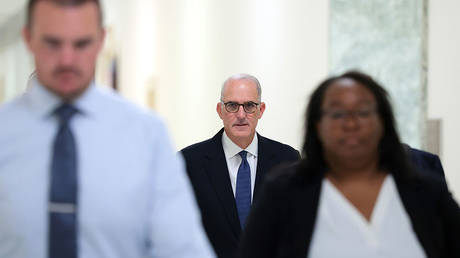
Memory gets incredibly selective when subpoena season rolls around on Capitol Hill. For years, a single explosive claim hung over the post-presidential legacy of Bill Clinton. The assertion came straight from the architect of his post-White House career, Doug Band. In a blockbuster 2020 interview, Band claimed that Clinton had visited Jeffrey Epstein’s private Caribbean retreat, Little St. James.
Now facing the House Oversight Committee under the risk of legal peril, that definitive claim has dissolved into a classic Washington shrug.
Band walked into a closed-door congressional interview and admitted he can't remember why he ever made that claim in the first place. It is a stunning reversal. For anyone tracking the web of political connections surrounding Epstein, it is a reminder of how quickly historical certainty degrades when lawmakers start looking for actual evidence.
The House Oversight Committee wanted to pin down the truth behind the conflicting stories. Clinton denies ever visiting the island. Flight logs from Epstein’s pilots show Clinton and his entourage, which frequently included Band, on more than two dozen flights between 2001 and 2003, but none of those logs show a destination of Little St. James. Ghislaine Maxwell herself even denied Clinton ever visited.
So why did Band say it happened?
When you strip away the political theater, you find a messy fallout between a powerful executive and his most trusted gatekeeper. Band started out as a young White House intern in the mid-1990s. He rose to become the premier architect of the Clinton Foundation and the Clinton Global Initiative. He knew the schedules, the donors, and the private flights better than anyone else.
Their bitter split split left plenty of room for score-settling. When Band aired out the island allegation, it lacked accompanying travel logs or receipts. Now that Congress is reviewing Department of Justice files under the Epstein Files Transparency Act, the story is changing from a definitive accusation to a hazy recollection.
The Problems With Selective Memory Under Oath
Washington has a long history of powerful figures who suddenly develop amnesia when a microphone is placed in front of them. It's a highly effective legal strategy. Saying "I don't know" or "I can't recall" protects a witness from perjury charges while simultaneously denying investigators the confirmation they need to build a case.
We see this play out across the political spectrum. It reveals a broader strategy where operatives distance themselves from their own public statements once those statements carry actual legal consequences.
- The Public Claim vs. The Legal Reality: In a media interview, you can say whatever fits your narrative. Under congressional scrutiny, every word is weighed against federal perjury statutes.
- The Paper Trail Deficit: Investigators rely heavily on documents over memories. If flight logs and Secret Service records don't place an individual at a specific latitude and longitude, a verbal claim carries little weight.
- The Burned Bridge Dynamics: High-level political splits often produce explosive claims that are difficult to verify years later. When relationships sour, old boundaries vanish.
The real challenge for investigators isn't just dealing with a witness who claims a lapse in memory. The issue is verifying the digital trail left behind. While Band’s memory of his old boss's travel has suddenly faded, recently unsealed DOJ documents show his own interactions with Epstein and Maxwell were far more frequent than previously acknowledged.
Unsealed Emails and the Paper Trail That Remains
Memories fade, but servers don't forget. While Band struggled to recall the context of his island claims, investigators have spent months digging into a massive cache of newly unsealed emails spanning from 2001 to 2006. These documents tell a much more specific story than anyone's current recollection.
The messages show a highly familiar, flirtatious dynamic between Band and Maxwell. They used cheeky nicknames like "babycakes" and "booboo" and discussed expensive gifts, including a $35,000 luxury watch that Epstein and Maxwell purchased for Band. Flight records released by the DOJ indicate that Band took over 35 flights with the pair, including several trips where they were the only passengers on board.
Band has pushed back hard against any implication of wrongdoing, stating clearly through his legal team that there was absolutely no physical relationship between himself and Maxwell, whom he now publicly calls a monster. He noted that these messages were sent when he was a young, unmarried man in his 20s.
This dynamic highlights the strategy used by political insiders caught in the Epstein orbit. They admit to the superficial social contact, the flights, and the favors while fiercely denying any knowledge of the underlying criminal activity. They position themselves as useful contacts who were ultimately kept in the dark.
Navigating the Fallout of Post-Presidency Associations
The focus on who flew where or who remembers what ignores a deeper systemic issue. The early 2000s were a wild-west era for post-presidential fundraising. Former leaders routinely mingled with high-net-worth individuals to bankroll massive global foundations, often ignoring the warning signs regarding where that money originated.
If you are managing high-level political relationships or running an organization that relies on major donors, you need to establish strict boundaries to avoid getting caught in a similar reputational trap.
The first step is implementing an independent, third-party vetting system for all primary donors and travel accommodations. Relying on "good vibes" or personal introductions is an absolute recipe for disaster. If an individual offers private air travel or major financial gifts, their background must be scrutinized by an outside firm with no stake in the outcome.
You also need to establish clear policies regarding personal gifts and casual communication. The casual, flirtatious emails between political aides and figures like Maxwell show how informal professional boundaries can become liability points years down the line. If an associate accepts luxury items or sends compromised messages, it creates an immediate vulnerability that investigators can exploit later.
Finally, keep meticulous, independent travel and meeting logs that exist outside of a principal donor’s private records. The fact that the Clinton team could counter Band’s claims with specific flight data highlights the importance of maintaining an ironclad paper trail. When a high-level relationship ends bitterly, your own detailed records are often your only reliable defense against revisionist history.
The congressional investigation continues to sift through thousands of pages of redacted files, but the immediate lesson is already clear. Public accusations might capture headlines, but they rapidly fall apart under oath without institutional records to back them up. In the high-stakes world of political oversight, an unverified memory is the very first thing to go.
Epstein investigation deepens with new aide interviews provides an in-depth breakdown of the ongoing House Oversight panel sessions and explains what these newly unsealed DOJ files mean for the broader investigation.