The asphalt in Philadelphia does not melt gracefully. It softens into a sticky, tar-scented trap, trapping the heat of a brutal sun and radiating it back into the shins of anyone brave enough to walk the historic streets. On July 4, 2026, the city was supposed to be the beating heart of a national triumph. Two hundred and fifty years of independence. A milestone birthday wrapped in the red, white, and blue of a quarter-millennium of history.
Instead, the air felt like a physical weight. Heavy. Suffocating.
Consider Marcus, a hypothetical stadium technician working the concourses of Lincoln Financial Field. He represents thousands of workers across the continent on this bizarre midsummer day. Marcus did not wake up thinking about the macro-dynamics of global emission trends or the meteorological definitions of a heat dome. He woke up thinking about ice. Specifically, how the stadium’s industrial ice makers were already failing by 9:00 AM, hours before a crucial World Cup match was set to kick off under a sky that looked less like summer blue and more like bleached bone.
The United States was supposed to be throwing the ultimate party. The calendar aligned perfectly: the grand Semiquincentennial celebration colliding with the biggest sporting event on earth, the 2026 FIFA World Cup. It was designed to be a showcase of American infrastructure, organizational might, and cultural joy.
Then came the heat wave.
The Mirage on the Pitch
Soccer is a game of continuous movement. It relies on a delicate balance of cardiovascular endurance and split-second cognitive processing. But when the ambient temperature hits 104 degrees Fahrenheit—with humidity pushing the heat index well past 115—the game ceases to be about tactics. It becomes an exercise in survival.
Watch the players on the pitch. They do not run; they glide cautiously, conserving every ounce of moisture. The elite athletes of the world, conditioned to sprint for ninety minutes, look suddenly mortal. Heavy legs. Glazed eyes. During the mandatory cooling breaks—now a permanent fixture rather than an occasional emergency measure—players huddle under tents, draped in ice towels that turn warm within minutes.
The stands present a different kind of crisis. A stadium packed with seventy thousand screaming fans is always a pressure cooker. Add a record-breaking atmospheric anomaly, and it becomes a public health frontier. Emergency medical personnel, usually tasked with treating minor cuts or alcohol-induced mishaps, find themselves running triage for heat stroke.
The contrast is jarring. On one side of the stadium gates, the global soccer elite chases a golden trophy. On the other, ordinary families sit slumped against concrete pillars, seeking the faint, recycled breeze of an indoor air vent. The beautiful game looks fragile when faced with a planet that refuses to cooperate.
Two Hundred and Fifty Years of Sweat
A few miles away from the stadium, the historical reenactors near Independence Hall are making a hard choice. Wool coats, heavy waistcoats, and powdered wigs are not designed for the climate of a changing century. To wear the uniform of George Washington’s continental army in this heat is to court disaster.
History tells us the summer of 1776 was hot, but the data tells us 2026 is uncharted territory.
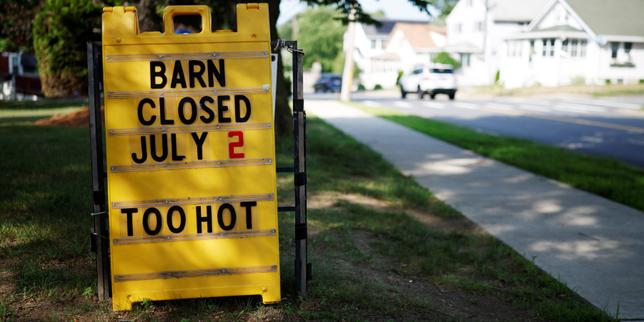
The traditional parades, long planned as sprawling epics of marching bands and historic floats, are being cut short. Towns across the Midwest and the East Coast are quietly canceling afternoon festivities. The risk to elderly veterans marching in the streets is simply too high. Mayors face an impossible calculation: push forward with a historic celebration and risk mass hospitalizations, or cancel the party and face the wrath of disappointed citizens who have waited years for this milestone.
Even the night offers little relief. The promise of the evening fireworks, the definitive punctuation mark of the Fourth of July, carries a dark irony. Across the western half of the nation, parched landscapes mean the spark of a single firework could ignite a catastrophic wildfire. In the East, the air is so thick with humidity and stagnant smog that the smoke from the pyrotechnics refuses to dissipate. It hangs over the cities, a ghostly shroud lit by neon bursts, trapping the heat even longer.
The grand birthday has become an endurance test.
The Logistics of a Melting Superpower
Behind the scenes, the infrastructure supporting these dual mega-events is cracking under the thermal load.
Electrical grids are humming a dangerous tune. Millions of air conditioners blast simultaneously, drawing power at rates that threaten rolling blackouts. For the World Cup organizers, a blackout does not just mean dark rooms; it means a total collapse of global broadcast feeds, stadium cooling systems, and transit networks.
Transporting hundreds of thousands of international fans between host cities requires a flawless aviation and rail network. But extreme heat thins the air. It makes it harder for airplanes to generate lift, forcing airlines to reduce passenger loads or delay flights until the dead of night when the air cools slightly. On the tracks, steel rails expand under the relentless sun, threatening to warp and forcing trains to slow down to a crawl.
The dream of a high-tech, high-speed summer has collided with the stubborn physics of extreme weather.
A Quiet Realization
What stays with you after a day spent navigating this sweltering landscape is not the statistics. It is the quiet moments.
It is the sight of a father pouring a precious, five-dollar bottle of stadium water over his daughter's head just to keep her crying down to a whimper. It is the realization that the traditions we took for granted—sitting on a metal bleacher, eating hot food in the sunshine, cheering for hours—are becoming luxuries dictated by the thermometer.
We are learning, in real-time, that our culture is bound by our climate. The games will finish, the trophies will be hoisted, and the 250th year of American independence will pass into the history books. But the memory of the summer the air stood still will remain.
The final whistle blows in the stadium. The fans trickle out into the heavy twilight, exhausted not from cheering, but from existing. The fireworks begin to thump in the distance, muffled by the heavy haze, a muted celebration for a nation discovering that its greatest challenge might not be political or economic, but atmospheric.