The heat in Qom does not just sit on your skin; it presses into your lungs, a dry, ancient weight that tastes of salt and sun-baked brick. This is the spiritual heart of Iran, a city of blue-tiled domes and whispering seminaries, where the air usually carries the scent of rosewater and the rhythmic shuffle of pilgrims’ feet. But lately, the air has changed. It carries the metallic tang of anxiety.
High above the minarets, the sky is a hard, uncaring turquoise. For the millions who live here, and the thousands who visit, that sky has become a source of quiet, constant scrutiny. Will it bring the rain? Or will it bring the streaks of fire that dominate the evening news? In the teahouses and the marble courtyards of the Fatima Masumeh Shrine, the talk of geopolitical chess—of retaliations, proxies, and "strategic patience"—is the background noise of survival.
Yet, on a dusty street corner just outside the holy precinct, the geopolitical tension meets its match in a plastic cup.
The Geography of a Gesture
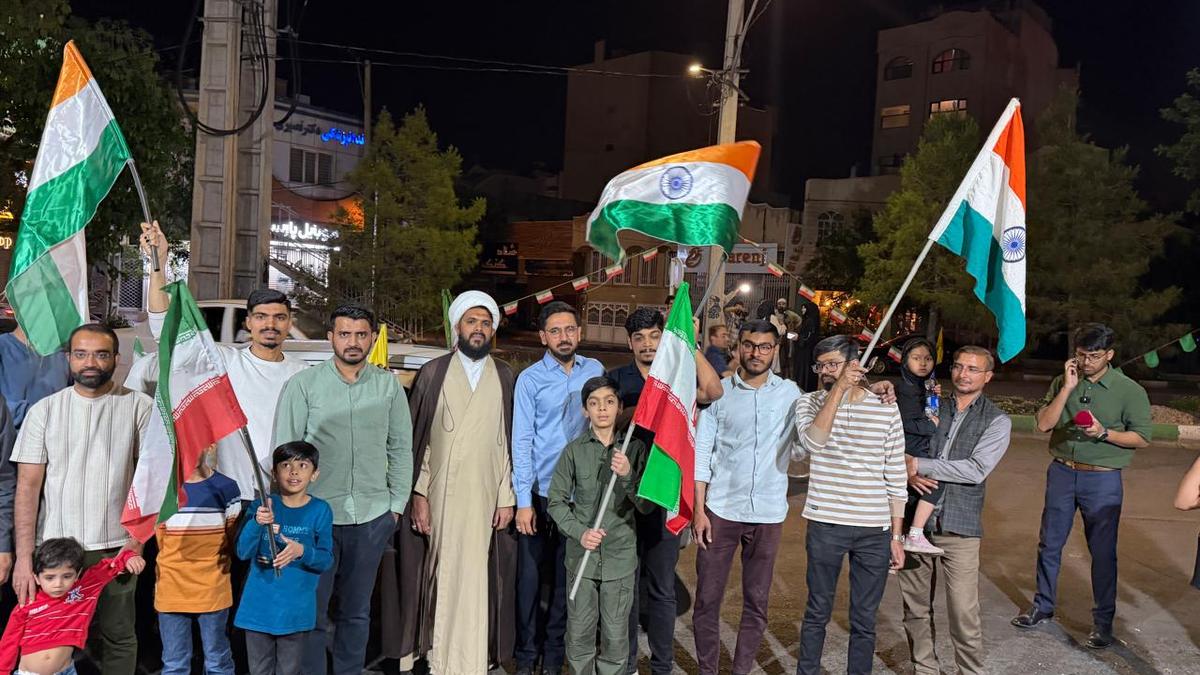
Ali is not a diplomat. He is a twenty-two-year-old student from Lucknow, India, with a thin beard and eyes that haven’t seen enough sleep. He is one of hundreds of Indian volunteers who have made the long journey to Qom, not for tourism, but for khidmat—service. He stands behind a massive, sweating metal canister, his hands stained a faint, cheerful yellow.
He is serving sharbat.
It is a simple concoction: water, sugar, a whisper of saffron, and a handful of basil seeds that bob like tiny pearls. In the logic of a world on the brink of conflict, Ali’s presence makes no sense. Why stay in a city that sits in the crosshairs of a regional shadow war? Why spend ten hours a day in 110-degree heat handing out free drinks to strangers when your own embassy is likely drafting evacuation plans?
"When you are thirsty," Ali says, handing a cup to an elderly Afghan man whose face is a map of deep-set wrinkles, "you do not ask if the sky is falling. You just drink."
This is the invisible stake of the Qom volunteers. While the world watches the movement of troop carriers and the rhetoric of generals, a parallel reality is unfolding on the ground. It is a reality built on the stubborn, almost defiant act of hospitality. To serve a cool drink in a time of heat and hate is an ancient form of protest. It is a declaration that the human connection is more durable than the political friction that threatens to melt it.
A City of Intersections
Qom is often portrayed in Western media as a monolith of austere clerics and "Death to America" murals. The reality is far more textured, a messy and vibrant intersection of the global South. Here, you hear the melodic lilt of Urdu, the sharp staccato of Arabic, and the soft, poetic vowels of Dari.
The Indian community in Qom is a vital artery of this ecosystem. Thousands of students from India—mostly from regions like Uttar Pradesh, Bihar, and Kashmir—come here to study theology, philosophy, and jurisprudence. They are not isolated. They are woven into the fabric of the city. When protests flare up in the streets or when the sonic booms of military jets rattle the windows, these students don’t just watch from the sidelines. They feel the vibration in their own floorboards.
Consider the logistics of kindness in a zone of uncertainty. To set up a sabeel—a water distribution point—requires more than just a bucket. It requires a supply chain of ice in a city where electricity can be temperamental. It requires volunteers who are willing to stand in the sun when others are retreating to the shade of their air-conditioned apartments.
These volunteers are operating on a different clock. To them, the "war fears" reported in international headlines are a persistent hum, like the sound of a distant refrigerator. You acknowledge it is there, but you don't let it stop you from making dinner. They see the protests not as abstract political movements, but as the cries of their neighbors—the shopkeeper who sells them bread, the librarian who helps them translate old manuscripts.
The Alchemy of the Cup
There is a specific psychological weight to the act of giving. In psychology, we might call it "prosocial behavior as a coping mechanism," a way for individuals to reclaim agency in a situation where they have none. When you cannot control whether a drone enters your airspace, you control the temperature of the water you give to a tired mother. You control the smile you offer a frightened child.
The sharbat itself is a metaphor. Saffron, the world's most expensive spice, must be harvested by hand, thread by thread, from the heart of a crocus flower. It is a labor of intense patience. To put saffron in a drink given for free to the public is a statement of radical value. It says: You are worth this effort. This moment, this connection, is worth the cost.
But the volunteers face a dual pressure. Back home in India, their families are frantic. WhatsApp messages fly across the Arabian Sea: Is it safe? Have you bought a plane ticket? Why are you still there?
"My mother calls every night," says a volunteer named Husain. He is stirring a giant pot of sugar syrup with a wooden paddle that looks like a rowing oar. "She sees the news and she cries. I tell her, 'Amma, there are millions of people here. If God wills, we are all together.' But then I tell her about the sabeel. I tell her about the people who come to the stand crying because they are so overwhelmed by the heat, and how their faces change when they take the first sip. Then she understands a little better."
The Invisible Stakes
What is truly at risk in Qom is not just the infrastructure or the political order. It is the concept of the "Global Commons"—the idea that we owe something to one another regardless of our passports.
The Indian volunteers represent a bridge. In a world that is rapidly "de-risking" and "de-coupling," where borders are hardening and empathy is being rationed, these students are practicing a form of radical internationalism. They are Indian citizens, living in an Iranian city, serving pilgrims from Iraq, Pakistan, and Lebanon.
If they were to leave—if the fear finally outweighed the faith—the city would lose more than just its free drinks. It would lose a piece of its soul. The presence of the "outsider" who chooses to stay and serve is a powerful stabilizer. It tells the locals that they have not been abandoned by the world. It tells the volunteers that their identity is not defined by their fear, but by their utility.
The Rhythm of the Afternoon
As the sun begins its slow, orange descent behind the Salt Mountains, the crowd at the sabeel grows. This is the peak hour. The heat has reached its crescendo, and the collective thirst of the city feels like a physical presence.
The volunteers work in a blur of motion. Scoop, pour, hand over. Scoop, pour, hand over.
There is no talk of the latest UN resolution here. There is no debate about the efficacy of sanctions. There is only the clink of ice against metal and the rhythmic "Shukran" (thank you) or "Tashakkur" from the recipients.
The one-word sentences of the thirsty.
Water.
Ice.
Life.
In these moments, the geopolitical reality feels fragile, almost fake, compared to the solidity of the metal ladle and the coldness of the cup. The "war" is a story told by people in suits in far-off capitals. The sharbat is the reality.
The Choice to Stay
We often think of bravery as a sudden, explosive act—a soldier charging a hill, a whistleblower speaking truth to power. But there is a quieter, more domestic kind of bravery. It is the bravery of staying put. It is the courage to maintain a routine of kindness when the world is screaming at you to run and hide.
The Indian volunteers in Qom are not looking for medals. Most of them will return to their villages and cities in India and become teachers, clerks, or local leaders. They will carry with them the memory of the summer the sky turned threatening, and they will remember that their response was not to arm themselves, but to sweeten the water.
This is the lesson the world ignores at its peril. We spend billions on the machinery of death and pennies on the architecture of hospitality. We study the "instability" of the Middle East as if it were a weather pattern, forgetting that the "stability" is actually held together by the millions of small, unrecorded acts of grace performed by people like Ali and Husain.
As night finally falls over Qom, the canisters are empty. The volunteers wipe down the tables and wash the sticky residue of sugar from their arms. The sky is dark now, pinned with stars that look like spilled salt. It is quiet. For today, the peace has held.
Tomorrow, the heat will return. The news will bring fresh reports of movements on the chess board. And Ali will wake up, go to the market, buy his sugar and his saffron, and begin the long, slow work of filling the cups again. He knows that you cannot stop a missile with a cup of sharbat. But he also knows that if you stop serving the sharbat, the missile has already won.
The yellow stain on his hands does not wash off easily. It is a mark of a choice made in the shadow of giants. It is the color of a quiet, cooling defiance.