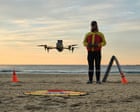
Australia's coastline operates under a permanent, quiet tension. For generations, the salt-water ritual was simple: you checked the surf, you waded past the shore break, and you accepted the ocean on its terms. Today, that social contract has fractured. A string of violent encounters along Sydney’s iconic shorelines forced a radical shift in how authorities manage the boundary between urban populations and apex predators. Sydney shark detection drones now hum above Bondi, Manly, and Maroubra, promising a sterile, mechanized form of security designed to get nervous swimmers back into the water without sacrificing public confidence.
The promise is seductive. High-altitude optics, artificial intelligence recognition algorithms, and real-time cellular alerts beam directly to lifeguard tablets. You sit on the golden sand, blissfully unaware that a three-meter bull shark is tracking a bait ball fifty meters beyond the breakers, while a small quadcopter circles silently overhead. But technology rarely solves a biological conflict without introducing a new set of human complications. Behind the corporate press releases and the comforting whir of rotor blades lies an expensive, complex administrative machinery struggling to reconcile public anxiety with the stubborn reality of marine ecosystems. If you found value in this article, you might want to read: this related article.
The Economics of Aerial Surveillance
Every administrative panic has a budget attached to it. When public confidence dips following a fatal or severe attack, tourism revenue follows a predictable downward curve. Municipal councils and state governments face immediate political pressure to project action. Buying fleets of commercial drones equipped with thermal imaging and specialized optical lenses offers a visible, scalable answer.
Yet, outfitting every patrol tower with advanced aerial units requires sustained capital. Hardware fails in corrosive marine environments. Salt spray eats brushless motors. High winds off the Tasman Sea ground lightweight aircraft on days when turbulent water already reduces underwater visibility. For another angle on this event, check out the latest coverage from Al Jazeera.
State agencies partner with private contractors to bridge the gap, funneling public funds into proprietary software licenses and specialized pilot training. This creates an ongoing fiscal dependency. The municipality no longer just buys a lifeguard tower and a rescue board; it subscribes to an aerial security ecosystem. When the contract renewal arrives, local leaders find themselves trapped between rising service costs and the political suicide of defunding coastal safety measures.
Why Traditional Barriers Failed
For decades, the standard Australian playbook relied on physical containment. Shark nets strung up along popular metropolitan beaches became synonymous with Sydney summers. They were crude, heavy, and culturally grandfathered into the collective consciousness of beachgoers.
They were also ecological carnage machines.
The nets did not create a defensive wall; they acted as gill curtains, entangling not only target species like great whites and bull sharks, but also rays, turtles, dolphins, and harmless nurse sharks. As public tolerance for marine mortality evaporated, environmental groups systematically dismantled the moral authority of netting programs. By the time scientific audits revealed that mesh barriers stopped only a fraction of sharks passing parallel to the shore, the political appetite for maintaining them had vanished.
Drones stepped into that vacuum not because they were infallible, but because they offered a clean exit strategy. They promised observation instead of execution. You do not kill the marine life; you simply watch it, track it, and clear the water until it moves on.
The Mechanics of Silicon Vigilance
To understand how modern aerial monitoring actually functions, one must look past the marketing gloss and examine the software stack. When a shark monitoring drone ascends over a surf zone, its camera feeds a continuous video stream into an on-board or cloud-based neural network.
This AI model has been trained on thousands of hours of aerial footage, learning to distinguish between the distinct shadow profile of a marine predator, a school of salmon, a surfer on a longboard, and a sun-bleached rock formation.
- Polarizing filters cut through surface glare to peer beneath the water column.
- Computer vision algorithms flag anomalous shapes moving at speeds inconsistent with current drift.
- Automated alert triggers push visual bounding boxes to human operators within seconds.
The human element remains the final bottleneck. Software generates false positives constantly. A large shadow cast by a wave crest, a floating log, or a dense school of bronze whalers can trigger an alert. The lifeguard must interpret the screen, weigh the risk, and make a split-second call on whether to sound the alarm and clear the water.
This creates a peculiar psychological burden. Lifeguards are no longer just scanning the horizon with polarized sunglasses and trained eyes. They are now monitors of computer screens, arbiters of algorithmic interpretations. When the system screams wolf three times in an hour over drifting kelp, operator fatigue sets in. When the operator tunes out the noise, that is precisely when a real vector slips through unnoticed.
The Behavioral Shift in the Water
Technology alters human behavior in ways engineers rarely anticipate. When people know an electronic eye is scanning the surf, a subtle shift occurs in risk assessment. False security settles over the beachgoer.
The psychological safety net provided by aerial surveillance encourages individuals to venture further out, swim during off-peak hours, or ignore traditional environmental warning signs like murky water after heavy rainfall. After all, if a shark were present, the machine would have seen it. The drone becomes an omniscient guardian angel in the public imagination, masking the inherent unpredictability of the ocean.
Marine biologists point out a stark biological truth that algorithms cannot change. Sharks are not static residents waiting in a grid square; they are highly mobile, opportunistic hunters moving along coastal corridors governed by water temperature, bait migrations, and tidal cycles.
A beach declared safe at nine in the morning can transform into an active hunting zone by noon as a school of tailor moves into the gutter. The drone provides a snapshot, a temporary data point in an endlessly shifting fluid environment. Treating that snapshot as a permanent guarantee of safety is a dangerous administrative fiction.
The Financial and Operational Realities
Deploying a fleet large enough to cover Sydney’s sprawling coastline requires an intricate logistical tail. Batteries degrade rapidly under heavy daily use, demanding rotation schedules that test station budgets. Operators require commercial remote pilot licenses, formal airspace clearance from civil aviation authorities, and specialized insurance policies.
When a drone crashes into the surf—an inevitable casualty of wind shear and salt corrosion—a multi-thousand-dollar piece of hardware vanishes into the deep.
Furthermore, privacy concerns linger quietly in the background. While the primary mission is marine observation, high-resolution optical sensors sweeping across crowded public beaches capture intimate details of human life on the sand. Councils must navigate strict data retention policies, ensuring that footage is scrubbed rather than stored, placating civil liberties advocates who look warily at the steady creep of municipal surveillance infrastructure.
Moving Past the Illusion of Control
The rush toward high-tech coastal monitoring reflects a broader cultural intolerance for uncertainty. We want digital metrics applied to natural chaos. We want an app, a sensor, and a camera feed to eliminate the primal risk of stepping into a wilderness.
Sydney's shift toward aerial surveillance has successfully modernized lifeguard operations, reduced reliance on destructive gill nets, and restored a measure of confidence to jittery tourists. But it remains a palliative, not a cure. The ocean refuses to be digitized. Sharks will continue to patrol the turbid edges of our beaches, indifferent to the buzzing machinery overhead, reminding us that every time we enter the water, we are simply visitors in an ancient, unmanaged domain.
The siren wails across the sand, the rotors spin down in the salt air, and the water closes over the surface without a trace


