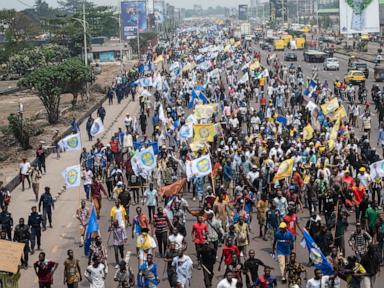
Security forces in the Democratic Republic of Congo deployed tear gas and live ammunition to disperse demonstrators massing in major urban centers, pushing back against legislative maneuvers aimed at altering the nation's foundational governing laws. The unrest in Kinshasa marks a dangerous escalation in a long-standing political crisis, as citizens and opposition factions mobilize against executive overreach that threatens the fragile architecture of the state.
For decades, the streets of Kinshasa have served as the ultimate testing ground for political legitimacy. When lawmakers begin debating amendments to presidential term limits or electoral mechanisms, the public response is swift. The recent deployment of chemical deterrents by the police highlights a familiar pattern of state suppression directed at civil dissent. Behind the immediate clashes lies a deeper structural anxiety regarding institutional decay, economic stagnation, and the erosion of democratic safeguards in Central Africa.
The Anatomy of Institutional Control
Constitutional engineering rarely happens in a vacuum. In the Democratic Republic of Congo, political survival depends heavily on legal architecture. When ruling coalitions attempt to alter the foundational rules of governance, the motivation is rarely administrative efficiency. It is about consolidation.
The strategy follows a predictable playbook. First, introduce ambiguous legislative packages under the guise of modernization or decentralization. Second, rush the committee phases to limit public scrutiny and opposition mobilization. Third, rely on a compliant judiciary to validate procedural shortcuts.
Citizens recognize this sequence. They have seen past transitions stall or reverse under the weight of executive manipulation. When police units clear the avenues with tear gas, they are not just stopping a march; they are enforcing a political transition managed from the top down. The public understands that altering the foundational text of the republic alters the balance of power permanently, shifting authority away from the electorate and locking in partisan advantages for years to come.
Economic Pressures and Popular Fury
Street protests in Kinshasa are fueled by more than abstract legal debates. Daily survival in the capital is an exercise in endurance. Inflation, currency depreciation, and crumbling public infrastructure create a volatile backdrop where any political spark can ignite widespread fury.
When people take to the boulevards despite the certainty of police crackdowns, their grievances are multifaceted. They face soaring food prices, erratic electricity grids, and few employment prospects in the formal economy. To the average worker or university student, legislative battles over governance rules represent a ruling class detached from reality. While families struggle to secure basic meals, political elites spend their energy rewriting the rules of engagement to perpetuate their tenure.
This economic desperation changes the nature of the protests. They are no longer isolated demonstrations organized by political parties. They have transformed into decentralized expressions of public exhaustion. Tear gas can clear a street corner temporarily, but it cannot dissolve the structural economic pressures driving thousands of citizens toward confrontation.
The Regional Implications of Internal Strife
Domestic political crises in the Democratic Republic of Congo rarely remain contained within national borders. Given the country's vast geographic expanse and its critical role in supplying global mineral markets, regional stability depends heavily on internal political equilibrium.
Neighboring states watch Kinshasa closely. Armed groups operating in the eastern provinces often exploit political vacuums and state distraction in the capital to expand their territorial control and illicit supply chains. When security forces are pulled off the front lines or diverted to urban centers to suppress civilian demonstrations, the peripheral security apparatus weakens.
International partners face a difficult diplomatic balancing act. Western capitals and regional bodies issue standard calls for restraint and dialogue, yet their leverage remains limited. Economic sanctions and diplomatic pressure often bounce off entrenched political networks that have learned to insulate themselves from external penalties. The international community's reluctance to impose meaningful consequences leaves civil society organizations and ordinary citizens to bear the brunt of state crackdowns alone.
The Breaking Point of State Legitimacy
A government that relies predominantly on tear gas and batons to manage its citizenry has exhausted its social contract. When the primary interface between the state and the populace becomes a riot shield or a chemical canister, the foundation of authority shifts from consent to coercion.
In the neighborhoods of Kinshasa, resilience runs deep, but patience is wearing thin. Opposition leaders continue to call for mobilization, knowing the risks involved, because the alternative is quiet acquiescence to permanent disenfranchisement. The legislative chambers may pass their amendments under a heavy guard of armed police, but laws enacted against the explicit will of the populace carry a profound vulnerability. They lack the legitimacy required to maintain long-term stability.
The tear gas clears from the asphalt, leaving behind smoking canisters and stinging eyes, but the underlying political crisis remains entirely unresolved. As the state tightens its grip through legislative maneuvering and physical force, the pressure within the system continues to build toward an inevitable reckoning.


