The kitchen table of a working dairy farm smells like cold tea, damp wool, and exhaustion.
Outside, the dark fields stretch out toward the horizon under a heavy County Down sky. Inside, the clock ticks with an aggressive, hollow rhythm. It is past ten at night. While the rest of the world sleeps, a farmer sits hunched over a kitchen table buried beneath an avalanche of paper. Receipts curl at the edges. Compliance logs demand immediate attention. Animal health records, milk quotas, tax obligations, and equipment maintenance schedules wait in untidy piles. Read more on a similar topic: this related article.
This is the invisible tax of agriculture. Long after the sun goes down and the milking parlors fall quiet, the real battle begins against a mountain of administrative bureaucracy.
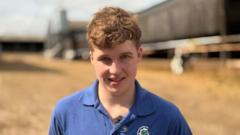
Most people look at this scene and feel a vague, passing pity before turning the page. Sixteen-year-old Ben O'Connor looked at this scene and felt an itch he had to scratch. More analysis by Ars Technica explores comparable views on the subject.
Growing up on a fourth-generation family farm that transitioned from beef to dairy, O'Connor understood the unique brand of isolation that comes with modern food production. He knew that the hardest part of farming isn't always the physical labor of hauling feed or tending to livestock. It is the administrative chokehold. It is the feeling of drowning in forms while trying to keep a living, breathing ecosystem afloat.
Long before most teenagers figure out how to navigate algebra tests, O'Connor was already building businesses. At nine years old, he sold firewood. By thirteen, he launched a mail-order gift basket venture called Giftery that quietly moved two hundred thousand units over three years. He learned early how markets move, how customers complain, and how hard it is to command respect across a negotiation table when your voice is still cracking and your adult peers outage you by decades.
Yet, digital commerce baskets were not enough. His mind kept drifting back to the dirt.
He noticed that existing agricultural software solutions were bloated, disconnected, and fundamentally misunderstood daily life on the land. Traditional herd management systems track milk yields, but they ignore workforce coordination, accounting, safety regulations, and compliance hurdles. They are built by people who look at farms through spreadsheets rather than muddy boots.
So, he decided to write his own rules.
While preparing for his GCSE exams, O'Connor quietly engineered a platform called FarmFlow. Think of it as a digital nervous system designed specifically for the chaotic reality of rural enterprise. Instead of forcing tired operators to juggle a dozen different browser tabs and paper ledgers, the platform consolidates task tracking, compliance checks, animal health signals, nutrition planning, and financial logs into a single interface.
Consider what happens next on a typical working farm. An animal shows early signs of distress. In the past, notes might get scribbled on a greasy hand, forgotten in a tractor pocket, or lost entirely until it becomes an expensive veterinary emergency. With O'Connor's system, a quick log via a mobile device flags the issue immediately, while simultaneously serving up safety protocols and best-practice guidance linked to the specific chore. It learns the rhythms of the property over time, adapting to the unique pressures of the herd.
Connectivity is another silent killer of rural innovation. Tech developers in glass skyscrapers often forget that fields have notoriously terrible cell reception. A cloud-dependent app that crashes when the signal drops is worse than useless; it is an active annoyance.
O'Connor solved this by engineering the software to operate locally. Operational data is stored right on the device and secured with end-to-end encryption, ensuring that the system never goes down just because a heavy rainstorm knocks out the local cell tower. Data privacy is treated not as an afterthought, but as an absolute requirement, managed by a teenager who happens to be qualifying as a data protection officer on the side.
Before a formal public rollout, more than one hundred and sixty pilot farms across the UK and Ireland began testing the system. Veteran producers, skeptical of tech solutions pitched by digital natives half their age, discovered something startling. The software actually gave them time back. It allowed them to step away from the property for an evening without feeling like the entire operation was about to collapse behind their backs.
Crucially, the platform operates on a philosophy born from lived empathy. Recognizing that cash flow is the perpetual heartbeat and headache of agricultural life, O'Connor structured the tool to always feature a robust free tier. He refuses to add another financial pressure to an industry already stretched thin by volatile markets and unpredictable weather.
There is a profound cultural shift happening in the quiet valleys and sprawling pastures of the modern countryside. The digital divide is closing, not because massive corporations finally decided to care about rural infrastructure, but because a new generation is growing up with code in one hand and a pitchfork in the other.
The kitchen tables across the countryside may never be completely empty of paperwork. Regulations will change, markets will fluctuate, and the weather will always remain stubbornly indifferent to human plans.
Yet, for the farmer closing their laptop tonight, there is a new kind of quiet settling over the room. It is the quiet of a system that finally works with them, instead of against them.
And somewhere out there in the dark, a sixteen-year-old developer is already thinking about what needs fixing next.