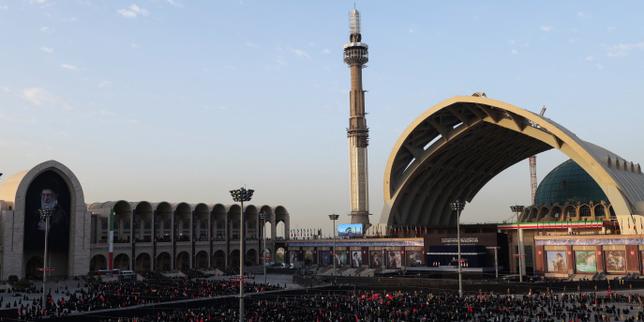
The international press is recycling the same tired script. Whenever a totalitarian ruler in the Middle East dies, the cameras pan across a sea of weeping faces, black flags, and packed boulevards. The immediate, lazy consensus from Western analysts follows on cue: "Look at the massive turnout, the regime still commands absolute legitimacy."
We saw it with Ruhollah Khomeini in 1989. We saw it with Qasem Soleimani in 2020. And we see it again in the coverage of Ali Khamenei’s funeral arrangements. The media interprets crowds as a mandate. They mistake state-mandated choreography for genuine political resilience.
They are misreading the room entirely.
Massive state funerals in autocratic regimes are not indicators of stability. They are highly engineered logistics operations designed to mask deep institutional fragility. When you look past the tightly framed television shots, the reality on the ground tells a completely different story.
The Logistics of Manufactured Grief
To understand why the mainstream narrative is flawed, you have to understand how these events are staged. Having analyzed state-run media strategies and internal security deployments in the region for over a decade, I can tell you that a turnout of hundreds of thousands is a triumph of bureaucracy, not ideology.
The Islamic Republic operates a massive apparatus of patronage and coercion. Attendance at these events is rarely purely voluntary.
- Civil Service Mobilization: Government employees, military personnel, and their families are explicitly ordered to attend. In many cases, attendance checks are mandatory, and missing the event can impact employment status or government benefits.
- Rural Pipeline: The regime busses in tens of thousands of citizens from rural provinces, offering free transportation, meals, and stipends. For struggling families in peripheral towns, a free trip to the capital is a pragmatic choice, not a political statement.
- School Closures: Universities and schools are shut down, with student groups organized into mandatory marching cohorts.
Imagine a scenario where a corporation forces every single employee, subcontractor, and vendor to attend an annual AGM under threat of contract termination, then points to the packed auditorium as proof of universal employee satisfaction. That is exactly what is happening in Tehran.
The crowd is real. The emotion, for a specific segment of the population, is real. But the conclusion that this reflects the political will of an entire nation is demonstrably false.
The Myth of the Monolithic Iranian Public
The biggest error the competitor article makes is treating the Iranian public as a monolith. By focusing exclusively on the mourners in the center of Tehran, they completely ignore the millions of Iranians staying home in silent dissent—or actively celebrating in private.
Data from independent, anonymous polling organizations operating inside Iran, such as the GAMAAN Research Foundation, consistently shows a massive disconnect between state ideology and public opinion. The vast majority of the younger demographic—which makes up the bulk of the population—is completely alienated from the clerical establishment.
When the state dominates the streets with security forces and Revolutionary Guard members, dissenters have no safe way to counter the narrative in real-time. Staying home is their only vote. By focusing only on the people who show up, international journalists fall for the regime's survivorship bias. They report on the minority that supports the system while the disenfranchised majority remains invisible to the cameras.
The Transition Crisis Hidden in Plain Sight
The funeral is a distraction from the real story: the brutal, destabilizing succession battle happening behind closed doors.
In a system where supreme power is concentrated in a single individual, the death of that individual creates an institutional vacuum. The public display of unity at a funeral is a desperate attempt by the Assembly of Experts and the Islamic Revolutionary Guard Corps (IRGC) to signal control while they scramble to manage internal fractures.
Historically, the transition of power in autocratic systems is the moment of maximum vulnerability. The regime is not mourning; it is panicking. The IRGC wants a successor they can control completely to protect their vast economic empire, which spans from telecommunications to oil smuggling. The traditional clerical elite wants to preserve religious legitimacy. These two factions are fundamentally incompatible over the long term.
The massive funeral is a pressure valve, a temporary truce meant to project strength to foreign adversaries and domestic rebels alike. Once the body is in the ground, the internal purge begins.
Dismantling the Stabilty Argument
People frequently ask: "If the regime is so unpopular, why don't these funerals spark immediate counter-protests?"
The premise of the question misunderstands the nature of modern authoritarian control. You do not protest during a maximum security mobilization. During a state funeral, the internal security architecture—the Basij militia, the police, and plainclothes intelligence officers—is at peak readiness. Sniper nests line the roofs. Cellular networks are throttled. Launching a protest in that environment is not activism; it is suicide.
True political stability means a system can withstand shocks without relying on total military mobilization. The Iranian state requires constant intimidation to survive. A country that must shut down its capital and deploy thousands of armed guards just to bury its leader is not stable. It is terrified of its own people.
Stop looking at the crowded streets of Tehran through the lens of Western democratic rallies. It is not an election victory parade. It is a highly coordinated, heavily armed theatrical production designed to make the status quo look inevitable. It isn't.
The cameras are showing you exactly what the regime wants you to see. The real future of Iran is being decided by the people who chose not to show up.