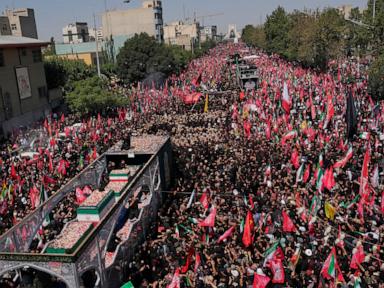
Mass mobilization in totalitarian regimes functions less as a spontaneous expression of grief and more as an engineered display of state survival. The millions of black-clad mourners moving from Revolution Square to Azadi Square in Tehran do not merely mark the passing of Ayatollah Ali Khamenei, who was assassinated four months ago on February 28. Instead, this multi-city, six-day orchestration serves as an architectural blueprint of state continuity following an unprecedented decapitation strike. By evaluating the mechanics of this event, we can decode Iran's internal power consolidation, its diplomatic leverage, and the strategic vulnerability of its transition.
The Strategic Functions of State Mourning
A standard journalistic narrative views the funeral through the lens of public sentiment, framing the mass assembly as either authentic or coerced. A structural analysis reveals a highly calculated three-part function engineered to stabilize the Islamic Republic during an ongoing existential crisis.
Institutional Resilience Over Individual Mortality
The primary vulnerability of a personalized theocracy is the sudden extraction of its apex authority. The Tehran procession aims to decouple the survival of the state from the physical life of the dictator. By bringing the remaining political apparatus into highly visible public spaces—including President Masoud Pezeshkian, Parliament Speaker Mohammad Baqer Qalibaf, and senior commanders of the Islamic Revolutionary Guard Corps (IRGC)—the regime transmits an unmistakable signal to both domestic factions and foreign intelligence services: the institutional architecture survives the executive vacancy.
The Plebiscite of the Masses
State media framing explicitly calls the funeral "another referendum for the Islamic Republic." Following the intense civil unrest that challenged the regime over the past several years, the state requires a massive counter-demonstration of popular legitimacy. Mobilizing millions into the streets serves as a visual veto against domestic opposition forces, using sheer density to imply that a revolutionary vanguard still commands the public sphere.
The Management of Transit Order
The logistics of the event represent a deliberate correction of historical failures. During the 1989 funeral of Ayatollah Ruhollah Khomeini, crowd control failures led to chaotic scenes, including a dropped casket and deadly stampedes. The 2020 funeral of Qasem Soleimani similarly resulted in dozens of deaths due to crowd surges. In contrast, the current proceedings rely on a heavily disciplined volunteer civic army and strict structural guidelines, advising citizens to cycle through the Grand Mosalla mosque rapidly. Maintaining absolute structural safety under the lens of 300 foreign journalists is designed to project operational competence under wartime conditions.
The Succession Dynamic and the Empty Throne
While the state projects structural solidity, the precise composition of the leadership present in Tehran reveals deep vulnerabilities in the transition mechanism. The appointment of Mojtaba Khamenei—the late Supreme Leader’s son—as the new apex authority introduces a delicate dynastic shift in an electoral theocracy designed to theoretically reject hereditary rule.
The strategic implications of the new leadership's absence from the main public procession are clear:
- The Security Bottleneck: Mojtaba Khamenei’s failure to appear alongside Pezeshkian and the IRGC command structure confirms that the state continues to operate under high-alert target-hardening protocols. The risk of a secondary decapitation strike outweighs the symbolic value of his physical presence at the altar.
- The Legitimacy Gap: By operating from an undisclosed location while his three brothers attend the public grieving process, the new Supreme Leader relies entirely on bureaucratic and military endorsement rather than direct public adulation. This deepens his dependence on the IRGC elite, shifting the domestic balance of power away from clerical consensus and toward military guardianship.
Diplomatic Alignment and Global Isolation
The foreign dignitary attendance list acts as a hard metric of Iran's current geopolitical positioning. By tracking who crossed the tarmac to Tehran, we can chart the parameters of Iran’s international network.
| Attendance Tier | Key Delegations | Geopolitical Implication |
|---|---|---|
| Executive Leadership | Pakistan (PM Shehbaz Sharif), Iraq, Oman, Qatar, Cuba | Direct regional mediators and anti-Western block states. |
| High-Level Deputies | Russia (Dmitry Medvedev) | Strategic transactional partners offering diplomatic alignment short of direct military entry. |
| Ministerial Delegations | China, India, Afghanistan, Turkmenistan | Economic buyers signaling trade continuity while maintaining political distance. |
The concentration of attendees from the Global South demonstrates the structural shrinking of Iran's broader diplomatic bridgeheads over the last decade. High-ranking Western delegations are entirely absent, reflecting a locked-in polarization. However, the presence of critical regional brokers like Pakistan and Oman suggests that the backchannels for wartime negotiations remain intact, even as public rhetoric leans heavily into escalation.
Economic Chokepoints as Negotiating Leverage
The funeral occurs in tandem with a broader economic offensive centered on maritime trade routes. Iran’s chief negotiator, Kazem Gharibabadi, used the timing of the procession to issue warnings regarding the Strait of Hormuz, threatening to impose state-enforced transit fees on vessels passing through the international waterway.
This creates an immediate strategic feedback loop:
[Decapitation Strike / Loss of Leadership]
                │
                ▼
[Massive Public Funeral Projection]
                │
                ▼
[Threat of Hormuz Transit Tariffs]
                │
                ▼
[Economic Leverage in Permanent Ceasefire Talks]
This strategy acts as a direct counterweight to the economic and military pressure applied by the United States. While Washington messages an ultimatum to either secure a comprehensive regional deal or face infrastructure destruction, Tehran utilizes its geographic dominance over international shipping lanes to prevent complete capitulation during the transition period.
The Strategic Play
The regime will successfully complete the six-day funeral cycle without immediate internal collapse, utilizing the administrative apparatus of the IRGC to enforce public compliance and security. The critical variable to monitor over the next 45 days is not the size of the crowds in Qom or Mashhad, but the execution of internal security purges within the Iranian intelligence framework.
Given that the February 28 strikes relied on highly precise intelligence regarding the exact coordinates of the leadership, Mojtaba Khamenei's primary objective will be an aggressive counter-intelligence sweep to eliminate systemic leaks. Western analysts must anticipate that behind the public displays of unity, the regime will undergo its most volatile phase of internal consolidation since 1989, making tactical concessions on the maritime front highly unlikely until the new leader establishes undisputed command over the security apparatus.