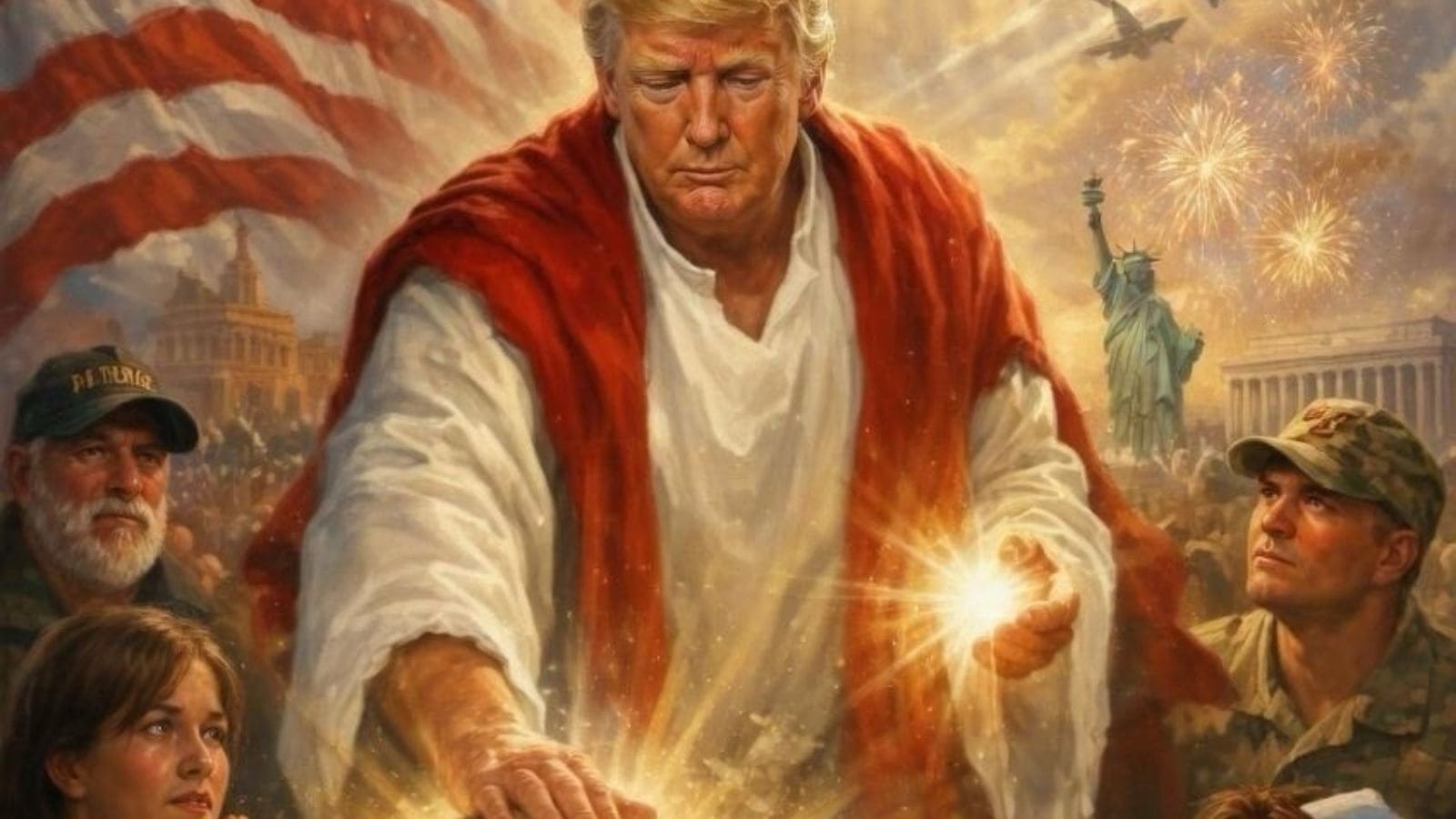
Donald Trump’s recent dissemination of an AI-generated image portraying himself as a messianic figure is not a random act of social media vanity. It is a calculated tactical strike in a broader culture war where the boundaries between political leadership and religious devotion are being intentionally blurred by generative technology. By circulating imagery that blends his likeness with Christ-like attributes, Trump is bypassing traditional gatekeepers of faith and law to establish a direct, emotional tether to his base. This isn't just about a picture. It is about the seizure of symbolic power in an era where truth is increasingly dictated by the visual intensity of the medium rather than the veracity of the source.
The specific image, which surfaced following Trump’s public disagreements with religious figures over legal and social policy, represents a significant escalation in the use of synthetic media for political insulation. While critics view the imagery as blasphemous or desperate, the strategy addresses a specific vulnerability: the need to frame legal challenges not as procedural hurdles, but as a spiritual persecution.
The Synthetic Shield Against Secular Authority
Political branding has moved past the era of the airbrushed headshot. We have entered the age of the synthetic archetype. When Trump shares an image of himself standing alongside a divine figure, he is performing a bypass of the standard political discourse. He is shifting the conversation from policy to identity. This move follows a friction-heavy period where his campaign sought to maintain its grip on the evangelical vote despite critiques regarding his rhetoric and legal standing.
The mechanics of this strategy rely on the "fringe benefit" of AI. Synthetic images allow a candidate to test the waters of extreme iconography without having to commission a human artist or photographer, which provides a degree of plausible deniability. If the backlash is too severe, the image is "just a meme" or "something a fan made." If it lands well, it becomes a new pillar of the digital campaign.
For a veteran observer of the political machine, the intent is transparent. By positioning himself as a figure under divine protection, Trump effectively signals to his followers that any earthly judgment—be it from a court of law or a religious leader—is secondary to a higher calling. It is a potent psychological tactic that turns every legal filing into a trial of faith for his supporters.
Dissecting the Pope Leo Swipe
The catalyst for this latest visual surge was a pointed disagreement involving the legacy of Catholic social teaching and modern law enforcement. Trump’s "weak on crime" critique aimed at figures referencing the tradition of Pope Leo XIII was a daring gamble. Pope Leo is best known for Rerum Novarum, a foundational document that addressed the rights of workers and the duties of the state. By attacking this lineage, Trump risked alienating a specific segment of conservative voters who value the intersection of faith and social order.
The AI-generated image served as the corrective. It functioned as a visual reset, designed to drown out the nuanced theological debate with a blunt, high-contrast emotional signal. It tells the viewer: "Do not listen to the scholars or the critics; look at the man chosen by Providence."
This is the brutal truth of modern political communication. Nuance is a liability. Complexity is a weakness. In the high-speed feed of a smartphone, a single striking image carries more weight than a thousand-page encyclical. Trump understands that his audience is not looking for a policy debate on the history of the Papacy; they are looking for a champion who looks like the heroes they already imagine in their minds.
The Architecture of the Digital Martyr
How does a billionaire from Queens transform into a digital martyr? The process is mechanical. AI tools are trained on vast datasets of classical religious art, meaning they are uniquely predisposed to generate images with specific lighting, poses, and compositions that trigger a sense of "holiness" or "authority" in the human brain.
When an AI model generates an image of Trump in a courtroom, it doesn't just show a man at a table. It uses Rembrandt lighting. It applies the Chiaroscuro effect to create deep shadows and bright highlights, subconsciously linking the subject to the great saints and martyrs of the Renaissance. This isn't an accident of the software; it is a feature of how these models perceive "important people" based on the art history they were fed.
- Subconscious Validation: The viewer sees the image and feels a sense of awe that they cannot quite explain, rooted in centuries of artistic tradition.
- Viral Velocity: These images are designed to be shared. Their high visual fidelity makes them "sticky" in social media algorithms that prioritize engagement over accuracy.
- Iterative Indoctrination: The more often these images appear, the more the distinction between the real man and the digital avatar begins to fade.
The danger here isn't just the misinformation. It is the permanent warping of the political imagination. When we can no longer distinguish between a photograph of a candidate and a digitally manufactured icon, the basis for rational democratic choice begins to crumble. We are no longer voting for a person; we are voting for a prompt.
Religious Leaders and the Fight for the Narrative
The reaction from the religious community has been predictably fractured. Some see the imagery as a harmless expression of support, while others view it as the ultimate form of pride. However, the institutional church faces a unique problem: how do you combat an image?
In the past, a religious leader could issue a statement that would be carried in newspapers and discussed from pulpits. Today, that statement must compete with a viral AI image that has already reached millions of people before the Bishop has even finished his morning coffee. The "weak on crime" swipe was a calculated attempt to put the church on the defensive, forcing them to defend their record while Trump claimed the aesthetic high ground.
The institutional response has often been too slow and too academic. By the time a theological critique of the AI image is published, the image has been remixed, filtered, and reposted ten thousand times. The speed of the synthetic era favors the disruptor, not the defender.
The Legal and Ethical Gray Zone
There is a significant legal vacuum surrounding the use of AI to generate political-religious iconography. Currently, there are few laws that prevent a candidate from using synthetic media to portray themselves in any light they choose, provided it doesn't cross into specific categories of defamation or fraud. However, the ethical implications are staggering.
We are witnessing the birth of Propaganda 3.0. Unlike the posters of the 20th century, which were clearly the work of human hands, AI-generated images possess a "hyper-reality" that can deceive the untrained eye. They carry the weight of a photograph with the flexibility of a dream. If a candidate can manufacture a visual reality where they are divine, where their enemies are literal demons, and where their trials are biblical events, then the traditional tools of fact-checking are rendered obsolete.
You cannot fact-check a feeling. You cannot debunk a metaphor.
The Technological Feedback Loop
The more Trump uses these tools, the more the AI models themselves change. As millions of users generate and share "Trump as Hero" images, those images become part of the training data for the next generation of AI. This creates a feedback loop where the software becomes increasingly proficient at generating this specific type of propaganda.
The technology is not neutral. It is a mirror that reflects the biases and desires of its most active users. In this case, the tools of the future are being used to resurrect the iconography of the distant past, creating a strange, techno-traditionalist aesthetic that serves a very modern political goal.
It is a mistake to view these images as mere jokes or internet culture artifacts. They are the frontline of a new type of psychological operations. In this environment, the "truth" is whatever image manages to stay in the viewer's mind the longest.
The surge of AI in political branding marks the end of the candidate as a person and the beginning of the candidate as a programmable brand. This brand is not limited by the laws of physics, the constraints of biology, or the requirements of traditional morality. It is a brand that can be whatever the algorithm needs it to be to keep the donor clicking and the voter energized.
The real crisis isn't that an AI can make a politician look like a saint. The crisis is that we have reached a point where the public no longer cares that the image is a lie, as long as it confirms what they already want to believe. We are moving into a period where the emotional resonance of a synthetic image outweighs the physical reality of the person it depicts.
For those watching the intersection of faith and power, the warning is clear. When the digital and the divine are merged for political gain, the first casualty is the sanctity of both. The technology to create a god in our own image is finally here, and it is being used to win an election.
The move away from grounded, reality-based campaigning toward a synthetic, icon-driven narrative represents a permanent shift in how power is projected and maintained. This is the new standard. There is no going back to a world where political images were expected to be true. From here on out, the most successful leaders will be those who can most effectively manipulate the digital dreamscape to their advantage, leaving the messy, complicated reality of policy and law far behind.