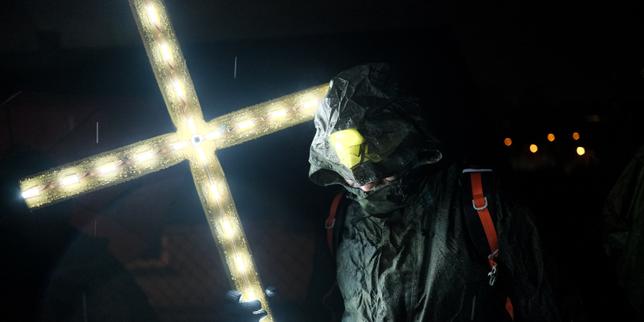
You leave the warmth of a parish church around 8:00 PM on a freezing March night. Your backpack feels heavy. In your hand is a crude, handmade wooden cross. Ahead lies at least 40 kilometers of pitch-black forest paths, muddy fields, and steep hill climbs.
You aren't allowed to talk. You aren't walking in a neat, singing procession. You're completely on your own, guided only by a tiny headlamp beam and a GPS track on your phone.
This is the Ekstremalna Droga Krzyżowa (EDK), or the Extreme Way of the Cross.
What started in 2009 with a handful of people in Kraków, Poland, has exploded into a massive global phenomenon. Well over 100,000 people now lace up their hiking boots every single year just before Easter. They aren't doing it for fitness tracking stats or social media bragging rights. They're looking for a brutal, physical encounter with their own limits.
If you think modern religion has become too soft, commercialized, or comfortable, the staggering popularity of this grueling night march proves that people are actually starving for something that hurts.
The Brutal Anatomy of the Night
The rules of the Extreme Way of the Cross are simple, unforgiving, and explicitly non-negotiable.
To qualify as an official EDK route, the path must be at least 40 kilometers (roughly 25 miles) long. If it's shorter, say 30 kilometers, it must feature at least 500 meters of total vertical ascent. You start after dark, usually following a Friday evening mass, and you walk straight through the night until the next morning.
Standard EDK Minimum Requirements:
- Distance: 40+ Kilometers
- Environment: Off-road terrain (forests, mud, mountains)
- Time: Overnight (typically 8:00 PM to 8:00 AM)
- Core Rule: Absolute, uninterrupted silence
You stop at 14 designated stations along the way. These aren't cozy church altars. A station might be a crumbling stone wayside shrine, a wooden cross tied to a pine tree, or just a specific GPS coordinate in the middle of a swamp. At each stop, you read a short, pre-prepared spiritual meditation on your phone or booklet, pray, and keep moving.
The most shocking part for first-timers is the absolute rule of silence. Group chatting is banned. You don't pass the time making small talk with the person walking next to you. If you go with a friend, you intentionally walk several paces apart.
When you strip away the social distractions, the only things left are the sound of your breathing, the crunch of gravel, and the uncomfortable thoughts you've been avoiding all year.
Why Modern Comfort Breeds a Need for Extreme Pain
It's easy to look at the skyrocketing attendance numbers and wonder why anyone with a warm bed would volunteer for blisters, sleep deprivation, and mild hypothermia.
The founder of the movement, Father Jacek Stryczek, hit on a profound psychological truth when he designed the event. Modern life has engineered pain and discomfort completely out of our daily routines. We live in climate-controlled bubbles, order food with a swipe, and scroll through sanitized feeds.
But our souls aren't built for total comfort.
When your knees ache at 3:00 AM, your feet are soaked through from a muddy bog, and the wind is freezing the sweat on your neck, you drop the ego. You stop pretending you have everything under control. The organizers openly state that the event is designed to break you down physically so that your mental and spiritual armor cracks open.
Many participants aren't regular churchgoers. A lot of them are exhausted professionals, corporate workers, and young people who feel completely disconnected from abstract theological concepts. They don't want to sit in a pew and listen to a lecture about suffering. They want to feel it in their calves and lungs.
Crossing Borders and Breaking Records
Though it began as a deeply Polish tradition rooted in the country's intense Catholic history, the movement has quietly spilled across borders. Official routes are now mapped out in over 18 countries, including Germany, the UK, the United States, Canada, and even Zambia.
The growth curve is wild. Look at how the numbers shifted over the years:
- 2009: A dozen pioneers in Kraków.
- 2015: 11,000 participants.
- 2019: Over 100,000 people registered.
- 2026: Record-breaking turnouts with nearly 2,000 unique routes worldwide.
The routes themselves have evolved from basic trail walks to insanely challenging geographical loops. Some mountain routes in southern Poland require navigating deep snow drifts and frozen rocky passes. Others wind through coastal sand dunes or thick wilderness areas where navigation becomes a genuine safety concern.
Yet, the organizers don't provide support stations. There are no volunteers handing out paper cups of isotonic drinks or shiny space blankets at kilometer 20. If your shoe breaks, you fix it. If you get too tired, you figure out how to call a taxi from a rural dirt road or you keep walking. You're entirely responsible for your own safety.
How to Prepare If You Actually Want to Do This
Don't treat this like a casual weekend stroll. If you don't prepare properly, you're going to end up injured or stranded in the woods at 4:00 AM. Here is the realistic, non-romanticized gear checklist you need to survive the night.
The Gear That Matters
- Footwear: Do not wear brand-new hiking boots. Wear broken-in trail runners or trekking shoes that you know won't destroy your heels by mile ten.
- Layering: You'll sweat heavily on uphill climbs and freeze instantly during the silent reading stops. Pack a high-quality windproof shell and a spare thermal layer in your pack.
- Illumination: A cheap smartphone flashlight won't cut it for a 12-hour night march. Get a dedicated headlamp with at least 300 lumens and pack extra batteries.
- The Cross: It's tradition to carry a physical, wooden cross. Don't make it so heavy that it ruins your shoulders, but don't skip it either—the physical weight is part of the psychological anchor.
Download the official EDK app well before you head out. It contains the verified GPS tracks for your specific route and the year's specific text meditations.
Test your offline maps too. Cell service often drops when you enter deep valleys or dense forests after midnight.
Your main goal on your first night isn't to look heroic or set a speed record. It's simply to maintain the rhythm of the silence, step by step, until the sun finally comes up over the horizon.