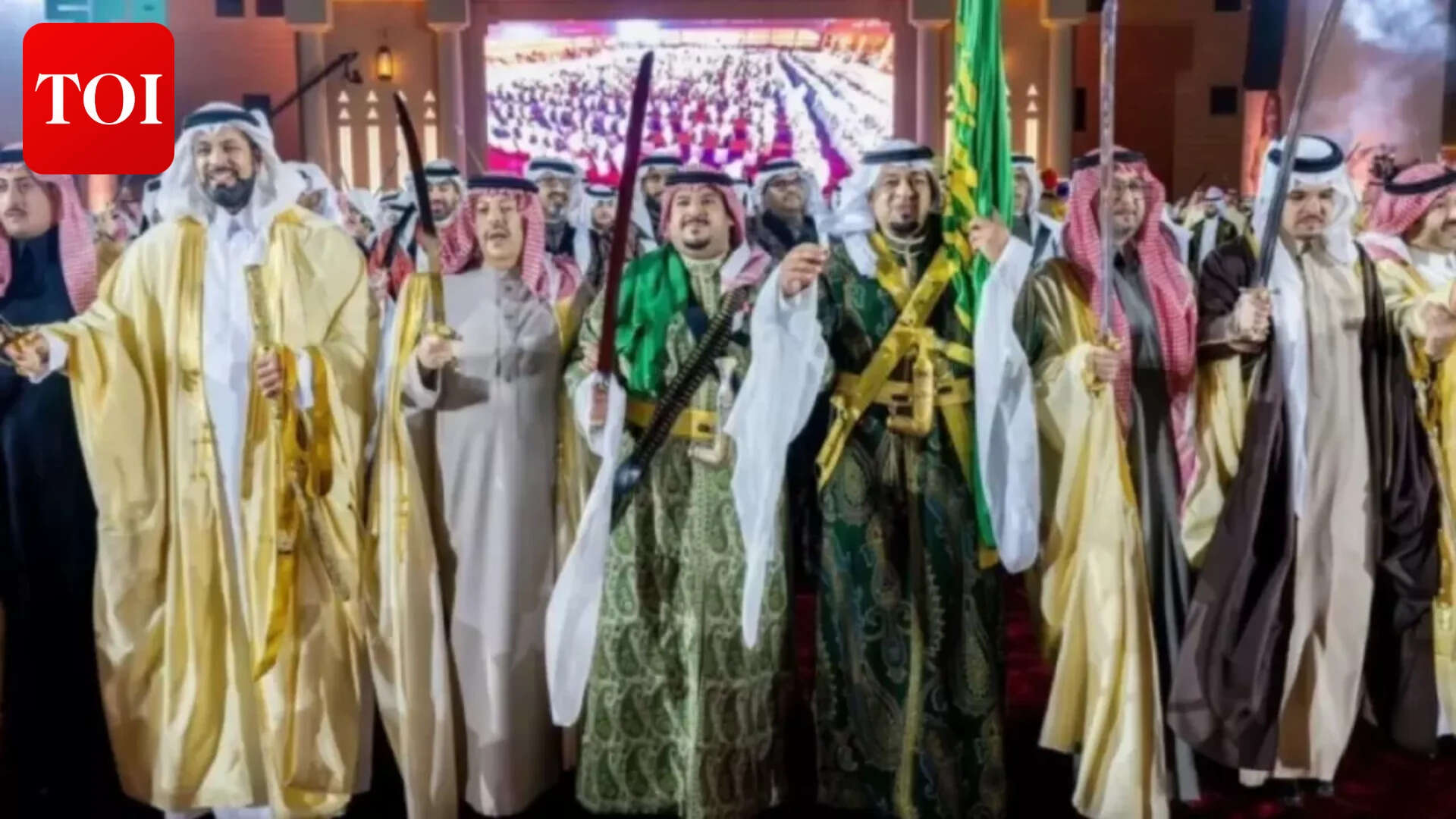
The air in Qasr Al-Hukm doesn’t just carry the scent of oud and coffee. On this particular evening, it carried a vibration. It was a low-frequency hum that started in the soles of your feet and worked its way up to your ribs. This wasn't the mechanical drone of a city or the white noise of a crowd. It was the synchronized pulse of thousands of men, their shoulders locked, their swords catching the amber glow of the palace lights.
They were waiting for the signal.
When the first beat of the takhmir drum finally broke the silence, it didn't just mark the beginning of a performance. It marked the moment a dry news headline about a Guinness World Record became a living, breathing testament to survival.
Most people see the Saudi Ardah and see a "sword dance." They see the long white ghutras, the cross-stitched dakhila, and the rhythmic swaying. But to understand why 500 men—and eventually a record-breaking assembly—gathered at the "Palace of Justice" in Riyadh, you have to understand what it feels like to have your history written in the air with steel.
The Weight of the Blade
Consider a young man named Faisal. He is hypothetical, but his experience is shared by every man who stood in those lines. Faisal works in a glass-and-steel office in North Riyadh, navigating spreadsheets and global markets. He is a product of the future. Yet, when he dons the ceremonial belt and feels the weight of the sword in his hand, the 21st century vanishes.
The sword isn't a prop. It is a memory.
The Ardah began as a war dance, a way for tribes to psych themselves up before a battle and to intimidate the opposition. It was a display of unity so fierce it could stop a conflict before the first blow was even struck. When Faisal stands in the shadow of Qasr Al-Hukm, he isn't just dancing. He is signaling to his ancestors that the thread hasn't broken.
The Guinness World Record attempted to quantify this. They wanted a number. They needed to know how many performers could move as one under the watchful eye of official adjudicators. But how do you measure the tension in a line of men who are reenacting the very foundation of their state?
The record was set with hundreds of performers, but the scale wasn't the point. The precision was. In the Ardah, if one man sways out of time, the entire wall crumbles. It is a metaphor for the social fabric itself. You are only as strong as the shoulder you are leaning against.
A Palace Built on Memory
Qasr Al-Hukm isn't just a backdrop. It is the protagonist of this story. For decades, this site has been the literal and symbolic heart of Saudi governance. It is where the late King Abdulaziz established the foundations of a modern nation. To perform the Ardah here is to dance in the footprints of giants.
The architecture of the palace—massive, earthen-colored, and imposing—creates an acoustic chamber. When the poets begin their verses, the words bounce off the walls, Creating an echo that feels like voices from the past joining the chorus. These poems, known as khalidiya, aren't about trivial things. They are epic chants of loyalty, bravery, and the harsh beauty of the desert.
Imagine the logistical nightmare of coordinating this. It isn't just about putting people in a circle. It involves the muallim, the leader who directs the flow, and the various groups of drummers who provide the heartbeat.
- The takhallul (the small drums) provide the frantic energy.
- The tamer (the large drums) provide the grounding force.
The rhythm is deceptive. It starts slow, almost hypnotic. You think you have the hang of it. Then, the tempo shifts. The swords rise. The chanting grows louder. It becomes a wall of sound that makes the heart skip.
The Invisible Stakes
Why does a record like this matter in an age of digital everything?
There is a quiet fear that haunts every rapidly developing nation: the fear of becoming a "nowhere place." When a city grows as fast as Riyadh, with its shimmering skyscrapers and high-speed rail, the risk of losing the "somewhere" is real. The Ardah is the anchor.
When the adjudicators from Guinness World Records stood there with their clipboards, they were looking for technical compliance. They were checking boxes on duration, synchronization, and participant count. But the men in the square were playing for much higher stakes. They were proving that the "human element" can’t be automated.
You cannot "disrupt" the Ardah. You cannot move it to the cloud. It requires physical presence. It requires sweat. It requires the literal rubbing of shoulders.
In the middle of the performance, the swords are raised toward the sky. It’s a breathtaking sight—a sea of silver reflecting the lights of a city that never sleeps. At that moment, the distinction between the CEO and the student, the old man and the teenager, disappears. They are simply part of the rhythm.
Beyond the Numbers
The official count solidified the record, but the true impact was felt in the silence that followed the final drumbeat. There is a specific kind of quiet that happens after a massive group of people stops moving in unison. It’s a heavy, satisfied silence.
We often get distracted by the "largest" or the "first" or the "most." We look at the Guinness plaque and think the job is done. But the record is just the skin of the fruit. The meat is the fact that in a world of fragmented attention and digital isolation, five hundred men can still find a single heartbeat.
This wasn't a performance for tourists. It wasn't a stunt for social media, though the cameras were certainly there. It was an act of cultural maintenance. Like oiling a machine or watering a garden, the Ardah must be practiced to survive.
Faisal returns to his office the next day. He still has the spreadsheets. He still has the global markets to worry about. But his shoulders feel different. He remembers the vibration. He remembers the weight of the sword. He knows that he belongs to a line that stretches back centuries and, thanks to the energy in the square that night, will stretch forward just as far.
The record is on a wall somewhere. The experience is in the marrow.
The drums will eventually fade, and the palace lights will dim, but the ground in Riyadh still remembers the stomp of a thousand feet. It is a reminder that even as we sprint toward the future, we carry the rhythm of our fathers in our blood, a steady, unyielding pulse that no amount of progress can ever truly silence.
The sword stays sharp, even when it is sheathed.