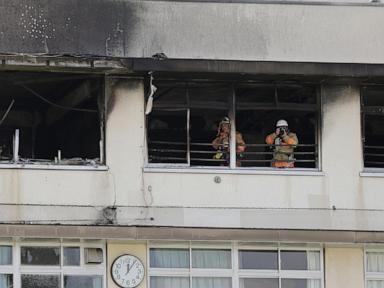
The media framing of the recent evacuation of 300 children and teachers from a Tokyo school fire is fundamentally flawed. Headlines praised the "miraculous rescue" and the flawless execution of standard emergency drills. This narrative is not just lazy; it is dangerous. It celebrates manual compliance while ignoring the systemic failure of modern architectural and automated safety infrastructure that allowed the situation to escalate to a mass evacuation in the first place.
We look at 300 people running into the street and call it a success story because nobody died. That is a low bar. In a technologically advanced metropolis, a school fire should be contained, suppressed, and neutralized long before a chaotic, mass exit of panicked children becomes necessary. The real story here is not the success of the drill. It is the failure of built-in mitigation. Recently making news in related news: The Broken Ink of Muzaffarabad.
The Mirage of Perfect Compliance
Every year, institutions waste thousands of hours training humans to act like predictable algorithms during a crisis. We run the drills. We line up in pairs. We pretend that human panic can be managed by a clipboard-wielding administrator.
Then a real fire breaks out. Further information on this are detailed by The Guardian.
The Tokyo incident showed that while compliance was high, the reliance on human-led evacuation is a ticking time bomb. When smoke fills a stairwell, the human operating system degrades instantly. Cognitive load spikes. Decision-making plummets.
Relying on children and teachers to execute a perfect exit strategy means our engineering has already failed. Safety shouldn't require heroism or flawless discipline. It should be baked into the drywall and the airflow systems.
Passive Containment Over Active Chaos
The obsession with evacuation routes ignores the core principle of modern fire engineering: compartmentation.
In structural design, a building should be a series of sealed boxes. If a fire starts in a science lab or a cafeteria, localized suppression systems and automated, high-rating fire doors should isolate the threat completely. The goal of a smart facility is to keep the fire small, not to make the evacuation big.
Imagine a scenario where a fire breaks out in a server room. Instead of triggering a building-wide alarm that dumps hundreds of students into potentially compromised corridors, the localized HVAC system instantly reverses to starve the room of oxygen while creating negative pressure to prevent smoke migration. The fire dies where it started. The rest of the building continues functioning.
Instead, our current infrastructure relies on primitive detection that triggers total panic. We pull a lever, sound a horn, and hope 300 kids don't trip over each other on the way to the playground. It is an archaic approach disguised as order.
The Flawed Premise of Standard Fire Alarms
People often ask: "How can we make school fire drills faster?"
That is the wrong question. The right question is: "Why are we still using centralized, binary alarm systems?"
The traditional fire alarm is a blunt instrument. It is either on or off. It tells you that there is a fire, but it tells you nothing about where the hazard is or how it is moving. This lack of data creates dangerous bottlenecks. If an alarm sounds and a teacher leads a class down the nearest stairwell, they might be walking directly into a rising column of toxic carbon monoxide.
We need dynamic, data-driven routing. Modern sensor arrays can track heat gradients and smoke density in real time, feeding localized directional data to digital signage. If Stairwell A is compromised, the building itself should actively block entry and redirect occupants via intelligent lighting pathways.
The Cost of the Status Quo
Implementing automated, smart containment and dynamic routing is expensive. Retrofitting older educational structures requires significant capital allocation. It is far cheaper for municipal governments to mandate another round of safety drills and print out updated evacuation maps.
But this cost-saving measure shifts the burden of safety from the infrastructure to the individual. I have analyzed safety protocols across various high-density facilities, and the data is consistent: human error during an active crisis remains the highest risk factor. By refusing to invest in autonomous containment, we are gambling on human perfection under extreme stress.
Stop celebrating the fact that 300 people managed to escape a burning building. Start demanding structures that refuse to let the fire spread in the first place. Fix the architecture, automate the suppression, and stop relying on a clipboard to save lives.


