The water always leaves a mark on the drywall. If you walk through the basement of any home in Terrasse-Vaudreuil, a quiet enclave of two thousand people tucked just west of Montreal, you can see the lines. They are horizontal, tea-colored bands tracking the years the river broke its banks. Three times in recent memory, the residents here have carried their soaked albums and ruined water heaters up into the light.
When a town floods three times in a handful of years, the relationship between human habitation and the natural world stops being an academic debate. It becomes an intimate, visceral reality. You learn that the asphalt cannot save you. You learn that infrastructure is not just concrete pipes and electrical grids.
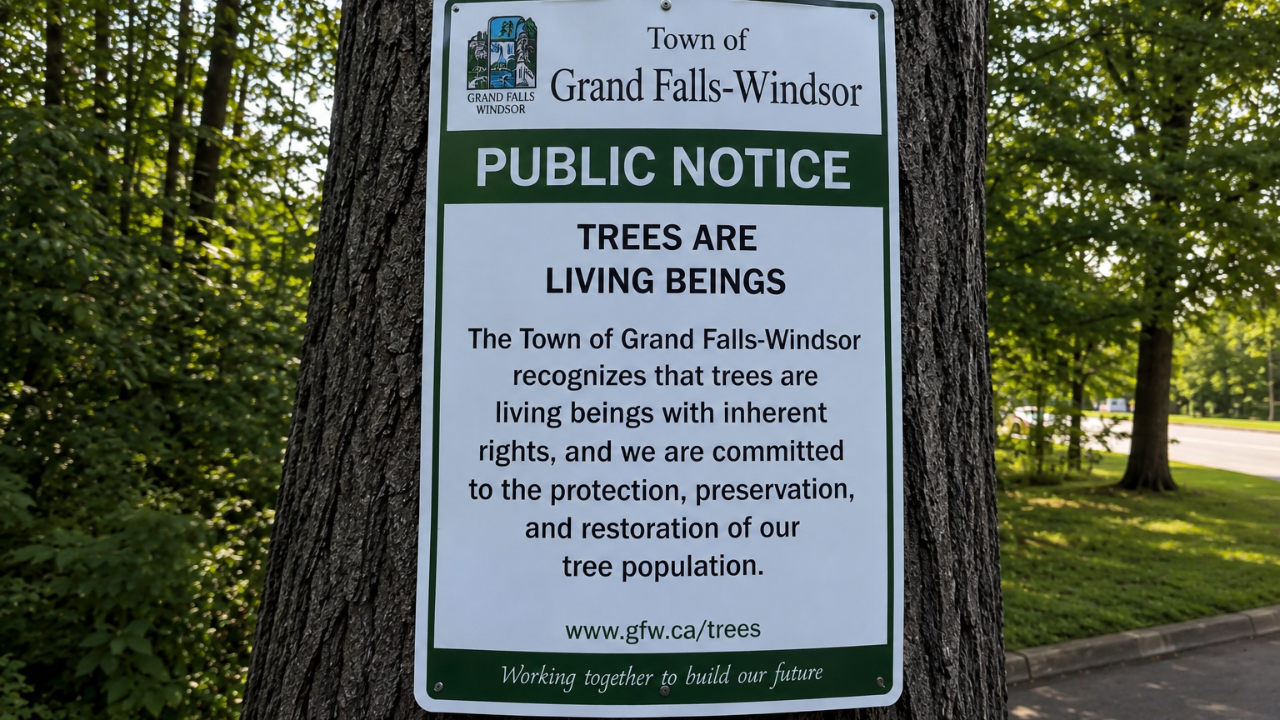
On a humid evening in June, the town’s local council gathered in a room that smelled faintly of damp wood and old paper. They did something that no other municipality in Canada had ever attempted. Led by Mayor Michel Bourdeau, the council voted unanimously to sign the Universal Declaration of the Rights of the Tree.
With a few strokes of a pen, the local government declared that the thousands of maples, oaks, and birches holding the town’s soil together were no longer merely municipal property. They were no longer resource units or aesthetic landscaping assets.
They were recognized as living entities. They were granted the right to life, to natural growth, to integrity, and to regeneration.
The Weight of Standing Still
To understand why a small town would grant legal rights to an oak tree, you have to look at how we have historically viewed anything that cannot speak for itself.
For centuries, our legal systems have been exceptionally generous to artificial creations. A shipping corporation, a tech conglomerate, an investment fund—these are legal persons. They can sue in court. They can own property. They have a protected existence under the law, despite having no pulse, no breath, and no biological reality. They are ghosts engineered out of paperwork.
Yet, a two-hundred-year-old sugar maple that anchors the hillside, filters forty thousand gallons of rainwater a year, and cools a whole neighborhood during a scorching July heatwave has traditionally possessed the same legal status as a discarded plastic lawn chair. It is an object. If a developer wishes to scrape it away to widen a driveway, the tree has no inherent right to exist. Its value is calculated purely by what it costs to log it or replace it.
Karine Péloffy, an environmental lawyer who has spent years analyzing the gaps in how we protect our environment, points out the absurdity of this imbalance. If a boardroom of executives who have never seen a town can hold legal personhood, why should a living organism that stabilizes the very ground we walk on be denied it?
Consider what happens when we look at a forest not as a collection of wood, but as a community.
The shift in perspective in Terrasse-Vaudreuil did not happen because of a legal textbook. It happened because of art. A local filmmaker named André Desrochers screened a documentary for the townspeople titled Des arbres et des arts. The film translated what botanists have been whispering into academic journals for decades: trees feel. Not with human sentiments, but with physiological senses. They communicate through subterranean fungal networks, warning neighboring saplings of insect attacks. They share sugars. They keep ancient stumps alive through root grafts, acting as a collective organism.
The citizens sat in the dark, watching the screen, and then they looked out their windows at the woods surrounding their properties. The realization was quiet but massive. The trees were not just background decoration. They were neighbors.
The New Math of a Small Town
When a town has no vacant land left to build on, its priorities shift. Terrasse-Vaudreuil is physically maxed out. There are no more open fields to pave over, no more sprawling developments to approve. The town is defined entirely by what it already has: its homes, its people, and its canopy.
Mayor Bourdeau does not talk about the new resolution with the airy romanticism of a mystic. He speaks with the pragmatic urgency of a man who has had to manage emergency municipal budgets after a climate disaster.
The old way of thinking viewed trees as a liability. They drop leaves that clog storm drains. Their roots crack old ceramic sewer pipes. They drop limbs during ice storms, knocking out power lines. In the traditional municipal ledger, trees are expensive to maintain and cheap to cut down.
The new resolution flips the ledger entirely.
The town is currently auditing every single one of its bylaws to align with the new declaration. Under the new framework, if a tree must be cut down for essential public safety, it cannot simply be erased from the map. It must be replaced, or its loss must be mitigated through a rigorous calculation of what that specific organism contributed to the community's survival.
The municipality is treating the canopy as green infrastructure. A mature tree is a living sponge. When rain hits a paved street, it rushes into the drainage system, overwhelming the pipes and flooding the basements. When rain hits a forest canopy, the leaves slow the descent, and the massive root systems drink thousands of liters before the water ever touches the street.
The trees are the defense line against the fourth flood.
When the Law Meets the Soil
Giving rights to nature sounds like a recipe for administrative gridlock. Critics immediately wonder if weeding a garden or mowing a lawn will soon be classified as an assault on a sapling. If a wild seedling sprouts in the middle of a soccer field, does the town have to relocate the match?
But the reality of implementing tree rights is less about courtroom drama and more about everyday municipal choices. It forces a pause.
In most North American towns, when a new utility line needs to go into the ground, the path chosen is the straightest line between two points. If that line passes through the root zone of a century-old oak, the roots are hacked away, and the tree dies five years later from structural rot. Under the new framework, the town must consider the tree’s right to integrity. The utility trench must be rerouted or bored underneath the roots. The extra cost of the construction is balanced against the massive cost of losing the tree's ecological services.
It is an exercise in solidarity. The town has committed to offering free trees to residents to plant on their private properties, deliberately expanding the canopy from the bottom up. They are treating the town’s ecosystem as a shared asset, a common good that requires human protection because our survival is hitched to theirs.
The shift is hard to quantify on a balance sheet, but you can feel it in the air. On a hot summer afternoon, the temperature difference between a street lined with mature maples and a bare concrete parking lot can be as much as twelve degrees. That difference is not just about comfort; it is about survival for elderly residents who cannot afford continuous air conditioning. The trees are providing public healthcare, free of charge, every single day.
The Standing Majority
The legal shift occurring in this small pocket of Quebec is not an isolated quirk. It is part of a slow, tectonic movement occurring across the globe. In New Zealand, the Whanganui River was granted legal personhood after a decades-long struggle by the Māori people. In Colombia, the Amazon rainforest was declared an entity possessing rights.
For generations, Western law has operated on the assumption that nature is an infinite pharmacy, a timber yard, and a dump. We are realizing, through the blunt force of changing climates, that this model is broken.
Terrasse-Vaudreuil is a tiny community, but its experiment is a template. It proves that a community does not need a federal mandate or an international treaty to change how it interacts with the earth. It can happen at a Tuesday night council meeting in a room filled with ordinary citizens.
If you walk through the town today, past the houses that still carry the invisible scars of the old floods, the woods feel slightly different. The great oaks stand tall along the avenues, their leaves catching the breeze from the river. They are no longer just scenery. They are citizens who cannot walk, recognized at last by the citizens who can.


