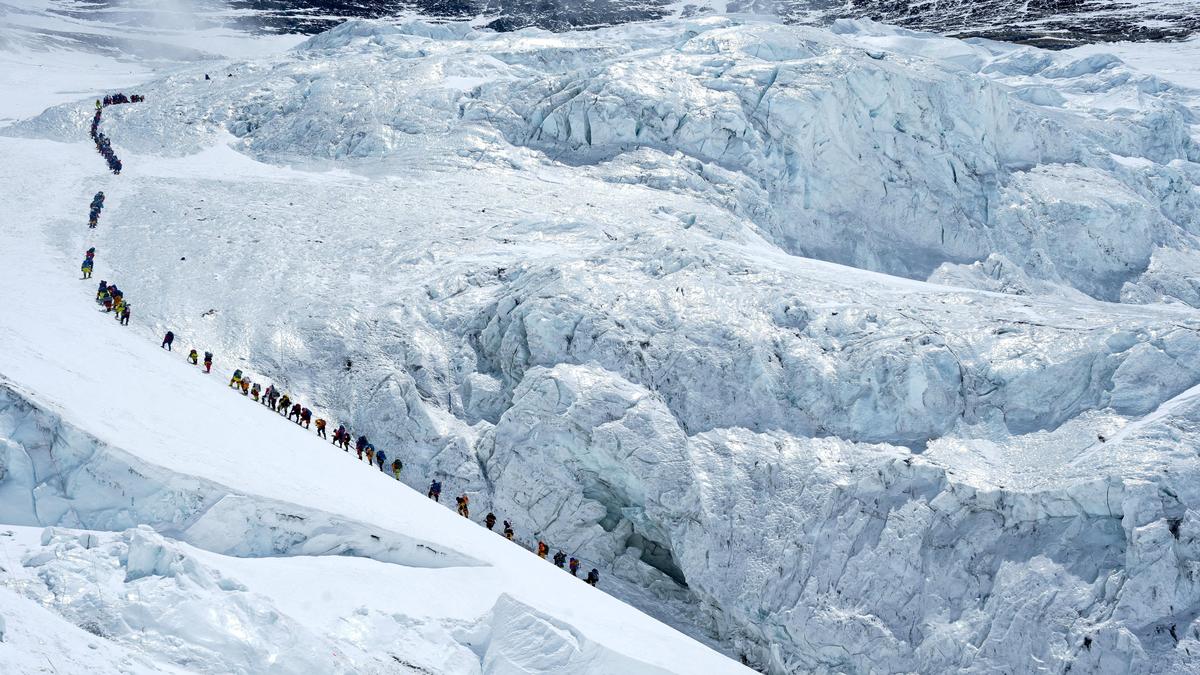
The ice behaves differently when it is crowded.
Under the weight of a single boot, the frozen crust of the Khumbu Icefall emits a sharp, metallic crack—a warning. But under the rhythmic, unrelenting thud of hundreds of boots, the mountain stops warning you. It vibrates. The sound becomes a low, continuous hum that rattles through the marrow of your teeth.
You are standing at 26,000 feet, gripped by a cold so absolute it feels less like a temperature and more like a physical assault. Your world has shrunk to the exact width of a three-inch nylon fixed line. Ahead of you, a neon puffer jacket stalls. Behind you, another presses against your backpack. You cannot turn around. You cannot sit down. To step off the line is to die. To stay on it is to wager your life against the capacity of a green steel cylinder strapped to your spine.
On a single Tuesday, Nepal’s Department of Tourism confirmed that 274 human beings stood on the apex of the world within a twenty-four-hour window. It is a record that should evoke awe. Instead, it evokes a quiet, suffocating terror.
To understand how we arrived at this vertical gridlock, you have to look past the glossy brochures of expedition agencies. You have to understand what happens to the human psyche when the ultimate symbol of wild, untamable earth is transformed into a highly organized, dangerously packed queue.
The Economics of the Death Zone
Mountaineering used to be an exercise in isolation. Today, it is an exercise in logistics.
Consider a hypothetical climber named Robert. He is a forty-five-year-old software executive from Chicago. He has spent eighty thousand dollars and trained for three years to get here. Robert is not an elite Alpinist; he is a man of immense willpower and considerable resources. In his mind, he is re-enacting the lonely, heroic struggles of George Mallory or Tenzing Norgay.
But the reality of modern Everest means Robert is part of an economic engine that cannot afford to stop turning.
The Nepalese government issued hundreds of permits for the spring climbing window, each costing thousands of dollars. When the meteorological reports finally flash a brief, precious window of clear weather—low winds, clear skies—every single expedition leader makes the exact same calculation at the exact same moment.
"We go tonight."
When everyone goes tonight, the mountain shrinks. The South Col, a desolate high-altitude plateau that serves as the final launching pad for the summit, suddenly resembles a crowded festival campground.
The bottleneck begins at the Hillary Step, a near-vertical rock face just below the summit. In the old days, climbing this was a technical feat. Today, it is a waiting room. Imagine waiting for a subway train in a blizzard, except the train is a snow-covered ridge and if you drop your mitten, you lose your fingers.
Every minute Robert spends waiting for the climber ahead of him to clear an anchor point is a minute his bottled oxygen levels tick downward. The math is brutal and unyielding. A standard cylinder lasts roughly five to seven hours at a normal climbing pace. When you are standing still, shivering so violently your core temperature drops despite your down suit, your body burns fuel at an alarming rate just to stay conscious.
The danger isn't the mountain anymore. It is the crowd.
The Illusion of Safety
There is a dangerous psychological phenomenon known as the "social proof" of safety. When we see hundreds of people doing something inherently perilous, our brains trick us into believing the peril has been engineered away.
We look at the fixed ropes, the rows of yellow tents, the Sherpa guides moving with the casual grace of construction workers on a skyscraper, and we forget where we are. We forget that above 8,000 meters, the human body is actively dying. The air contains only one-third of the oxygen available at sea level. Without supplemental gas, your brain swells. Your lungs fill with fluid. Your decision-making capacity degrades to that of a severely intoxicated toddler.
But because there are 273 other people on the ridge, you believe you are safe.
This illusion is what leads to the staggering statistics we see today. The fact that 274 people reached the top in a single day is a testament to the extraordinary strength and skill of the Sherpa guides who fix the routes, carry the loads, and literally pull clients toward the sky. It is not a testament to the safety of the mountain.
The physical reality of that day was not a triumphant march. It was a slow, agonizing shuffle. Climbers reported waiting in lines for over three hours in the Death Zone. In those hours, the margin for error evaporated. If a storm had rolled in unexpectedly—as it did in 1996, the year immortalized in Jon Krakauer's Into Thin Air—the death toll would not have been counted on one hand. It would have been a catastrophe of historic proportions.
We are gambling against the weather, using human lives as chips, relying on the assumption that the sky will remain blue just long enough to get everyone down.
The View from the Top
What do you actually see when you reach the summit of Everest on a day when 273 others do the same?
You don't see the curve of the earth in splendid isolation. You see the back of someone else's helmet. You see a frantic scramble to take a selfie before the next guide gently but firmly pushes you aside to make room for the person behind you. You have perhaps ten minutes to absorb the fact that you are standing on the roof of the world before the reality of the descent crashes down on you.
Because getting to the top is only half the journey.
Most fatalities on Everest happen on the way down. Gravity, exhaustion, and depleted oxygen reserves conspire against the human frame. When you turn around to head back down the knife-edge ridge, you face the oncoming traffic of the people who are still climbing up.
Two human beings, bulky in their down gear, must press chest-to-chest over a drop of ten thousand feet, unclipping and reclipping their safety carabiners around each other on a single rope. One mistake by a panicked, hypoxic climber can drag multiple people into the abyss.
This is the hidden cost of the record books. The achievement is no longer about conquering nature; it is about surviving the human infrastructure we have built upon it.
The sun dips below the horizon, casting long, purple shadows across the Tibetan plateau. The neon line of climbers slowly winds its way back down to the tents of Camp IV. The mountain, briefly conquered by numbers, returns to its silent, frozen state.
In the medical tents at Base Camp, the frostbite is assessed. The empty oxygen bottles are stacked in piles. The checks have cleared, the certificates will be issued, and the record books will update their pages with the number 274.
But high on the ridge, where the wind strips the snow down to the black, ancient rock, the mountain remains indifferent to our records. It doesn't care about our permits, our technology, or our ambition. It simply waits for the next clear morning, when hundreds more will step onto the thin nylon line, hoping their oxygen lasts longer than the queue.