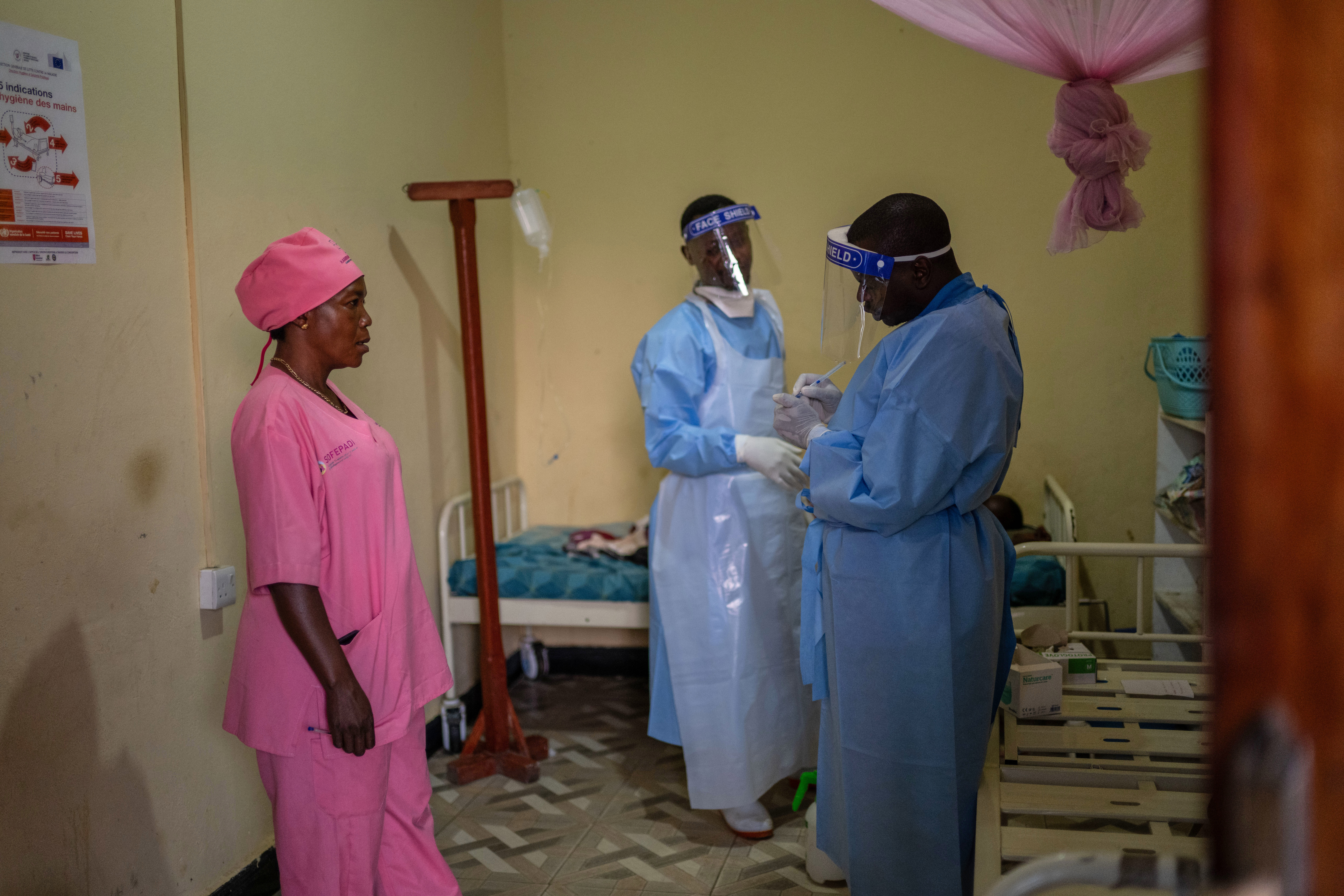
The current containment strategy for the Bundibugyo ebolavirus outbreak in the eastern Democratic Republic of the Congo (DRC) is structurally compromised. While international response frameworks are built around the deployment of specialized medical assets and financial capital—such as the $112 million committed by the United States and immediate medical aid from the European Union—the epidemic is expanding at a velocity that exceeds the operational capacity of these interventions. With official figures indicating over 900 suspected cases and more than 220 deaths across Ituri, North Kivu, and South Kivu provinces, internal modeling suggests the true scale of infection may be three to four times higher than reported. This divergence between observed data and reality is not merely a function of delayed reporting. It represents a fundamental breakdown in epidemic containment mechanics, driven by a zero-vaccine biomedical baseline, active kinetic conflict, and a catastrophic failure rate in contact tracing infrastructure.
The Baseline Crisis: The Mathematical Certainty of Unthttp://googleusercontent.com/image_content/214
reated Pathogens
Epidemic containment relies on reducing the effective reproduction number ($R_t$), defined as the average number of secondary cases generated by a single infectious individual at time $t$. To achieve eradication, interventions must drive $R_t$ below 1. In previous Zaire ebolavirus outbreaks, public health agencies achieved this by leveraging highly effective vesicular stomatitis virus-eboravirus (ERVEBO) vaccines to create rings of immunity around identified cases.
The Bundibugyo strain presents a fundamentally different mathematical problem. There are currently no approved vaccines or targeted therapeutic interventions for this specific viral variant. Without a biomedical mechanism to artificially reduce the pool of susceptible individuals ($S$), containment is entirely dependent on non-pharmaceutical interventions (NPIs). Under these conditions, the transmission equation simplifies to a pure function of contact rates ($c$) and the probability of transmission per contact ($p$):
$$R_t = c \times p \times d$$
where $d$ represents the duration of infectivity.
Because the biomedical baseline provides no reduction to $p$ via immunization, the entire containment apparatus must force $c$ toward zero through strict isolation, quarantine, and contact tracing. When these operational levers fail, exponential growth becomes mathematically locked in.
The Contact Tracing Bottleneck: Logistical Choke Points in Field Surveillance
The primary mechanism for reducing contact rates ($c$) is rigorous contact tracing, which seeks to identify, test, and isolate individuals within the transmission chain before they become infectious. Field data reveals an operational collapse at this specific choke point. Internal coordination metrics indicate that out of more than 1,200 identified high-risk contacts, only 7% were actively located and monitored within the critical surveillance window.
This operational deficit is driven by three distinct systemic friction points.
Population Mobility and Economic Imperatives
The Ituri province and adjacent Kivu regions function within a highly fluid informal economy characterized by intense cross-border migration, artisanal mining operations, and regional trade networks. When health agencies mandate 21-day isolation periods without providing localized economic safety nets, individuals face a choice between compliance or economic destitution. Consequently, high-risk contacts frequently migrate out of primary surveillance zones to maintain subsistence income, completely severing the tracking thread.
The Asymmetric Testing Deficit
Active surveillance requires decentralized, rapid diagnostic capability to differentiate Bundibugyo infections from endemic febrile illnesses such as malaria or typhoid. The centralization of molecular testing facilities in major urban hubs like Bunia introduces a logistical lag. Swabs collected in peripheral health zones face transit delays over degraded infrastructure, creating a multi-day diagnostic blind spot. During this window, unconfirmed patients either remain in general ward settings—accelerating nosocomial transmission—or return to their communities while highly infectious.
The Velocity Inversion
For an intervention to successfully suppress an epidemic, the velocity of the response ($V_r$) must exceed the velocity of viral transmission ($V_t$). When contact tracing efficiency drops to single-digit percentages, the virus achieves a velocity inversion. Each unmonitored contact who transitions to an active, infectious state multiplies the required surveillance field exponentially, ensuring that fixed-capacity response teams fall progressively further behind the transmission curve.
Geopolitical Friction and Frontier Closures
As the virus breaches borders, neighboring nation-states routinely implement unilateral travel restrictions and border closures. Uganda has already logged confirmed cases, prompting immediate border management escalations across the East African region. Concurrently, international policies have restricted travel for non-citizens originating from the affected zones.
Strategic analysis of past public health emergencies demonstrates that absolute border closures fail to contain filovirus transmission. Instead, they produce severe negative externalities that actively accelerate regional transmission.
Border closures do not halt human movement; they shift it from formal, monitored entry points to informal, unmonitored border crossings. This movement renders screening protocols—such as thermal scanning and symptom checklists—completely obsolete, meaning individuals incubating the virus cross frontiers without entering surveillance registries.
Furthermore, sealing international borders creates strong disincentives for regional transparency. When sovereign states anticipate severe economic penalties and isolation as a consequence of reporting infections, local authorities are incentivized to underreport cases or delay data sharing. This degrades the fidelity of the global epidemiological map, preventing the proactive allocation of resources to emerging hot spots.
Kinetic Conflict as an Epidemiological Multiplier
The eastern DRC is a highly volatile security environment characterized by active military operations and shifting territories controlled by non-state armed actors, including the Allied Democratic Forces (ADF) and the M23 rebel group. The intersection of kinetic warfare and outbreak dynamics transforms conflict zones into epidemiological accelerators.
Civilian displacement driven by military maneuvers forces large populations into high-density, poorly sanitized internally displaced person (IDP) camps. These environments feature elevated contact rates ($c$), driving up $R_t$ independently of biological mutations.
Furthermore, armed conflict physically restricts the geographic reach of epidemiologists. Massive swathes of territory controlled by rebel factions are completely inaccessible to international health workers or government surveillance teams. When the virus enters these security vacuums, it replicates unchecked, establishing hidden reservoirs of infection that periodically spill back into secured urban centers via displaced populations.
[Kinetic Conflict]
       │
       ├─► Civilian Displacement ──► High-Density IDP Camps ──► Elevated Contact Rates (c)
       │
       └─► Geographic Isolation ──► Security Vacuums ────────► Hidden Viral Reservoirs
This dynamic is severely compounded by acute community mistrust, which frequently manifests as overt hostility toward medical personnel. Stringent biosecurity protocols designed to halt post-mortem transmission—such as secure, formalized burials—directly disrupt deeply embedded local funerary traditions that emphasize physical contact with the deceased.
Because deceased Ebola victims possess an extraordinarily high viral load, traditional washing and burial practices represent peak transmission events. However, when external health interventions impose biocontainment measures without deep, culturally aligned mediation, communities interpret these actions as desecration. This friction has resulted in at least three coordinated kinetic attacks on health infrastructure and isolation facilities in Ituri, forcing emergency teams to evacuate and leaving active transmission chains unmonitored.
Re-Engineering the Intervention Architecture
To arrest the expansion of the Bundibugyo outbreak, the response model must shift away from centralized, asset-heavy resource drops toward a decentralized, friction-minimizing operational architecture.
First, public health capital must prioritize the immediate field deployment of point-of-care molecular diagnostics to eradicate the diagnostic lag time. Testing must occur at the initial point of triage in peripheral health zones, rather than at centralized facilities in Bunia.
Second, isolation protocols must be structurally coupled with direct economic compensation, specifically targeted food security and cash transfers managed by organizations like the World Food Programme. By eliminating the economic penalty of compliance, public health agencies can stabilize high-risk populations and lower the attrition rate in contact tracing lines.
Finally, border management strategies must pivot from punitive closures to high-throughput, cooperative biosecurity corridors. Neighboring states must maintain open commercial lanes contingent upon shared, standardized pre-departure testing protocols and synchronized contact data systems. Punitive isolation must be discarded in favor of transparency, or the virus will continue to leverage the region's geopolitical and social fractures to outpace global containment efforts.