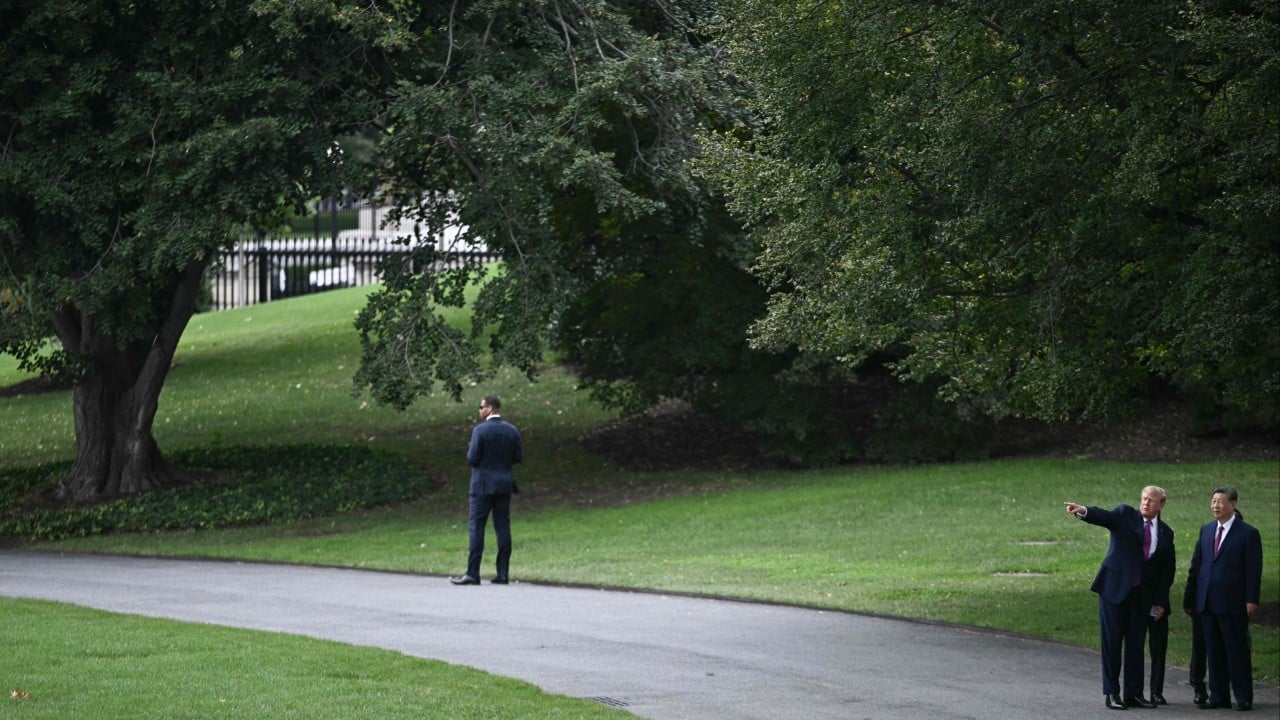
The mainstream press watched Donald Trump walk Xi Jinping through a White House construction zone and immediately reached for the lowest-hanging fruit. They called it tacky. They called it self-absorbed egoism. They framed it as a reality television host turning statecraft into a tacky real estate infomercial. They missed the entire point because they refuse to understand how power actually communicates in the physical world.
When you invite the supreme leader of your primary geopolitical adversary into a half-built concrete shell on the executive grounds, you are not showing off interior design choices. You are flashing structural staying power.
Architectural diplomacy is not a modern invention. From Louis XIV at Versailles to the monolithic monuments of Soviet Moscow, leaders have always used bricks, steel, and mortar to intimidate rivals. When a superpower boss walks a visiting head of state through a chaotic, messy, active construction site, the subtext is brutal and unmistakable: We are tearing down our past to rebuild our future while you are stuck managing managed decline.
The lazy consensus treats this encounter as a bizarre anecdote. It was actually a masterclass in hard-hat psychological warfare.
The Architecture of Intimidation
For decades, foreign policy has been dominated by smooth-talking diplomats in muted suits whispering vague threats across mahogany tables. This is sanitized, bloodless theater. It allows bureaucratic states to hide their decay behind polite communiques and rehearsed handshakes.
Trump bypassed the diplomatic corps entirely and took Xi to where the dust was flying.
Think about what an active construction site represents. It means disruption. It means noise, capital expenditure, and raw industrial muscle. It means an institution is actively altering its physical footprint in real time. For a leader like Xi Jinping—who presides over a nation obsessed with massive infrastructure projects, high-speed rail networks, and hyper-accelerated urban expansion—concrete and steel speak a language far louder than any joint statement on trade deficits or maritime rights.
Xi understands infrastructure because Beijing built its entire modern economic miracle on top of it. When Trump showed him a ballroom under construction, Xi did not see a vanity project. He saw a government that refuses to fossilize.
Why Show Construction Instead of Completion?
A finished building is a static monument. It tells the viewer what already happened. It belongs to history.
A construction site is a dynamic threat. It tells the viewer what is coming next.
If Trump had walked Xi through a completed, gilded ballroom with polished chandeliers and velvet ropes, the messaging would have been weak. It would have communicated preservation, luxury, and complacency. It would have invited comparisons to the palaces of declining empires.
A construction site communicates something entirely different. It signals aggression, renewal, and financial liquidity. It says: This state has the cash, the bureaucratic override power, and the sheer audacity to rip up the Executive Mansion while running a global superpower.
In high-stakes negotiation, showing your opponent the mess you are making is a flex. It declares that you are not afraid of chaos. While foreign diplomats panic over regulatory compliance and administrative continuity, Trump treated the most famous house on earth like a fixer-upper project. That kind of casual disregard for institutional sacredness rattles foreign adversaries who rely on predictable, procedural bureaucracy.
The Chinese Communist Party Understands This Better Than Anyone
Western pundits laughed because they viewed the White House through the lens of American domestic political optics. They worried about the aesthetics, the cost overruns, or the breach of protocol.
They forgot who they were hosting.
The Chinese Communist Party built its legitimacy on physical transformation. Entire mega-cities rise from empty agricultural fields in a matter of years. To Beijing, political will is measured in cubic yards of poured concrete. When Xi Jinping stood in that construction zone, he was looking at an American president doing on a micro scale what Beijing does on a macro scale: overriding the inertia of the status quo to impose a physical vision on the landscape.
You do not impress the ruler of a hyper-industrialized manufacturing giant by showing him a nice painting. You impress him by showing him that you still know how to swing a sledgehammer in your own capital.
The media spent days mocking the absurdity of the tour. Beijing noticed the operational capacity. There is a vast chasm between mocking a leader's taste and respecting his ability to mobilize resources. Xi belongs to a political culture that respects raw muscle. The construction site delivered that message without a single translator needing to open a dictionary.
The Myth of the Superficial Ego Trip
The core error of modern political commentary is the assumption that everything Trump does is driven purely by personal vanity. It is a comforting narrative for critics because it reduces complex geopolitical signaling down to psychological flaws they think they can mock.
It is also dangerously naive.
Every major real estate project undertaken by a sitting head of state is an assertion of sovereign dominion. When the executive branch remodels its own home, it is sending a signal to domestic rivals and foreign enemies alike: We own this space, we are altering it, and we do not need your permission.
Consider the alternative. Imagine a modern administration trapped in paralyzed reverence for historic preservation, unable to change a lightbulb without a multi-year environmental impact study and a congressional subcommittee hearing. That is the picture of a sclerotic empire. That is what managed decline looks like.
When a leader guts a building while hosting the world's most formidable authoritarian rival, he is performing an intentional subversion of institutional calcification. He is showing that the machinery of state power remains flexible and responsive to executive will.
Dismantling the Bureaucratic Mindset
The deep state hates construction because construction breaks rules. It requires permits to be fast-tracked, historical boards to be ignored, and contractors to be brought in who care more about deadlines than bureaucratic etiquette.
By dragging Xi Jinping into the middle of that operational chaos, Trump symbolically weaponized American entrepreneurial grit against Chinese state capitalism. He was saying, in effect: You might build ghost cities across the Gobi Desert, but I can tear up the center of American power on a whim and rebuild it to my own specifications.
It is a style of diplomacy rooted in tangible reality rather than abstract diplomacy. Words are cheap. Treaties are broken. Trade agreements are rewritten. But a reinforced concrete foundation poured in the heart of Washington, DC, is an undeniable physical fact.
Critics called it a distraction. They were right, but not in the way they thought. It distracted the foreign delegation away from the tired talking points of traditional statecraft and forced them to engage with the raw, chaotic energy of American renovation.
The Reality of Power Projection
We live in an era obsessed with virtual signaling, digital diplomacy, and algorithm-driven public relations. We expect our leaders to fight their battles on social media feeds and television screens.
Trump’s tour of the White House construction project rejected that ethereal nonsense entirely. It dragged foreign policy back into the physical realm. It reminded everyone involved that global power ultimately belongs to those who control physical space, allocate physical resources, and possess the audacity to break things in order to build something bigger.
The commentators who laughed at the hard hats missed the plot. They were looking at the drywall dust while Xi Jinping was reading the blueprints.
Power does not whisper in a clean room. It makes noise, it makes a mess, and it leaves the rest of the world wondering what you are going to tear down next.