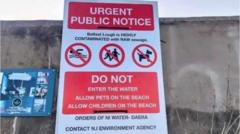
You might've seen the posters. They’re hard to miss, plastered around the banks of Lough Neagh with stark warnings about raw sewage and "official" looking government logos. They look real. They sound urgent. But according to Andrew Muir, the Agriculture, Environment and Rural Affairs Minister, they’re complete fakes.
This isn't just a case of some kids with a printer. It’s a sign of how desperate and angry people have become about the state of our water. When the government doesn't move fast enough, the public starts taking the messaging into their own hands. It's messy. It's confusing. And frankly, it's a bit of a PR disaster for the Department of Agriculture, Environment and Rural Affairs (DAERA).
Minister Muir Denies Official Status of Sewage Signs
The posters appeared recently, looking for all the world like official health and safety notices. They warn swimmers and boaters about the presence of untreated waste in the water. Naturally, people got worried. They started calling the department, asking if the water was finally being officially declared a biohazard.
Minister Muir had to step up to clarify that his department didn't put them there. He called them "unauthorized" and warned that they could be misleading. Here’s the thing though—while the posters themselves might be "fake" in a legal sense, the sentiment behind them is rooted in a very ugly reality. People are tired of the blue-green algae. They’re tired of the "do not swim" advice that seems to be permanent.
If you’re standing on the shore of Lough Neagh, does it really matter if the warning sign has the right government stamp? If the water is toxic, it’s toxic. The minister's focus on the "authenticity" of the paper and ink feels like missing the forest for the trees. It’s defensive. It’s the kind of bureaucratic response that makes people even more cynical.
Why the Public Is Taking Branding Into Their Own Hands
Why go to the trouble of designing and laminating fake signs? Because the official communication has been lackluster. For years, the issues at Lough Neagh have been treated like a technical glitch rather than an ecological emergency.
The public is using "guerrilla marketing" to force a conversation. By mimicking official branding, these activists are poking the bear. They’re forcing the Minister to talk about sewage. Even if he’s only talking about it to say "we didn't print that," he’s still saying the words "raw sewage" in a public forum. That’s a win for the activists.
We've seen this before in other environmental protests. When the authorities won't post the warning, the neighbors will. It creates a weird informational vacuum where you don't know who to trust. Do you trust the guy in the suit saying everything is under control, or the anonymous poster that looks like it was made by someone who actually lives near the water?
The Actual State of Water Quality at Lough Neagh
Let’s get into the weeds. Or rather, the algae. The blue-green algae crisis at Lough Neagh isn't a mystery. It’s the result of decades of nutrient runoff, mostly from agriculture and failing wastewater infrastructure.
- Nitrogen and Phosphorus: These are the main culprits. They come from fertilizer and animal waste. When it rains, it washes into the Lough. It’s basically rocket fuel for algae.
- Wastewater Treatment: Some of our systems are old. Really old. When we get heavy rain, these systems overflow. That’s where the "raw sewage" claims come from. It’s not a constant stream, but it happens often enough to be a massive problem.
- Climate Change: Warmer water temperatures mean the algae stays longer and grows faster. It’s a perfect storm.
The DAERA has its 100-point plan. They talk about "long-term strategies" and "stakeholder engagement." But if you’re a local business owner or someone who just wants to take their dog for a walk, those words don't mean much. You see green sludge. You see dead fish. You see "unofficial" signs because the official ones are too busy being polite.
What This Means for You if You Visit the Lough
If you’re heading down to the water, you need to be smart. Don't wait for a sign—official or otherwise—to tell you what your eyes can see.
- Check the water: If it looks like pea soup or has a thick scum on top, stay out. Don't let your pets drink it. Don't let them even touch it.
- Look for official DAERA updates: Despite the drama over the posters, the department does post water quality data online. It might be buried in a PDF, but it’s there.
- Report what you see: Don't just post a photo on Facebook. Use the "Northern Ireland Environmental Agency" (NIEA) reporting app. If they get flooded with reports, they can't ignore the scale of the problem.
The "fake" posters are a symptom of a broken trust between the people and the planners. Minister Muir can tear down the signs, but he can't tear down the public’s perception that the water isn't safe. Until the actual pollution stops, expect to see more of this. Expect more "unauthorized" truth-telling.
The next time you see a sign that looks a bit off, don't just dismiss it. Ask why someone felt the need to put it there. They aren't doing it for fun. They're doing it because they feel like nobody else is watching out for them.
The government needs to stop worrying about the font on the posters and start worrying about the toxins in the water. That’s the only way the fake signs will ever truly go away. Check the NI Direct website for the latest official bathing water quality results before you even think about getting your feet wet.
Stay away from any water that looks discolored or smells. If you see an algal bloom, report it immediately to the NIEA emergency pollution hotline at 0800 80 70 60.