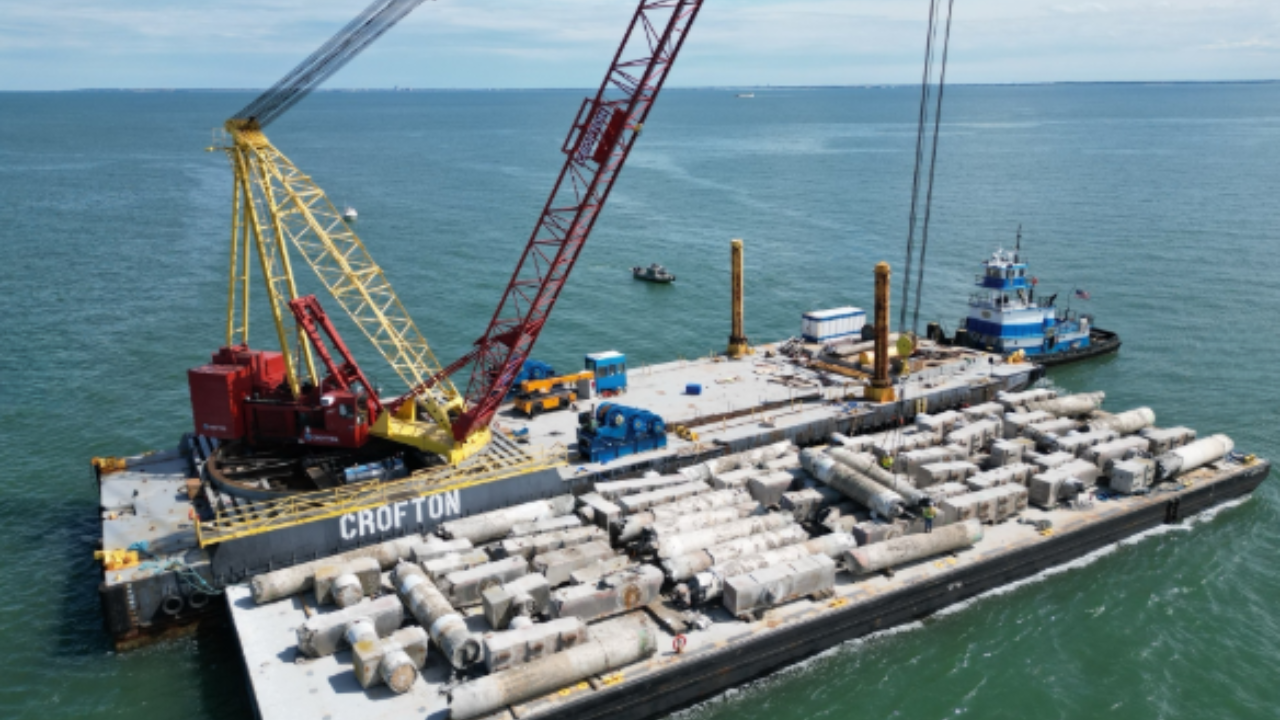
Dumping demolished concrete into coastal waters makes great press releases. It rarely builds thriving marine ecosystems on its own.
Virginia's plan to sink 100,000 tons of bridge concrete into artificial reefs—with 951 tons already deployed—is being hailed by lazy observers as a clean win for both infrastructure recycling and marine life. Tear down an old span. Drop the chunks in the ocean. Watch fish move in. Problem solved.
That is the lazy consensus. It confuses movement with progress. It mistakes cheap waste disposal for ecological restoration.
I have spent years watching coastal restoration projects, municipal budgets, and marine habitat initiatives burn through money and goodwill on big, shiny interventions that look heroic on paper and disappoint underwater. Officials love a massive tonnage number. It sounds heavy. It sounds decisive. It gives politicians a photo op near a crane or a barge and lets agencies claim they are "creating habitat" without doing the harder, slower work of fixing water quality, protecting existing nurseries, or managing fishing pressure.
When you drop rubble on a muddy or sandy sea floor, fish often show up. Of course they do. Put a cinderblock or a slab of broken concrete in barren water and curious reef fish, crabs, and encrusting organisms will investigate. That initial gathering is what commentators point to as proof of success.
Show up on day one and count the fish around a new structure. You will find plenty of reasons to celebrate. Come back after a decade and ask a tougher question: did this project create new marine life, or did it just rearrange where existing fish hang out?
The Habitat Versus Attraction Trap
Marine biologists have argued for decades over the attraction versus production problem in artificial reef research. It is the single most important distinction in this entire debate, and almost every upbeat news story glosses over it.
Attraction happens when a structure draws fish from surrounding areas without increasing the total number of fish in the region. Production happens when a habitat genuinely boosts survival, growth, and reproduction—meaning more fish exist in the ecosystem than would otherwise survive.
Concrete rubble is fantastic at attracting fish. Structure provides visual landmarks, current breaks, and shelter from predators. If you place concrete chunks near a shipping channel or a flat bottom, predators and target species will aggregate around them. Anglers notice that right away. Journalists notice that right away.
True production is much harder to earn. To increase actual biomass over time, a reef needs to support a food web from the bottom up: settlement surfaces for larvae, food for juveniles, refuge from predation across life stages, and water conditions that do not suffocate or poison what settles there.
Imagine a scenario where a coastal planner drops 20,000 tons of broken bridge deck onto a low-oxygen bottom with heavy sediment drift. Fish might swim over to inspect the pile in week one. If silt smothers the crevices or seasonal dead zones strip dissolved oxygen from the water, the site becomes a seasonal pit stop rather than a productive nursery. Calling that "new habitat" stretches the definition past breaking point.
What Concrete Actually Does Underwater
Concrete is not magic stone. It is an engineered mixture of cement, aggregate, water, and often steel reinforcement. Once submerged in saltwater, several physical and chemical processes begin immediately.
Fresh concrete leaches alkaline compounds into the surrounding water, raising surface pH locally until a mineral crust and biological film—known as biofilm—gradually form. Over time, algae, barnacles, hydroids, bryozoans, sponges, and oysters can colonize exposed surfaces. That biological layer is where real ecological value starts. Bare concrete is just a rock. A living encrusting community is a food source and micro-habitat.
Rebar is another story. If bridge rubble contains exposed or poorly coated steel reinforcing bars, saltwater corrosion accelerates. Rusting steel expands, cracking concrete further and leaving jagged metal protruding into the water column. That creates snag hazards for gear and divers and adds structural messiness that has nothing to do with natural reef morphology.
Size and shape matter just as much as material. A pile of flat, tightly packed slabs traps far less varied shelter than a porous, three-dimensional arrangement with varied interstitial spaces. Small crevices protect juveniles and invertebrates. Larger voids shelter adult fish. When demolished bridge pieces are dumped haphazardly, dense compaction can leave huge portions of the pile inaccessible or low-value.
Why "Recycling" Bridge Rubble Is Not Always a Bargain
Another piece of lazy thinking treats ocean dumping as a clever two-for-one bargain: get rid of demolition waste cheaply and help fish at the same time.
Let's look at the math of logistics. Demolishing a bridge generates massive, irregular pieces of concrete. Moving 100,000 tons of heavy material requires cranes, heavy trucks, staging areas, barges, fuel, and marine permits. Even when sinking material at sea avoids some landfill tipping fees or long-haul inland trucking costs, marine transport and placement are expensive and weather-dependent.
At 951 tons placed so far, Virginia is less than 1% of the way to 100,000 tons. That early figure is a tiny toe in the water, not a finished triumph. Scaling from under a thousand tons to one hundred thousand tons requires sustained funding, consistent material supply from specific demolition projects, barge availability, and strict compliance with environmental rules.
People also assume that any concrete diverted from land is automatically an environmental win. That is a shallow view. Landfills have their own impacts, and ocean placement has its own trade-offs. Placing heavy structures on soft sediment compacts the seabed beneath them and alters local bottom currents and scour patterns. If placed poorly, shifting sediment or storm surge can bury lower sections or move pieces unpredictably.
There is also a subtle psychological trap in calling this "recycling." True recycling turns old material into a high-value product that replaces raw extraction. Sinking demolition debris into coastal waters is often closer to beneficial reuse or managed disposal—putting waste somewhere approved where it might do some good rather than sitting in a dump. Nothing is wrong with beneficial reuse when done carefully, provided we do not pretend it solves deeper ecological problems.
The Questions People Actually Should Be Asking
When stories like this circulate, readers tend to type the same predictable questions into search bars: Do artificial reefs really work? Is bridge concrete safe for fish? How long does it take for marine life to move in?
Those questions miss the mark.
Asking Do artificial reefs work? is like asking Do houses work? It depends on where you build them, how you design them, what materials you use, and whether the neighborhood is livable. A well-sited, well-designed reef with clean, properly prepared material in good water quality can be a real asset. A poorly sited pile of debris in degraded water is an expensive underwater rock garden.
Asking Is concrete safe for fish? misses the bigger threat to coastal fish populations. For most Atlantic and Chesapeake-region fish species, the biggest bottlenecks are rarely a shortage of broken concrete. They are water quality, nutrient runoff, habitat loss in marshes and seagrass beds, temperature stress, and fishing pressure. Concrete cannot cure runoff. Concrete cannot restore dissolved oxygen. Concrete cannot replace healthy estuarine nurseries.
Asking How long does it take marine life to move in? focuses on the easiest part of the timeline. Mobile fish can show up in days or weeks. Building a mature, stable biological community—and proving whether it adds net production over years—takes much longer and requires real monitoring, not just a ribbon-cutting photo.
Brutal Honesty on the Big Misconceptions
- Misconception: More tons automatically mean more ecological impact. Reality: Placement, void space, water quality, and biological colonization matter far more than sheer tonnage.
- Misconception: Fish around a reef prove the reef increased fish populations. Reality: Aggregation is easy to observe; net production is hard to prove and requires careful study.
- Misconception: Sinking old concrete fixes coastal habitat decline. Reality: It is a supporting tactic at best, not a substitute for protecting wetlands, submerged aquatic vegetation, and clean water.
What Serious Coastal Restoration Looks Like Instead
If you actually care about healthy fish populations rather than headline-friendly tonnage numbers, start with triage. Protect what is already working before trying to invent substitutes.
Coastal marshes, oyster reefs, and seagrass beds do heavy lifting that broken bridge slabs cannot match. They filter water, stabilize shorelines, cycle nutrients, and provide critical nursery cover for juvenile species. Losing an acre of functioning natural habitat and replacing it with a pile of rubble is a net loss, even if adult fish swim around the rubble.
When artificial structures are used, treat engineering and biology as inseparable partners from day one. Engineers know how to move heavy loads and keep structures stable. Marine scientists and fisheries managers know how to evaluate siting, currents, substrate compatibility, and ecological outcomes. When those two sides operate in silos, projects drift toward convenience rather than performance.
Prioritize clean, properly prepared material. Remove loose contaminants, address exposed steel where appropriate, and design placement patterns that create varied nooks, crannies, and vertical relief rather than a flat pancake of debris.
Most importantly, fund long-term monitoring and be willing to publish unglamorous results. If a reef site underperforms, adjust the design or location on future phases instead of defending the original press release. Real stewardship means caring whether the ecosystem improves five and ten years later, not just how loud the applause is on launch day.
Where My Contrarian Stance Can Bite Back
Being skeptical of big, feel-good infrastructure-to-reef projects carries its own risks, and I will own them straight up.
First, cynicism can stall decent pragmatic compromises. Coastal management is full of trade-offs, tight budgets, and competing interests. If perfection becomes the enemy of good-enough action, nothing gets built at all. Sometimes using demolished bridge material in an approved reef zone really is cleaner, cheaper, and more practical than hauling it inland.
Second, over-focusing on the attraction-versus-production debate can make people dismiss real benefits that anglers, divers, and local economies care about. Even if a reef primarily concentrates fish in a known, accessible spot—or gives local marine life shelter where there was none—those effects are not zero. Dismissing every artificial reef as "useless" goes too far in the other direction.
Third, large-scale projects often evolve over time. Early deployments—like the first few hundred or thousand tons of a much larger effort—are rarely the full story. Judging a multi-year program solely by its opening chapter can overlook lessons learned along the way.
A Better Playbook for Coastal Decision-Makers
Stop measuring success in tons dropped and start measuring it in ecological function and accountability.
Set clear biological goals before the first barge leaves the dock. Decide what species or life stages a site is meant to support, pick locations with strong water quality and appropriate bottom type, and structure the material to maximize useful shelter rather than mere bulk.
Pair every major deployment with a realistic monitoring budget that lasts years, not months. Track colonization, fish presence, habitat stability, and whether the site actually supports lasting biological activity.
And above all, tell the public the truth. People can handle nuance. They do not need another fairy tale about concrete saving the sea. Give them honest engineering, honest ecology, and real results.
Build reefs that earn their keep underwater, not just in the headlines.