Gravity rarely negotiates in the Himalayas.
When a monsoon-swollen river carves through a limestone gorge in Nepal, it leaves behind walls so steep that even mountain goats hesitate, and currents so violent they turn boulders into gravel. Anyone who has spent time trekking the high river valleys of the Trishuli or the Seti knows that sound—a low, vibrating roar that you feel in your teeth before you ever see the water. It is an indifferent sound.
Now put yourself on a wet rock shelf three feet wide, fifty feet below the lip of that canyon, with the mist soaking your coat and the thunder of snowmelt vibrating through your ribs.
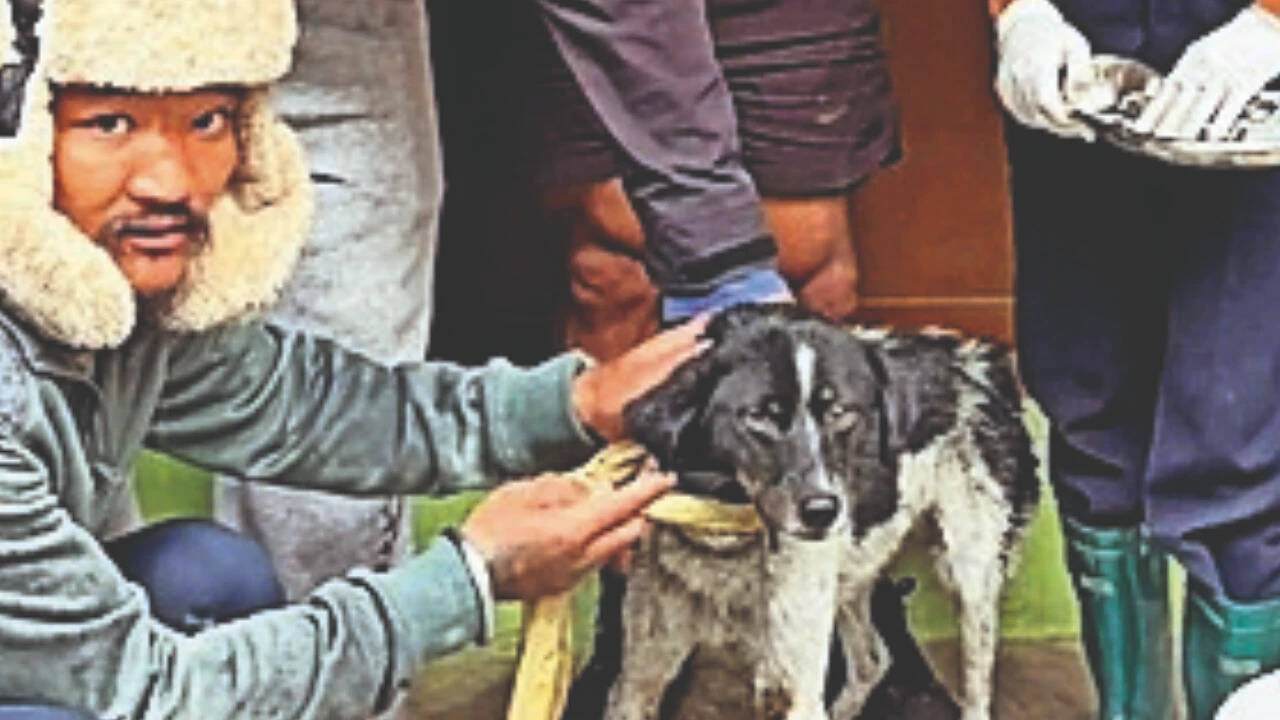
That is where a stray street dog found himself after slipping off a canyon trail in Nepal. For twenty days, he existed in the narrowest possible margin between a vertical rock wall he could not climb and a churning, glacial river he could not swim.
Most news reports reduce an event like this to a tidy, heartwarming bullet point. A dog fell. People noticed. Rescuers used ropes. The dog survived. We smile, scroll past, and forget it within thirty seconds.
Yet reducing a twenty-day ordeal to a tidy anecdote misses the entire point of why stories like this grip us so tightly. Beneath the surface of a simple animal rescue lies a profound examination of endurance, the invisible calculus of human compassion, and what happens when ordinary people decide that a single, nameless life is worth risking their own.
The Architecture of a Trap
To understand how a dog survives twenty days in a canyon gorge, you first have to understand the geography of the trap.
Nepal’s river gorges are geological wounds. During the post-monsoon and summer runoff months, glacial meltwater from the high peaks rushes down narrow chutes at terrifying speeds. The water isn't just fast; it is freezing, thick with glacial silt, and aerated with whitewater that strips away buoyancy. Even an experienced kayaker wears a high-flotation vest and a helmet before dropping into these channels. For a medium-sized street dog—likely a local pariah mix weighing thirty-five or forty pounds—entering that current meant instant drowning.
Above him sat the cliff. Wet shale and mossy granite offer zero purchase for canine claws. Dogs are built for forward momentum, not vertical climbing; their paws lack the grasping mechanics required to pull dead weight upward against gravity.
Consider a hypothetical commuter—let’s call him Aarav—walking the canyon road above the gorge every morning on his way to work. On day one, Aarav hears a faint bark echoing up from the mist. He peers over the edge, spots a brown shape pacing a narrow ledge far below, and assumes the animal will find a game trail out by evening. On day three, Aarav walks past again. The shape is still there, smaller now, curled tight against the rock face to escape the spray.
By day seven, the casual observer realizes the truth. There is no game trail.
The Biology of Twenty Days
How does a body endure three weeks without a proper meal on a damp ledge?
Veterinary science gives us a clinical map of canine starvation, though the reality is far grimmer than the textbook summary. A healthy adult dog can technically survive up to three weeks without solid food, provided—and this is the absolute condition—it has access to water. In the damp, mist-choked microclimate of a Nepali gorge, condensation pooling in rock depressions and the spray from the river itself likely kept the dog hydrated. Water bought him time.
Everything else in his body began eating itself to pay the rent.
During the first forty-eight hours, a stranded animal burns through its glycogen reserves. By day four, the metabolism shifts into ketosis, breaking down fat stores to fuel the brain and heart. In a street dog—an animal already lean from scavenging scraps on the margins of towns—those fat reserves vanish quickly. By the second week, the body begins catabolizing muscle tissue. Every shiver against the night air burns precious calories that cannot be replaced.
Think of the psychological toll alongside the physical decay. Canines are profoundly social animals, wired over fifteen thousand years of domestication to read human faces, seek pack proximity, and anchor their nervous systems to others. Isolation on a noisy, freezing ledge strips away every evolutionary comfort a dog possesses. The constant roar of the river creates sensory overload, masking the sounds of approaching footsteps above and keeping cortisol levels spiked for days on end.
Twenty days is not a weekend mishap. Twenty days is an eternity measured in shivering nights, shrinking muscle mass, and the slow, quiet fading of hope.
Why Strangers Step Over the Edge
This is where the story shifts from a tale of biological endurance to a study of human intervention.
In Kathmandu and the surrounding valley towns, local animal welfare groups—organizations like Sneha’s Care and the Kathmandu Animal Treatment Centre—operate under constant strain. Street dogs are everywhere in Nepal, woven into the fabric of neighborhood life and celebrated once a year during Kukur Tihar, the Hindu festival honoring dogs for their loyalty and guardianship. Yet during the other three hundred and sixty-four days of the year, resources are scarce, veterinary clinics are stretched thin, and municipal rescue gear is practically nonexistent.
When word spreads that a dog is trapped in an inaccessible gorge, there is no municipal budget line item for a high-angle rope rescue. Nobody gets overtime pay for dangling over a canyon.
Someone simply has to decide that leaving the animal to die is unacceptable.
High-angle canyon rescues require specialized hardware: static kernmantle ropes, climbing harnesses, ascenders, carabiners, and bombproof anchor points rigged to boulders or vehicles at the cliff's edge. More than gear, they require nerve. Lowering a human rescuer into a wet gorge means exposing that person to loose rockfall, unpredictable wind gusts, and the deafening disorientation of whitewater below.
Let’s trace the mechanics of what happens when a rescue team finally arrives at the rim.
First comes the rigging. Anchors must be tested twice because a failing anchor in a river gorge is fatal. Next comes the descent. As the rescuer rappels down the cliff face, every movement dislodges pebbles and wet moss. Reaching the ledge is only half the battle; the real danger begins the moment human hands touch a terrified, starving animal.
A dog that has spent twenty days in survival mode does not know that a person dangling from a nylon rope is a savior. To an exhausted animal cornered against a cliff, an approaching human looks like a predator closing off the final exit. A panicked lunge on a three-foot ledge can send both dog and rescuer tumbling into the river.
To succeed, the rescuer has to project absolute calm while hanging in a harness fifty feet above roaring water. Slow movements. Soft voice. A slip lead or a secure rescue bag eased over a trembling frame. Only when the dog is clipped securely into the main line does the grueling haul back up the rock face begin.
The Invisible Stakes of Small Rescues
Critics often look at stories like this and raise a pragmatic eyebrow. In a developing nation grappling with infrastructure challenges, landslide risks, and economic pressure, why pour hours of human effort and technical gear into saving a single stray dog?
It is a fair question, and the answer has nothing to do with sentimentality.
Societies reveal their true structural integrity in how they treat creatures that offer zero economic return. A stray dog in a gorge cannot pay taxes, cannot vote, and cannot thank its rescuers in words. Saving that animal is an act of pure, uncompensated agency. It is a refusal to let geography and indifference dictate the outcome of a living creature’s story.
I have stood at the edge of steep mountain drop-offs after monsoon rains, watching local villagers band together with nothing more than frayed nylon ropes and sheer stubbornness to pull a stranded calf or a neighbor’s goat back from a landslide scar. Nobody in those moments gives a speech about ethics. They simply tie the knot, dig their heels into the mud, and pull. That muscle memory—the habit of refusing to abandon the vulnerable when terrain turns hostile—is the exact same reflex that saves human lives when earthquakes or floods strike the region.
Compassion is not a finite currency that runs dry when we spend it on an animal. It is a muscle. Every time a community mobilizes to pull a starving dog off a canyon ledge, it strengthens the civic reflex to show up when things get hard.
The Return to Solid Ground
When the ropes finally cleared the lip of the Nepali gorge after twenty days, the dog lifted from the canyon was barely recognizable as the animal that had fallen in. Ribs pressed sharply against damp fur. Hind legs trembled uncontrollably as paws finally met flat, dry earth instead of slick stone.
Yet the most telling detail in rescues of this kind rarely makes the headline. It is what happens in the first sixty seconds after the harness comes off.
Instead of bolting into the brush, starving dogs rescued from prolonged isolation almost always lean their weight against the legs of the people who pulled them up. After three weeks of roaring water and cold stone, the warmth of a human palm is the first solid anchor they have felt.
A bowl of clean water goes down first, sipped slowly so the stomach doesn't rebel. Then small, bland portions of food—boiled rice, soft broth—to wake up a digestive tract that has been dormant for weeks. Within days, the dull, sunken eyes brighten. Within weeks, muscle returns to the haunches, and the memory of the canyon fades into the background noise of a life reclaimed.
High above the gorge, the river still roars through the limestone chute, indifferent as ever, carving the stone millimeter by millimeter. Down in the valley, far from the mist and the vertical drop, a dog sleeps curled in a patch of afternoon sun, his paws twitching in dreams that no longer involve the edge of a cliff.