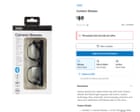
The boxes did not arrive on velvet cushions. They arrived stacked high on metal pallets under the harsh fluorescent glare of discount warehouse aisles, right next to the discounted kitchen gadgets and the bulk-pack paper towels.
Inside those cardboard cartons sat a pair of glasses priced at roughly twenty dollars. To a casual shopper browsing the shelves across Australia, they looked like a quirky novelty item. A cheap accessory for a music festival, perhaps. A gadget for kids to record their skateboarding tricks. But within hours, the entire stock vanished. Shelves emptied. Online carts flashed out of stock. Also making headlines recently: The Structural Mechanics of Early Scientific Innovation.
People rushed to buy them. They did not rush because the glasses came from a household name in Silicon Valley. They rushed because twenty dollars is pocket change for a superpower.
What You Miss When You Look At A Face
Consider what happens next. Additional details into this topic are explored by ZDNet.
Sarah walks into a crowded suburban cafe on a Tuesday morning. She is wearing the twenty-dollar frames. To the person pouring her coffee, she looks like any other commuter fighting off sleep with caffeine. The plastic frames sit slightly crooked on her nose. The small, dark dot of a camera lens sits tucked into the corner of the rim, completely invisible unless you are looking for it from inches away.
Sarah is not taking a cinematic video of her latte art. She is recording every single person behind the counter, every customer waiting in line, and every private conversation happening at the corner table. She walks out two minutes later with her coffee, carrying a digital carbon copy of strangers' lives in her pocket.
This is not science fiction. This is retail reality.
For years, we watched tech giants spend billions trying to make smart eyewear happen. They gave us sleek advertisements, titanium hinges, and grand promises about augmented reality and hands-free computing. Those high-end frames carried hefty price tags and required a certain tax bracket to adopt. They turned heads. They made people suspicious.
The budget version changed the math entirely. When the cost of continuous surveillance drops to the price of a takeout lunch, the barrier to entry disappears. Mass adoption follows immediately. And with it comes an entirely new social friction that we have no language to describe yet.
The Anatomy Of A Privacy Nightmare
We have spent the last two decades training ourselves to panic about the glowing rectangles in our hands. We know when someone is holding up a smartphone to take a video. We see the arm extend. We see the screen light up. We can turn away, adjust our posture, or ask them to stop.
The camera glasses remove the telltale physical cue.
Privacy experts across the country started sounding alarms the moment the stock flew off the shelves. They called it a privacy nightmare. But calling it a nightmare abstracts the problem into a policy debate, and this is not a policy debate. This is visceral. It is about the sudden loss of that quiet, unrecorded space we used to inhabit when we walked down a public street.
Imagine walking into a locker room, a medical waiting area, or a quiet park bench to cry in peace, knowing that anyone passing by could be archiving your moment for an Instagram reel or a private archive. You cannot see the record button. There is no flashing red light. There is only a pair of ordinary glasses and a person who looks like they are staring blankly ahead.
We are sleepwalking into a world where public anonymity is dead. Not because a government decreed it, but because a discount retailer put it on clearance.
Why We Bought Them Anyway
It is easy to point fingers at the buyers and label them reckless. Yet that misses the psychological pull of the device.
We live in a culture that treats memory as a failing. If you didn't record it, did it happen? We carry an existential dread of forgetting, of missing out, of letting life slip through our fingers uncaptured. These glasses promise a cure for that dread. They offer pure, frictionless point-of-view capture. You press a button on the arm, and your exact perspective becomes permanent.
We traded our right to privacy for the cheap thrill of effortless documentation.
The low price point acted as a moral lubricant. If a gadget costs five hundred dollars, you weigh the ethical implications against your bank account. You think twice. If it costs twenty dollars, the purchase requires no thought. It becomes an impulse buy. An experiment.
And so the boxes emptied. The trucks rolled out of the warehouses. The glasses settled onto thousands of faces across the suburbs, recording birthdays, arguments, awkward silences, and mundane commutes without the consent of the people passing by.
The Line We Can't Uncross
We cannot un-invent the cheap lens.
Once manufacturing efficiencies allow for high-definition recording equipment to be miniaturized and slapped onto mass-market plastic frames, the genie does not go back into the bottle. Other manufacturers will notice. Other retailers will stock their own versions. The market will flood.
We are forced to adapt to a reality where every face we pass on the street might be a lens.
Notice how cafe conversations are already changing. Watch how people lower their voices on public transport, glancing nervously at the person sitting opposite them who happens to be wearing frames with slightly thick temples. We are developing a new social radar, constantly scanning for the invisible camera.
The twenty-dollar camera glasses did not just cause a retail frenzy. They drew a hard, permanent line across the history of how we look at one another.
The shelves are empty now. But the glasses are out there. Moving through the world. Watching. Waiting for the next button to be pressed.

