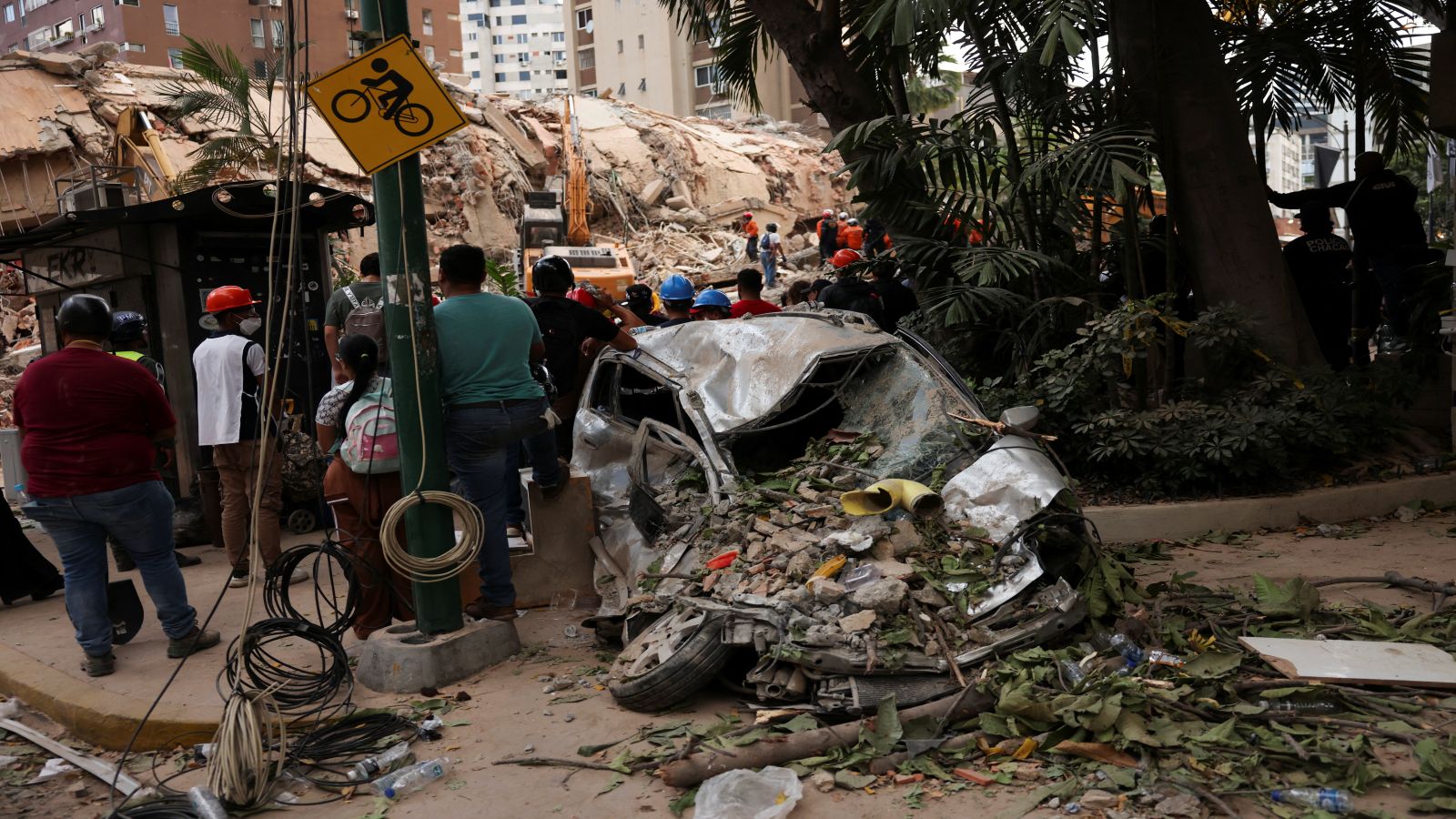
When the ground starts shaking violently beneath a major city, the immediate human instinct is to survive the initial jolt and then brace for the aftershocks. We expect the subsequent tremors to be smaller, weaker, and generally less destructive.
But nature does not always follow the standard playbook.
A devastating double earthquake sequence along Venezuela's northern coast shattered that expectation. On a Wednesday evening, a massive magnitude 7.2 earthquake tore through the region near Caracas. Just 39 seconds later, as residents were scrambling through dust and falling debris, a second, even more powerful magnitude 7.5 earthquake struck the exact same area.
This was not a mainshock followed by an aftershock. It was an earthquake doublet, a rare and deeply troubling seismic phenomenon where two near-equal main shocks hit the same region in rapid succession. The deadly one-two punch toppled high-rises, flattened coastal structures in La Guaira, left more than 180 people dead, and injured over 1,500.
To understand why this happens—and why our current infrastructure is dangerously unprepared for it—we have to look at the violent mechanics of stress transfer deep within the Earth's crust.
Breaking Båth's Law
In traditional seismology, earthquakes follow a predictable pattern known to scientists as Båth’s Law. This rule states that the largest aftershock in a sequence will typically be about 1.2 magnitude units smaller than the mainshock. If you get hit by a magnitude 7.0 quake, you can reasonably expect the largest aftershock to hover around a magnitude 5.8.
An earthquake doublet completely breaks this rule.
Instead of a decaying pattern of energy, a doublet releases two distinct, massive packets of energy from the crust. Seismologists define a doublet as a pair of earthquakes occurring close in time and location that feature nearly identical seismic waveforms and magnitudes, usually within 0.4 units of each other.
When the second quake hits, it does not just add to the terror; it fundamentally changes the disaster landscape. A 39-second gap means the ground simply never stops moving. The duration of intense shaking doubles, keeping building materials under maximum stress long past their engineering limits.
Worse yet, structures already cracked, tilted, or structurally compromised by the first shock are instantly subjected to an even rougher pounding. Columns that barely held up during the 7.2 magnitude tremor simply snap when the 7.5 wave arrives less than a minute later.
The Trigger Mechanism Behind the Chaos
Doublets happen because fault lines are rarely clean, straight cuts through the earth. They are jagged, highly complex networks of rock with sharp bends, steps, and locked patches called asperities.
When tectonic plates grind past each other, stress builds up on these asperities. In a normal earthquake, the rock snaps, the fault slips, and the pent-up tectonic energy dissipates across the region. The fault goes quiet for decades or centuries while it slowly reloads.
In a doublet sequence, the first rupture fails to release all the stored tension. Instead, the sudden movement on the first segment of the fault instantly shoves an immense amount of physical stress directly onto an adjacent, already-loaded segment. Seismologists call this static stress transfer.
Think of it like a zipper under extreme tension. Pulling the zipper down rapidly might release one jammed section, only to put an impossible amount of pressure on the next tooth, causing it to snap instantly.
In Venezuela, this violent interaction played out along the boundary where the Caribbean and South American tectonic plates meet. The Caribbean plate moves eastward relative to the South American plate at a rate of roughly two centimeters per year. While this boundary is statistically less active than places like the Pacific Ring of Fire, the system builds up massive strain over centuries.
When the Bocono fault system finally ruptured, the physical shockwave and the altered stress field were enough to push a neighboring segment past its breaking point in under 40 seconds. We saw a similar, deeply tragic version of this mechanism during the 2023 Kahranmanmaras earthquakes in Turkey, where a magnitude 7.8 was followed nine hours later by a magnitude 7.5 on a separate but connected fault branch.
The Invisible Threat Facing Modern Cities
The structural failure caused by twin earthquakes is exacerbated by a secondary geological threat that standard building codes often ignore: site response and basin amplification.
Caracas, like many global metropolises, sits on top of a deep sedimentary basin. When seismic waves travel through hard bedrock and hit the loose, saturated sediments of a river valley or an ancient lakebed, they slow down. As they slow, the laws of physics dictate that their amplitude must grow.
The soft dirt acts like a giant megaphone for earth movements, amplifying the shaking and causing it to bounce back and forth inside the basin. When a doublet strikes, the sedimentary basin is still vibrating from the first shockwave when the second wave hits, multiplying the destructive forces moving through building foundations.
Furthermore, prolonged shaking in coastal plains and river valleys triggers widespread liquefaction. The ground loses its structural integrity and behaves like a liquid, causing roads to split and heavy buildings to sink or tip over entirely.
What Engineering Teams Must Do Next
The traditional approach to seismic hazard assessment is broken because it relies heavily on the characteristic earthquake model. This older framework assumes faults are neatly segmented and will only break one piece at a time, keeping earthquake sizes capped. Doublets prove that faults communicate, interact, and trigger one another across segments seamlessly.
Engineering and municipal planning teams must immediately pivot to address this reality.
- Rewrite Building Failure Tolerances: Structural engineers design modern buildings to survive a major quake without collapsing, allowing people to evacuate safely. However, those designs assume the building will have days, weeks, or months of downtime to be inspected and reinforced before facing another massive shock. Standard software models must now simulate back-to-back design-basis earthquakes with zero delay between events.
- Enforce Redundant Structural Reinforcements: Retrofitting existing high-density housing with dampening systems, base isolators, and carbon-fiber column wraps is no longer an optional safety upgrade. It is a baseline requirement for cities built over complex fault networks.
- Invest in Multi-Phase Early Warning Systems: Venezuela completely lacks a functional earthquake early warning system, leaving residents with absolutely no time to evacuate. For nations updating or installing these sensor networks, the software must be explicitly programmed to recognize and broadcast warnings for secondary mainshocks, rather than filtering them out as mere aftershock anomalies.
Relying on the hope that an earthquake will be a solitary event is a dangerous gamble. If your city rests on a complex, highly segmented fault system, the double-punch of a seismic doublet is a physical reality that your infrastructure needs to be ready to fight right now.
You can watch this detailed breakdown on How Earthquake Doublets Work featuring expert insights from seismologists analyzing the exact tectonic triggers that caused the devastating double tremors along the Venezuelan coast.