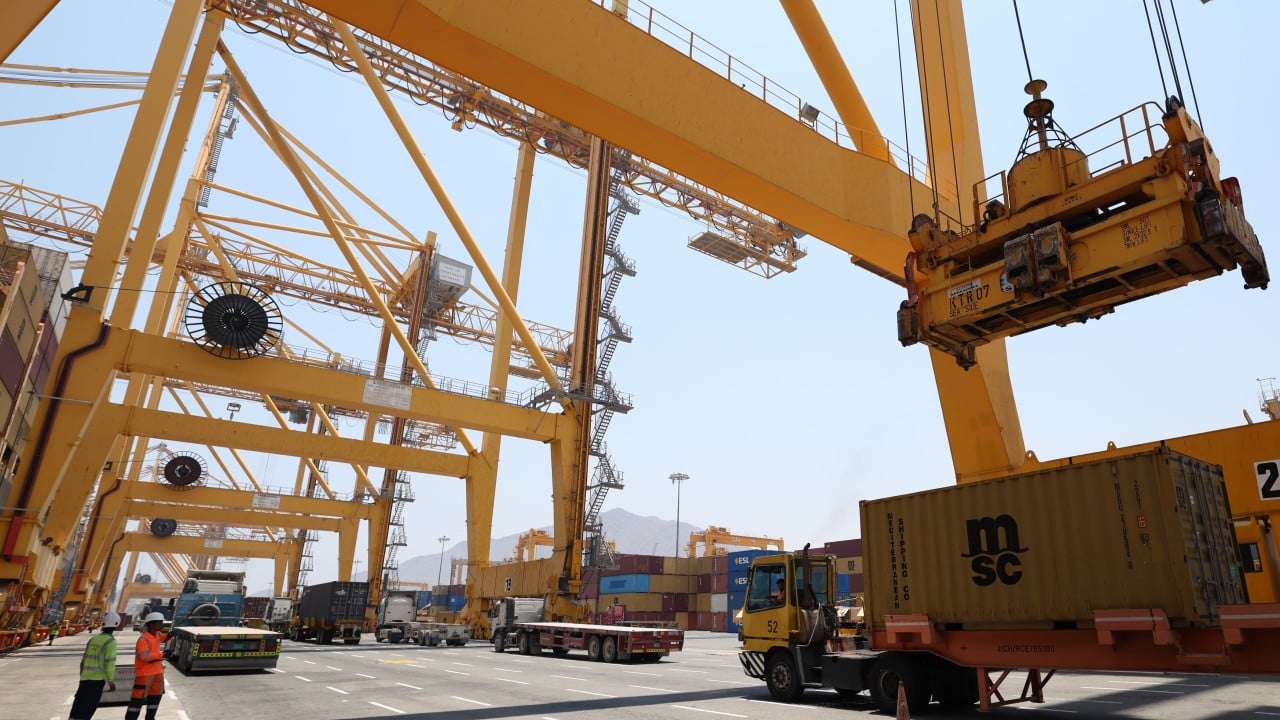
You can't move a trillion-dollar economic engine overnight, but the UAE is trying anyway.
For decades, Dubai's Jebel Ali port stood as an untouchable titan of global trade. It's the largest container hub between Rotterdam and Singapore, acting as the vital link connecting factories in China to markets across Africa and Europe. But Jebel Ali has a fatal geographic flaw. It sits deep inside the Persian Gulf, meaning every single ship serving it must squeeze through the Strait of Hormuz. For an alternative perspective, check out: this related article.
When geopolitical tensions exploded into full-blown maritime conflict earlier this year, Iran effectively shut the waterway. The results were catastrophic for regional logistics. Activity at Jebel Ali didn't just slow down—it cratered by an astonishing 90% to 95%. For an economy built on the premise of frictionless global trade, the crisis exposed a terrifying reality: total reliance on a single 21-mile-wide maritime bottleneck is a fast track to economic paralysis.
Now, the UAE is moving to permanently reshape its trade map. Similar coverage on this matter has been published by Business Insider.
The government isn't waiting around for long-term peace deals to hold. UAE Minister of Foreign Trade Thani Al Zeyoudi made the country's posture clear when he stated that the ultimate goal is to bring reliance on the Strait of Hormuz down to absolute zero, regardless of whether the waterway is open or closed.
The Great Migration to the Eastern Coast
To survive future blockades, the Emirates are aggressively shifting their logistics weight to the east, setting up shop directly on the Gulf of Oman.
DP World, the Dubai-owned port giant that operates Jebel Ali, is currently finalizing terms with government officials to construct a brand-new multipurpose port and container terminal in the emirate of Fujairah. Fujairah has long served as a critical bunkering and oil export hub, but its container handling capacity hasn't been anywhere near what's needed to pick up Jebel Ali's slack.
The timeline for this new build is remarkably aggressive. DP World officials estimate that the new port facilities could be operational in as little as 18 months. They're looking to invest hundreds of millions of dollars right out of the gate, with plans to scale up financing rapidly as demand dictates.
DP World isn't the only player pouring cash into the east coast. Sharjah-based operator Gulftainer recently dropped a massive $2 billion investment plan to expand the capacity of Khor Fakkan port, another critical terminal sitting safely outside the Persian Gulf choke point. Along with expansions at Dibba, the UAE's eastern coastline is rapidly turning into a massive construction zone designed to catch trade before it ever enters dangerous waters.
The Realities of Trucking a Trillion Dollars
It sounds like a perfect fix on paper. Ships drop off their cargo at Fujairah or Khor Fakkan, and the goods enter the UAE without ever risking an encounter with an Iranian drone or naval mine.
But in practice, bypassing Hormuz introduces friction that the UAE's hyper-efficient business model hates.
Jebel Ali isn't just a harbor where ships drop off boxes. It's an entire economic ecosystem. The Jebel Ali Free Zone (Jafza) hosts more than 11,000 businesses, heavy industrial facilities, and massive warehousing networks that took decades and billions of dollars to construct. You can't replicate that kind of infrastructure on the eastern coast in a year and a half.
Moving goods overland from Fujairah to the commercial zones of Dubai and Abu Dhabi requires a massive trucking operation. Trucking thousands of containers across the country adds significant time and spikes inland freight costs. To offset this bottleneck, the UAE is frantically expanding its national rail network and upgrading road freight links to connect the eastern ports back to the western industrial zones.
Even with those upgrades, Jebel Ali remains completely irreplaceable. Company executives have been quick to reassure markets that Jebel Ali will not be downsized. The goal here isn't substitution; it's survival through redundancy. The UAE is building parallel logistics pathways to absorb the blow the next time regional tensions flare up.
The Parallel Fight for Energy Independence
The bypass strategy isn't restricted to consumer goods and manufacturing components. The energy sector is undergoing the exact same structural shift.
Before the recent conflict, roughly 20% of global liquefied natural gas (LNG) and crude oil moved through the Strait of Hormuz. When the strait went dark, global energy markets fractured.
Abu Dhabi has relied on the Habshan-Fujairah pipeline to send a portion of its crude straight to the Arabian Sea for years. But the capacity limitations became painfully obvious during the height of the shipping blockade. In response, the government has fast-tracked the construction of a second pipeline to double the amount of crude it can move overland to the east coast. Feasibility studies are already underway for a third petroleum pipeline.
This infrastructure pivot has allowed the UAE to maintain its massive production goals. In June, after moving away from strict OPEC constraints, the country pumped a record 4.1 million barrels per day, pushing a significant chunk of those exports out through its newly expanded eastern facilities.
Shifting Focus From Efficiency to Resilience
For decades, the entire global logistics sector prioritized one metric above all else: efficiency. Supply chains were designed to be as lean and cheap as possible. The crisis in the Strait of Hormuz has forced a hard shift away from that mindset, replacing it with a focus on absolute resilience.
The financial hit to regional port operators shows why this transition is non-negotiable. Credit rating agency Moody's estimated that DP World's annual revenue would slip from $6.6 billion down to $5.9 billion due to the direct disruptions caused by the maritime blockade. A drop of that scale for a global logistics leader is a warning shot that no board of directors can ignore.
The UAE is realizing that paying higher upfront costs for rail expansions, new port berths, and redundant pipelines is much cheaper than letting its entire economy be held hostage by regional flashpoints.
If you're a business operating in the Gulf or relying on its supply chains, you need to adjust your operations to mirror this geography shift. Stop assuming the trade routes of the last twenty years will remain stable.
Start audit trails on your regional freight providers to see how much of their capacity is tied to Persian Gulf transits versus east coast bypass routes. Diversify your warehousing footprint by looking at logistics spaces opening up around Fujairah and Khor Fakkan rather than keeping all your inventory concentrated in Jebel Ali. The UAE is building the infrastructure to survive outside the Gulf; you should make sure your supply chain is ready to use it.
To see exactly how these regional supply chain disruptions are forcing global logistics giants to rewrite their playbooks, check out this detailed report on Dubai's Fujairah port expansion. This breakdown outlines the sheer scale of the investments pouring into the UAE's eastern coast to bypass the shipping freeze.