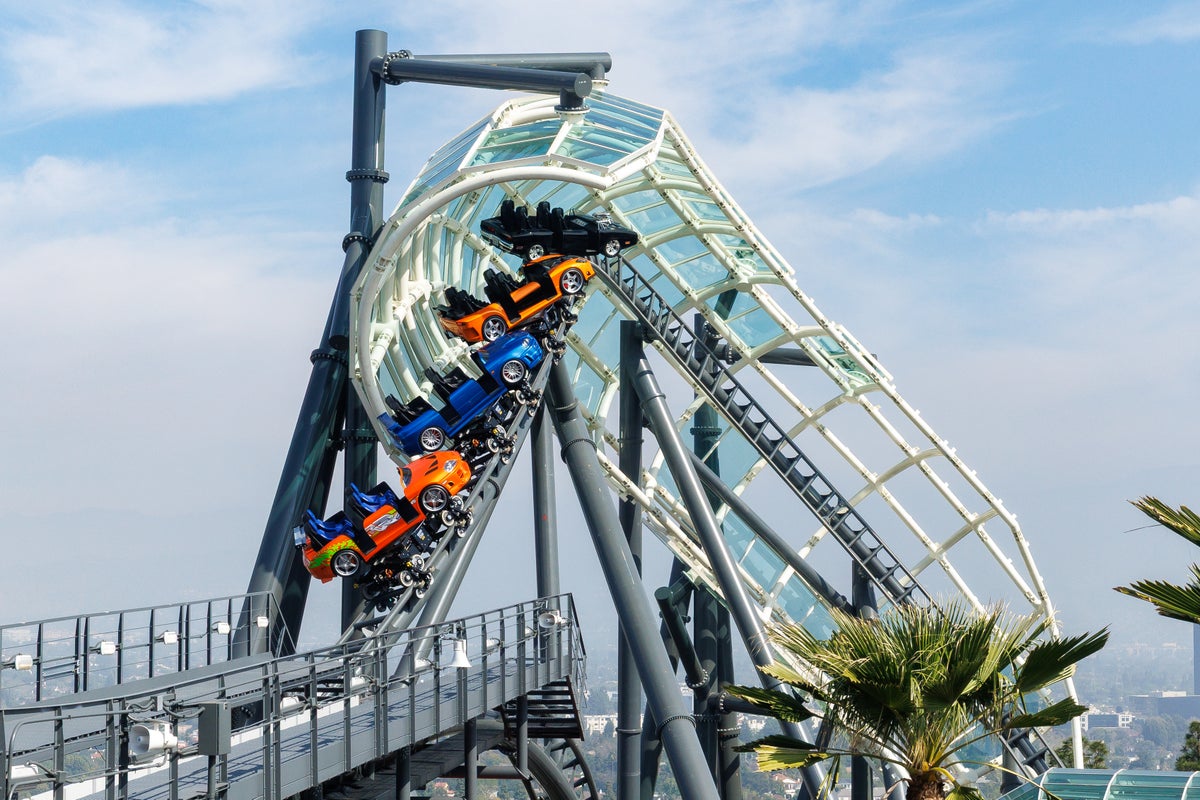
Universal Studios Hollywood is finding out that you can engineer a track to be quiet, but you cannot easily quiet the human voice. As technical rehearsals ramp up for Fast and Furious: Hollywood Drift, the park's ambitious new high-speed outdoor roller coaster, residents in adjacent Toluca Lake are discovering a jarring new reality. Every thirty to forty seconds, the sound of sheer terror cuts through the valley air. It is not the mechanical clatter of steel wheels on track, which engineers successfully muffled using pea gravel and specialized low-rumble designs. It is the unbridled, repetitive screaming of passengers hurtling through space at 72 miles per hour.
The friction between a major multi-national theme park and its residential neighbors is an old story in Southern California, yet this particular conflict exposes a modern blind spot in urban entertainment engineering. When resort planners map out multi-million dollar attractions, their acoustic models typically focus on mechanical decibel levels to satisfy municipal code requirements. They account for motor hums, launch systems, and structural vibrations. What they frequently underestimate is the organic variable. You can project sound footprints using empty cars, but human adrenaline refuses to be plotted on a predictable graph.
The Anatomy of an Urban Theme Park Friction Point
Universal Studios Hollywood occupies a uniquely precarious geographic footprint. Perched on a hill immediately abutting dense, affluent residential communities like Toluca Lake and Studio City, the property operates in a tight physical corridor. Unlike its sprawling sibling in Orlando, Florida, which sits on massive swathes of isolated land buffering it from civilian ears, the Hollywood destination is an urban island.
When the park announced Fast and Furious: Hollywood Drift, management anticipated pushback. They proactively integrated heavy noise mitigation into the blueprints. Over 900 feet of sound walls were scheduled. Specialized half-pipe shields, modeled structurally after the property's massive outdoor escalators, were constructed to trap and deflect noise at the source. The ride vehicles were even engineered with 360-degree rotation capabilities, theoretically allowing the resort to point passengers away from residential zones during critical sections of the layout.
During empty-car testing phases, these precautions worked brilliantly. The track hummed quietly, disappearing beneath the ambient drone of Los Angeles freeway traffic and city life.
Then came the human element. Once technical rehearsals introduced live riders into the equation, the acoustic profile transformed overnight. Local homeowners began reporting a relentless audio loop echoing through double-paned windows. For residents trying to enjoy their backyards, the experience resembles living inside an eternal open-air amphitheater where the headliner is a continuous wave of panic.
Why Acoustic Engineering Fails the Human Voice
Physics explains why standard sound walls struggle with roller coaster screams. Mechanical track noise tends to possess a lower frequency spectrum, which can be relatively easily blocked, absorbed, or diffused by heavy barriers and dense materials like gravel. Human screams, conversely, occupy a high-frequency band—typically ranging between 2,000 and 4,000 Hertz. This frequency range cuts cleanly through air, bends around structural obstacles more efficiently, and is perceived by the human ear as piercingly distinct.
When hundreds of passengers experience sudden drops and centrifugal forces simultaneously, their collective vocal output creates a directional acoustic beam. If the barrier height or placement fails to account for the elevated trajectory of an outdoor coaster banking heavily above ground level, the sound simply vaults over the defense system and spills directly into residential canyons.
Recognizing this engineering shortfall, Los Angeles City Councilmember Adrin Nazarian announced that the theme park is moving to install two additional sound barriers. These additions are designed to stretch longer than two football fields, utilizing advanced sound-absorbing materials meant to catch what the initial mitigation missed.
Yet, hardware fixes rarely solve the core social friction. Sound walls can alter propagation vectors, but they cannot eliminate the sound entirely without turning the perimeter into an enclosed industrial tunnel—an aesthetic non-starter for a resort relying on cinematic views and open-air atmosphere.
The Broader Precedent for Urban Expansion
This clash points to a wider tension facing urban entertainment destinations globally. As land values skyrocket and real estate development pushes closer to historical entertainment boundaries, the margin for error shrinks. Theme parks can no longer rely on distance to maintain good neighborly relations. Every decibel matters when backyards sit a few hundred yards from high-thrill hardware.
Universal's response—combining public outreach, community hotlines, and rapid infrastructure adjustments during technical rehearsals—demonstrates an awareness of public relations risk. They are caught in a delicate balancing act. They must deliver top-tier, competitive thrill experiences that match contemporary visitor demands while maintaining compliance with municipal standards that were written in an era before multi-directional, high-speed outdoor coasters squeezed into hillside margins.
As construction crews work to finish the supplemental barriers ahead of the official public launch, the situation serves as a cautionary study for future development. Engineering a world-class attraction requires mastering physics, hydraulics, and metallurgy. But managing the relationship between corporate expansion and neighborhood peace requires anticipating something far more volatile: the sound of a thousand people discovering a 72-mile-per-hour drop for the very first time.