The air inside a paper mill does not smell like paper. It smells like boiled cabbage, wet wood, and the sharp, metallic bite of things that are never meant to touch the skin. In Longview, Washington, the workers at the Nippon mill knew that smell well. They lived by it. They timed their shifts by the heavy thrum of the machinery and fed their families with the wages it brought home.
Then came May.
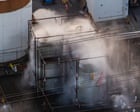
A storage tank did not just leak; it catastrophically failed. When a massive chemical tank structurally collapses, the sound is not a clean explosion. It is a sickening, tearing shriek of industrial steel giving way under the weight of thousands of gallons of toxic liquid. Within moments, eleven people were dead.
Eleven human beings who woke up, packed lunches, kissed their spouses goodbye, and never came home.
The Geometry of Danger
We tend to think of industrial disasters as anomalies, rare lightning strikes of terrible luck. They are not. They are a mathematical certainty born of a quiet, deliberate erasure of the rules that keep the pressure inside the pipes.
Consider what happens next when the invisible guardrails are pulled away.
According to data forced into the light by a lawsuit from Public Employees for Environmental Responsibility (PEER), industrial chemical accidents in the United States have surged by more than 50% since 2021. Last year alone, 131 major chemical releases were reported to the federal government. That is not a statistic; it is a drumbeat. It averages out to nearly five hazardous chemical incidents every single week.
Imagine living in Garden Grove, California, when a tank holding 7,000 gallons of highly volatile methyl methacrylate begins to overheat, vibrating with the energy of a bomb waiting for a match. Forty thousand residents had to flee their homes, grabbing pets and medication, looking back at a skyline that suddenly felt like a hostile entity.
CHEMICAL ACCIDENTS IN THE U.S. (2021 vs. PRESENT)
+-------------------+------+------+---------+
| Metric            | 2021 | 2025 | Surge   |
+-------------------+------+------+---------+
| Reported Releases | 83   | 131  | +57%    |
| Injury/Fatal Acts | 60   | 89   | +48%    |
+-------------------+------+------+---------+
The data shows a trajectory that is moving sharply in the wrong direction. The human cost is accelerating right alongside the spreadsheet numbers.
The Cost of Compliance
But why is this happening now? The answer lies in the sterile rooms of Washington D.C., where words like "regulatory burden" are used to replace the reality of toxic smoke.
In 2024, after more than a decade of agonizing research, testimony, and community tears, a federal rule was finalized to strengthen the Risk Management Program (RMP). It was a modest shield. It required chemical plants to bring in independent, third-party auditors after a severe accident occurred. It forced companies to analyze safer technological alternatives and plan for how extreme weather—fueled by a changing climate—might crack open their aging infrastructure.
The chemical industry looked at these rules and saw a dollar sign. Specifically, they saw a compliance cost.
By early this year, the Trump administration’s Environmental Protection Agency (EPA) proposed a total reversal. The new rule, ironically named the Common Sense Approach to Chemical Accident Prevention, seeks to gut the 2024 protections. The logic provided by the agency is entirely financial: repealing these safety measures will save chemical companies an estimated $234 million to $241 million annually.
"Once again, we're seeing the prioritization of corporate profits instead of doing the basic job of keeping families safe from industrial emergencies," says Emma Cheuse, a senior attorney at Earthjustice.
To make matters more complicated, an investigation by Citizens for Responsibility and Ethics in Washington (CREW) revealed that sixteen Trump-appointed EPA officials had previously received more than $2.8 million in compensation from the very chemical companies and industry trade groups they are now tasked with regulating.
The conflict of interest is not subtle. It is written directly into the policy rollbacks.
Living in the Shadow of the Stack
If you want to understand the true weight of these changes, you cannot look at Washington. You have to look at the fenceline communities.
Nearly 150 million Americans live within three miles of a high-risk chemical facility. These are not affluent suburbs. They are historically underserved neighborhoods, predominantly Black and Latino, where the rent is cheap precisely because the air is heavy.
In these neighborhoods, parents keep a mental map of the quickest way out of town. They know which windows leak when the wind blows from the east. They understand that the local refinery, built before 1985 with infrastructure that is literally rusting from the inside out, is a sleeping giant.
The federal government has dismantled the public website that used to inform local residents and first responders exactly what chemicals were being stored behind the chain-link fences down the street. If a fire breaks out tonight, the firefighters rushing into the plume will be doing so blind, guessing whether the smoke will choke them or dissolve their lungs.
At the same time, the administration has targeted the Chemical Safety and Hazard Investigation Board (CSB) for complete elimination, attempting to strip its funding. The CSB is the independent watchdog that arrives at the scene of a tragedy to figure out why workers died. It is the agency that looks at corporate culture, worker fatigue, and deferred maintenance. Removing it means removing the mirror that forces the industry to look at its own failures.
The Fragmented Armor
Some argue that federal rollbacks do not mean a total collapse of safety. The argument goes that individual states can step in with their own strong regulations to protect their people.
But toxic gas does not recognize state lines. A plume of hydrogen fluoride released from a refinery in one state can drift across borders on a stiff breeze, indifferent to local legislation. When federal protections are reduced to a patchwork of local rules, the communities with the least economic political leverage are always the ones left unprotected.
The risk grows greater with every passing year because concrete rots and steel corrodes. The infrastructure of industrial America is growing old, brittle, and unstable. It requires more oversight, more rigorous auditing, and more careful stewardship than ever before.
Instead, the federal presence is shrinking, withdrawing its inspectors and rewriting its rulebooks to suit the corporate ledger.
The cost savings of a few hundred million dollars for the chemical sector are easily quantified on a balance sheet. What remains unquantified is the value of an ordinary Tuesday morning in Longview, Washington, before the sky tore open.