Stop looking at virtual taekwondo as a glorified video game. If you think it is just kids flailing their arms in a living room, you are completely missing the seismic shift happening right now in combat sports.
The Olympic Council of Asia recently shattered traditional expectations by adding virtual taekwondo to the official medal program for the Aichi-Nagoya 2026 Asian Games. This isn't a side exhibition or a marketing gimmick to lure in gaming teenagers. It is a highly regulated, physically brutal competitive discipline that might just save a sport currently suffering an identity crisis. Meanwhile, you can explore related stories here: The Geopolitical Leverage of FIFA Article 27: Mechanics of the Balogun Precedent.
For the last two decades, traditional sparring—known as kyorugi—has faced heavy criticism from purists. The introduction of electronic scoring protectors in the late 2000s fundamentally altered the martial art. Instead of the powerful, cinematic knockout kicks that defined its golden era, modern Olympic taekwondo frequently devolves into what frustrated masters call "tip-tap" fighting—athletes awkwardly bouncing on one leg, trying to gently slap their opponent's sensor pads to register a point.
Virtual taekwondo strips away the clunky electronic armor and changes the rules of engagement entirely. By moving the fight into a digital arena, World Taekwondo and Singapore-based Refract Technologies have done something radical: they have made speed, precise footwork, and tactical positioning the absolute metrics of victory, without the risk of concussions or broken bones. To explore the complete picture, we recommend the recent report by Yahoo Sports.
The Physics of a Fight Without Impact
How do you actually fight someone when you cannot touch them?
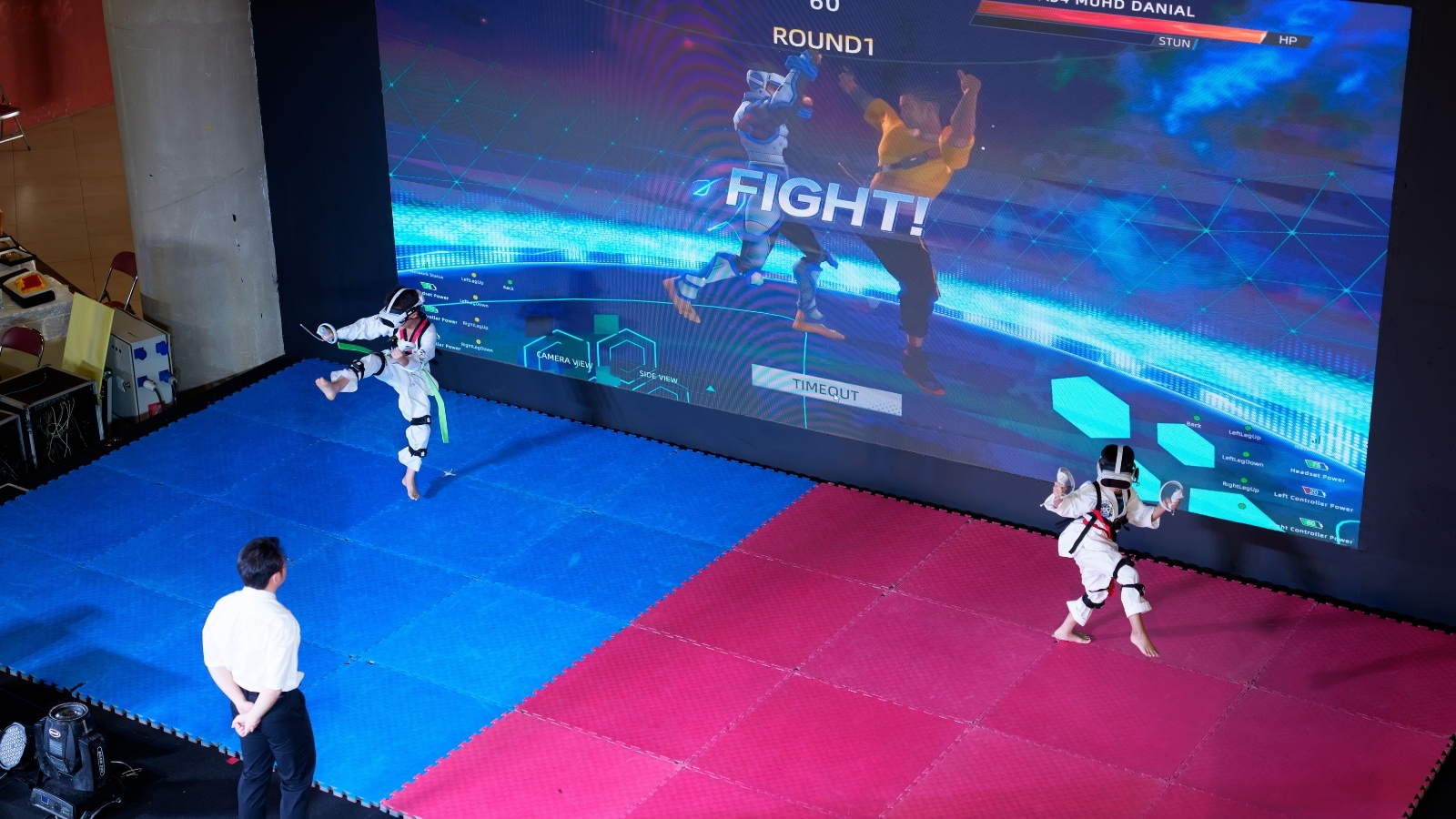
Athletes step into a designated 4-by-4-meter physical ring. They strap on a standalone virtual reality headset and five advanced motion-tracking sensors placed on their spine, thighs, and shins. Using the AXIS motion capture system, every millimeter of their real-world movement translates instantly to a 3D avatar on a screen viewed by judges and spectators.
The mechanics of a bout are simple yet grueling:
- The Clock: Matches consist of best-of-three rounds, lasting 60 seconds each.
- The Objective: Every fast, well-executed kick that breaches an opponent’s digital guard depletes their virtual health bar.
- The Win: You win by completely draining the opponent's power gauge or holding the higher score when the horn sounds.
If you talk to traditional practitioners who have tried it, they will tell you the exact same thing: it is exhausting. Vietnamese fighter Nguyen Thanh Hien Linh admitted that during her first virtual tournament in Singapore, she was completely lost, just blindly kicking the air. Two years later, after adapting to the spatial awareness required to track a digital opponent, she won gold at a major virtual tournament in Malaysia.
Because there is no physical resistance from hitting a heavy pad or a human torso, you cannot rely on leaning your body weight into a strike. You have to snap your kicks back with perfect form and maintain balance entirely on your own core strength. It requires immense cardiovascular endurance to throw continuous, full-speed spinning techniques into empty air for a solid minute without falling over.
Destroying Traditional Sports Barriers
The most fascinating aspect of the Asian Games format is the complete elimination of demographic divisions. In traditional combat sports, weight classes are absolute law. A 130-pound fighter never steps into a ring with a 200-pound fighter for obvious safety reasons.
Virtual taekwondo throws out the rulebook. At the upcoming Aichi-Nagoya Games, the competition will feature a direct 16-player single-elimination tournament that is completely mixed-gender and open to any athlete between the ages of 17 and 35.
"When you wear the VR, everybody is the same," says Raja Mardiah Idris, a 45-year-old competitive martial artist who recently decided to abandon full-contact sparring to focus entirely on the virtual discipline. "You win through your technique, your strategy and your fitness."
Without raw physical mass and brute force dominating the meta, a lighter, faster female athlete can easily out-point a heavier male opponent if her execution speed and spatial timing are superior. It creates a pure test of martial arts IQ. Older athletes whose joints can no longer handle the jarring impact of full-contact blows can stay in the competitive pipeline far longer.
Dealing with the Virtual Reality Reality Check
Let's be realistic: the sport has hurdles to clear before it achieves mainstream global adoption.
First, the sensory adjustment is tough. Several elite athletes have noted that jumping into an immersive digital environment causes immediate spatial disorientation and dizziness during the first few sessions. Your brain sees the avatar moving across the digital canvas, but your inner ear knows your feet are planted on a stationary rubber mat. It takes weeks of conditioning just to eliminate the motion sickness.
Second, the hardware barrier is incredibly high right now. A traditional taekwondo student needs a uniform, some cheap foam shin guards, and a target pad to train. A competitive virtual athlete requires high-end VR gear, a precise five-sensor motion capture suite, and a specialized tracking environment. Right now, grassroots clubs in developing regions simply cannot afford this kit out of pocket.
To fix this, World Taekwondo launched a dedicated global esports hub and opened the Virtual Taekwondo Central Training Centre in Taekwondowon, located in Muju, South Korea. They are actively building an Amateur League to subsidize training and educational resources for international athletes who don't have local access to the technology.
Where to Go From Here
If you are a martial artist looking to transition or an esports competitor eyeing a legitimate athletic track, you need to get ahead of this curve before the Asian Games coverage hits televisions worldwide.
- Focus on Spatial Mapping: Stop focusing on power. Work on your footwork drills inside a strict 4x4 meter boundary to build muscle memory for the physical arena limits.
- Build Non-Impact Core Strength: Practice snapping your kicks without hitting a target. If your knees or hips hyperextend when you miss, you will injure yourself quickly in a virtual fight.
- Track the Circuit: Watch the upcoming Chuncheon Korea Open International Virtual Taekwondo Championships to analyze how top-tier players utilize digital blind spots and execute feints.
The infrastructure is expanding rapidly. With the sport already confirmed for major continental games and regional tournaments like the 2027 Southeast Asian Games in Malaysia, the digital mat is no longer an experimental gimmick. It is the new frontier.
Exploring the future of taekwondo with virtual reality is an insightful video that breaks down the development of the AXIS motion technology and shows how physical athletes adapt to fighting in a non-contact, digital environment.