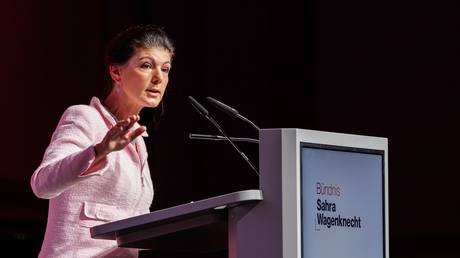
The studio lights are blinding, clinical, and perfectly calibrated to erase the shadows under a presenter’s eyes. Inside the soundproofed walls of a modern television studio, everything feels sterile, safe, and controlled. A technician adjusts a microphone capsule. A producer counts down through an earpiece. To the casual viewer flipping channels on a rainy evening, what follows looks like standard political commentary—the familiar, comforting hum of democratic debate.
But words are not neutral. In the digital age, a studio microphone is no longer just a tool for amplification; it is a piece of precision artillery.
Consider the quiet gravity of a minister stepping up to a podium, not to announce an economic policy or a infrastructure project, but to point a finger at a single individual broadcasting on national airwaves. When Jean-Noël Barrot, France’s Minister for Europe, publicly leveled charges against commentator Xenia Fedorova, he was not merely engaging in a political spat. He was drawing a line in the sand of a much larger, largely invisible conflict. Barrot labeled Fedorova a "certified propagandist" who actively "serves the soup" to Vladimir Putin.
It was a stark, jarring moment that shattered the polite veneer of political broadcasting. It forced a uncomfortable question into the public consciousness: What happens when the infrastructure of a free press is utilized to dismantle the very foundations of that freedom?
The Architecture of Influence
To understand how we reached this point, we have to look past the immediate outrage and examine the machinery behind the screen. Xenia Fedorova is not a newcomer to the high-stakes world of international media. She previously climbed the ranks to helm RT France, the state-funded Russian television network that Paris banned shortly after the invasion of Ukraine. When those broadcast signals were cut, the official narrative appeared to stop.
But influence is fluid. It adapts. It finds new channels.
Fedorova soon re-emerged within the media ecosystem controlled by French billionaire Vincent Bolloré. To the untrained eye, her presence on these platforms is just another voice in a diverse choir of opinion. This is where the mechanics of modern disinformation become subtle, sophisticated, and deeply effective. It rarely presents itself as an obvious lie. Instead, it operates through the careful curation of doubt, the relentless amplification of existing social fractures, and the gentle steering of public anxiety.
Imagine a specialized lens placed over a camera. It does not invent the scenery, but it distorts the proportions. It magnifies the dust motes until they look like boulders, while blurring the horizon entirely.
This is the essence of modern cognitive warfare. By anchoring commentary within domestic media empires, external geopolitical narratives gain a veneer of local authenticity. They no longer sound like foreign press releases; they sound like the grievances of a neighbor. The state-sponsored messaging blends seamlessly with local culture wars, creating an alloy that is incredibly difficult to separate and analyze.
The Strategy of the Echo Chamber
Why does this matter so deeply to a nation's security? The answer lies in the way human beings process information. We are wired to seek validation, not contradiction. When a trusted broadcast network provides a platform to a skilled communicator, it grants an implicit stamp of legitimacy.
The strategy relies on a simple, three-tiered approach to altering public perception:
- The Normalization of Extreme Narratives: By repeatedly introducing fringe geopolitical viewpoints into mainstream panels, those viewpoints cease to shock. They become just another valid perspective on the menu of democratic thought.
- The Sapping of Institutional Trust: The narrative focus consistently returns to the incompetence, corruption, or hypocrisy of Western democratic systems. Over time, this erodes the public’s faith in their own institutions, leaving them unmoored.
- The Creation of Strategic Paralysis: If the public is thoroughly confused, divided, and skeptical of all information sources, they cannot form a coherent consensus. A society that cannot agree on basic facts cannot act decisively in moments of international crisis.
The minister’s public denunciation was an attempt to break this spell. By using blunt, unvarnished language, Barrot sought to strip away the domestic protective coloring and expose the geopolitical alignment underneath. It was an admission that defensive measures—like blocking foreign websites or banning state media outlets—are no longer sufficient when the ideas themselves have already migrated inside the gates.
The Battlefield of the Unseen
The true danger of this dynamic is that it exploits the finest virtues of a liberal democracy—openness, tolerance, and a commitment to free expression—and turns them into structural vulnerabilities. When regulatory bodies or government officials attempt to intervene, they are immediately accused of censorship, heavy-handedness, and authoritarianism. It is a masterful trap. If the state remains silent, the corrosive narratives spread unchecked. If the state speaks out or acts, it appears to validate the very accusations of tyranny that the commentators are making.
This is not a problem that can be solved by an algorithm or a simple content filter. The digital landscape has evolved past the point where automated fact-checking can save us. We are dealing with sophisticated narrative arcs designed to alter the cultural and political trajectory of entire nations over years, even decades.
We find ourselves standing in a confusing, high-stakes twilight where the boundaries between journalism, commentary, and psychological operations have dissolved entirely. The battle is no longer being fought on distant frontiers or through overt cyberattacks on infrastructure. It is being fought in the quiet spaces of our living rooms, through the speakers of our televisions, and within the subtle shifts of our daily conversations.
The lights in the studio will continue to shine bright and clean. The presenters will continue to speak with poise and confidence. But the true weight of those words will be measured far beyond the studio walls, in the resilience or the fracturing of the society that listens to them.