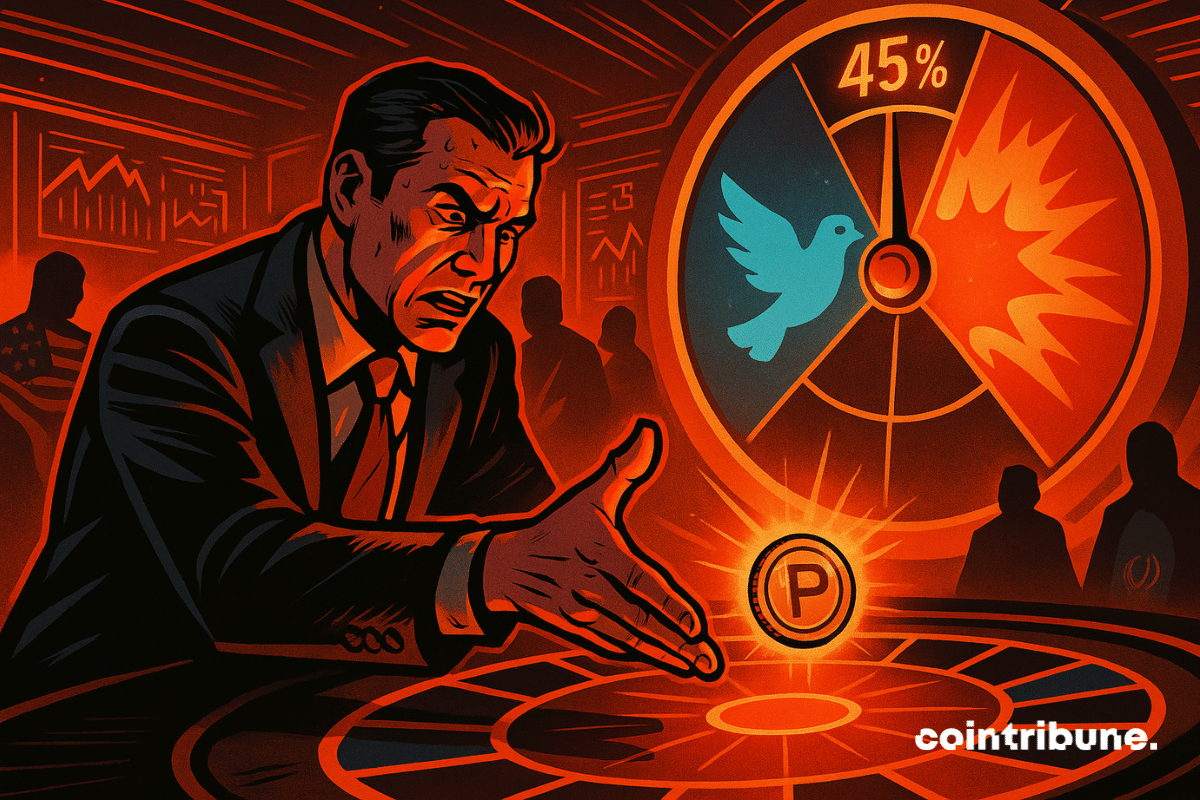
The White House is panicking about prediction markets again. The internal memo warning staff against "betting" on a potential conflict with Iran isn't an ethical stand. It’s a desperate attempt to maintain a monopoly on truth.
When the Biden administration tells staffers to stay off platforms like Kalshi or Polymarket, they aren't worried about insider trading. They are terrified of the price signal. For decades, the military-industrial complex and the diplomatic corps have operated in a vacuum of accountability. They thrive on ambiguity. They love "high confidence" assessments that allow for moving goalposts. In other news, take a look at: The Clock and the Crown.
Prediction markets kill ambiguity. They turn vague geopolitical posturing into hard data. If a mid-level staffer at the State Department knows a strike is coming and buys "Yes" contracts, the market moves. That movement is a whistle blown in real-time. The "warning" issued to staff is effectively a gag order disguised as a compliance manual.
The Myth of the Unethical Wager
Critics love to moralize. They claim it’s "ghoulish" to profit from the outbreak of war. This is the first lazy consensus we need to bury. NBC News has analyzed this critical topic in great detail.
Wall Street has been betting on war for a century. Defense stocks like Lockheed Martin and Northrop Grumman fluctuate based on the probability of kinetic conflict. Raytheon's board doesn't get a memo telling them it’s "unethical" to see their stock price jump when tensions rise in the Strait of Hormuz.
The only difference is that prediction markets democratize the information. They allow the collective intelligence of thousands to challenge the curated narrative of a press secretary. When the White House says "we are seeking a diplomatic solution," but the market gives a 70% chance of missile strikes by Friday, the market is usually the one telling the truth.
Betting on war isn't causing war. It’s measuring the temperature. Breaking the thermometer won't break the fever.
Why Intelligence Agencies Hate Being Fact Checked
The intelligence community operates on a scale of 1 to 100, but they rarely have to show their work. If a three-letter agency says there is a "moderate chance" of an Iranian escalation, what does that actually mean? 40%? 60%? By refusing to use numbers, they escape the consequences of being wrong.
Prediction markets force a number. As Philip Tetlock demonstrated in his landmark research on "Superforecasting," people who have skin in the game—meaning they lose money when they’re wrong—are exponentially better at predicting global events than "experts" with fancy titles and no downside.
The White House memo is an admission of inferiority. They know that a decentralized pool of bettors, using open-source intelligence (OSINT) and flight tracking data, will likely out-predict the National Security Council. If the public starts looking at Polymarket instead of CNN to gauge the risk of World War III, the government loses its ability to manufacture consent.
The Insider Trading Fallacy
The government’s primary legal argument is that staffers have access to non-public information. Therefore, betting is insider trading.
Let's look at the mechanics. If a White House staffer uses "insider info" to bet on a war, they are effectively leaking that information into the market price. In every other sector, we call this "price discovery." It makes the market more accurate.
If we want to know if a war is coming, we want the people who know to be reflected in the price. We should be encouraging the flow of information, not stifling it. The irony is that the same government that bans its low-level staffers from betting $500 on a prediction market seems perfectly fine with members of Congress trading millions in individual stocks while sitting on committees that oversee those very industries.
The "insider trading" concern is a red herring. The real fear is that these markets create a scoreboard. If the administration says "there is no threat," and the market is screaming "Red Alert," the administration looks incompetent or dishonest. Often, they are both.
The High Cost of Artificial Ignorance
By banning staff participation, the government is intentionally blinding itself. Imagine a scenario where a junior analyst sees a massive, unexplained spike in the probability of a specific maritime incident. That spike is a data point. It’s an early warning system.
Instead of leveraging this technology, the administrative state is trying to litigate it out of existence. They want to return to a world where "truth" is whatever is printed in the Tuesday morning briefing.
This isn't about protecting the "integrity" of the office. It’s about protecting the "infallibility" of the office.
The Actionable Reality
If you are watching the Iran situation, ignore the televised pundits. Ignore the "senior officials" speaking on condition of anonymity. These people are paid to spin.
Look at the liquidity.
Look at the order books.
When millions of dollars are at stake, the noise disappears. People don't bet their hard-earned capital on what they hope will happen; they bet on what they believe will happen based on the best available evidence.
The White House can issue all the memos they want. They can threaten their staff with disciplinary action. They can try to lobby the CFTC to shut down domestic markets. But they cannot stop the math. The era of the "expert" gatekeeper is over. The era of the transparent, incentivized truth is here.
The government isn't trying to save us from the "immorality" of gambling on war. They are trying to save themselves from a world where we finally see their cards before they play them.
Stop asking if it’s "right" to bet on these outcomes. Start asking why the people in charge are so afraid of the results.
Place your bets. The truth has a price.