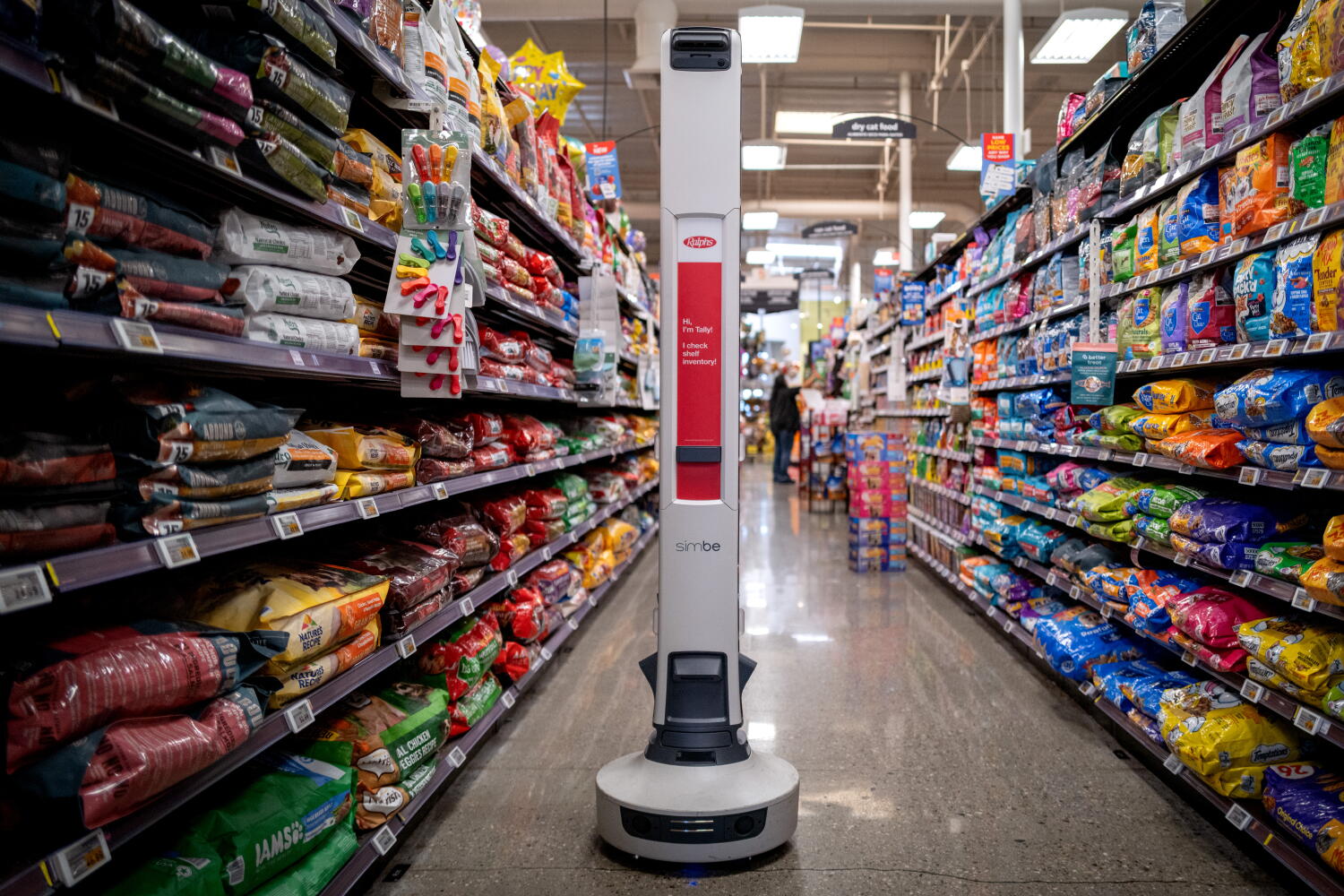
Fluorescent lights hum over polished linoleum. A cart squeaks near the olive oil. Then, gliding smoothly between the boxes of saltines and the jars of marinara, comes a tall, white column on quiet wheels, its vertical strip of cameras drinking in every price tag and empty space along the shelf.
Stop. Meanwhile, you can explore related developments here: Heritage Protection Economics Inside London’s Oldest Restaurant.
Look closely at what that machine is doing while you reach for a bag of lentils, because what feels like a minor convenience in a Los Angeles supermarket is actually a quiet renegotiation of who belongs in our everyday public spaces and whose labor counts.
I have spent years reporting on retail floors and watching how technological shifts land on real people—not in boardrooms, but in the tired calves of a night-shift stocker or the sudden pause of a shopper wondering if a camera is recording her face while she checks her budget. Even I find myself catching my breath when a rolling tower eases past me in an aisle. Is it helpful? Usually, yes. Is it unsettling when you have not asked for it? Unmistakably. To see the full picture, check out the recent article by Harvard Business Review.
Let me be clear about how we will walk through this together. Where I introduce a character to bring the tension of Los Angeles grocery aisles into sharp focus, I will tell you plainly that they are a composite or hypothetical figure built from real reporting patterns and verified retail dynamics. Where I use an analogy to explain sensors, computer vision, or store margins, I will name the metaphor as such. Truth is the spine of this piece; storytelling is the breath.
The Quiet Machine Between the Shelves
Consider a hypothetical shopper named Elena—a stand-in created to illustrate how ordinary errands feel when automation enters the room. Elena lives in East Los Angeles, works two part-time shifts, and shops on Tuesday mornings when the store is half-empty and the air still smells faintly of floor wax and baked bread. She isn't looking for a tech demonstration. She is looking for avocados that won't turn to mush by Thursday, a carton of oat milk that hasn't jumped another fifty cents, and five quiet minutes without someone rushing past her cart.
Suddenly, a sleek, upright robot rolls down Aisle 4, pausing briefly before a gap where three rows of canned tomatoes used to sit. Its sensors scan the shelf edge, log the missing stock, verify the price tag, and move on without saying a word.
In grocery stores across the United States—including locations in Southern California—retailers have increasingly turned to autonomous inventory and shelf-scanning robots to solve an age-old headache: out-of-stock items, misplaced products, and price discrepancies. Grocery chains operate on razor-thin net profit margins, often hovering around one to three percent. When a shopper walks down an aisle and doesn't find what they came for, they don't just leave that item behind; they sometimes leave the store, or they switch to delivery apps that eat into store profitability.
Think of a shelf-scanning robot as a night-owl accountant on roller skates. That is a metaphor, of course—robots don't wear skates or balance ledgers in ink—but it captures the job. Instead of a human employee walking every row with a handheld scanner, bending to check low shelves, and writing down what ran out, an autonomous unit follows a mapped route, capturing images and data continuously.
To a store manager trying to keep shelves full in a sprawling Los Angeles neighborhood where foot traffic surges unpredictably, that promise is hard to ignore. Empty shelves cost money. Lost time costs money. Yet the moment a machine begins patrolling the same narrow corridor where people squeeze past one another with bulging baskets, the atmosphere shifts.
What Workers See When the Rollers Start Turning
To understand why grocery workers in Los Angeles and beyond view these machines with a mix of curiosity and unease, picture a hypothetical clerk named Marcus—again, a composite figure representing front-line and overnight retail staff rather than a single real individual. Marcus has spent six years on his feet in a bustling L.A. grocery store. He knows which regular customer has trouble reaching the top shelf of baking supplies. He knows when a delivery pallet is running late and which aisles get hit hardest on the first of the month.
When Marcus sees an autonomous robot gliding down his aisle, his first reaction isn't sci-fi panic. It is a sharper, more practical question: If the machine tracks what is missing, who gets blamed when the shelf isn't full—and what happens to the hours on next week's schedule?
Grocery labor in Southern California carries heavy history. Workers there have fought hard, often through union organizing and contract battles, over wages, health benefits, scheduling predictability, and store staffing levels. When automation arrives in a high-cost city like Los Angeles, workers rarely experience it in isolation. They experience it alongside rising rents, fluctuating shift hours, self-checkout lanes that already reduced cashier headcount in many chains, and pressure to move faster with fewer hands on deck.
Even when a company insists a robot is only meant to "assist" staff rather than replace them, workers know how budgets work. Hours don't always disappear all at once through dramatic layoffs; sometimes they thin out quietly—an open shift isn't posted, a stocking team shrinks by one person, or expectations rise because management now has real-time data on every gap on the floor.
There is also a subtle shift in how work feels. A human stocker notices a torn bag of flour and sweeps it up; a human cashier chats with an elderly shopper who hasn't spoken to anyone all day. A robot sees pixels, barcodes, and shelf density. It doesn't feel fatigue, and it doesn't feel solidarity. For workers already stretched thin, sharing space with a tireless machine can feel like having a silent supervisor rolling past every few minutes, turning every empty spot on a shelf into a timestamped metric.
Shoppers, Cameras, and the Unspoken Contract
Why do shoppers get nervous when a robot glides into view? Partly because we aren't told what it is actually looking at.
Imagine you are standing in front of the pharmacy or feminine care aisle in a Los Angeles supermarket, squinting at ingredients while a column with lenses pauses two feet away. Even if the robot's software is programmed solely to read shelf tags and product facings—and even if it blurs faces or ignores human bodies—the presence of lenses in a public space triggers an immediate human instinct. We feel observed.
In cities where surveillance feels woven into daily life—from street cameras and license-plate readers to smart doorbells and delivery drones—a rolling machine with cameras inside a grocery store can feel like one more eye. Shoppers often ask whether these robots record video, store customer images, or track where people walk. Usually, commercial shelf-scanning robots are designed around inventory data rather than facial recognition, relying on depth sensors, lidar or optical cameras, and mapping software to navigate aisles without hitting carts or children. Still, transparency lags behind deployment. When a store rolls out a robot without clear signage explaining what data it collects, what it does not collect, and how that data is used, trust gets left on the table.
And then there is the friction of physical space. Grocery aisles are intimate places. People step backward without looking. Toddlers dart out from behind carts. Someone with a mobility aid or a heavy load of water cases needs room to turn. A robot might be programmed to stop or reroute smoothly, yet sharing tight quarters with an autonomous machine requires a new kind of spatial negotiation. You adjust your cart. You step aside. You wonder who has the right of way in an aisle meant for neighbors.
A History of Rolling Into the Future
This tension isn't brand new, even though the machines look sleeker than ever.
Look back over the past century of retail. Self-service grocery stores were once radical—shoppers used to hand a list to a clerk behind a counter rather than pick items off shelves themselves. Later came barcode scanners at checkout, then self-checkout kiosks, then loyalty apps and curbside pickup. Every single wave promised speed, lower friction, and modern convenience. Every single wave also sparked pushback from workers worried about job security and customers worried about losing the human touch.
What makes today's grocery robots feel different is that they move. A self-checkout kiosk stays bolted to the floor near the exit; you can walk past it to a human cashier if you choose. A mobile robot enters the middle of the room, sharing the exact path where you browse, linger, and decide what to feed your family.
Historically, technologies that last in everyday life are the ones that fit into human habits rather than forcing humans to contort around them. When a tool respects boundaries—clear purpose, honest communication, and genuine support for the people doing the hardest work—it fades into the background like a good pair of shoes. When it feels imposed, opaque, or aimed solely at squeezing more output from fewer workers, people push back.
The Invisible Stakes in Every Aisle
So what is actually at stake when robots roam Los Angeles grocery aisles?
Not the end of civilization. Not a takeover by machines.
The real stakes are quieter, closer to home, and far more urgent. They are about dignity on the job, privacy in ordinary routines, and whether technology makes a neighborhood store feel more welcoming or more transactional.
If a robot frees a worker from tediously counting cans at midnight so they can focus on fresh produce, customer help, or safer working conditions—and if that worker keeps fair hours, fair pay, and a voice in how tools are used—then the technology serves people. If, instead, it becomes a pretext to cut staffing, speed up unrealistic quotas, or gather data behind a curtain of corporate jargon, the cost falls squarely on workers and shoppers alike.
Shoppers have leverage, too, even when it feels small. We notice how a store treats its staff. We notice whether aisles feel chaotic or cared for. We notice when a business treats us like data points versus human beings trying to get dinner on the table.
Picture Elena again at the end of her Tuesday trip, standing near the exit with a bag of groceries over her shoulder. Down the main concourse, the white robot hums softly on its way back toward a charging dock or another aisle. A real employee—maybe someone like Marcus—waves goodbye to a regular customer at the register, asking how her mother is doing.
In that moment, the difference is unmistakable. One keeps the store running on schedule. The other keeps the store alive.
A machine can count every box on the shelf and still miss the warmth of a neighbor saying hello.