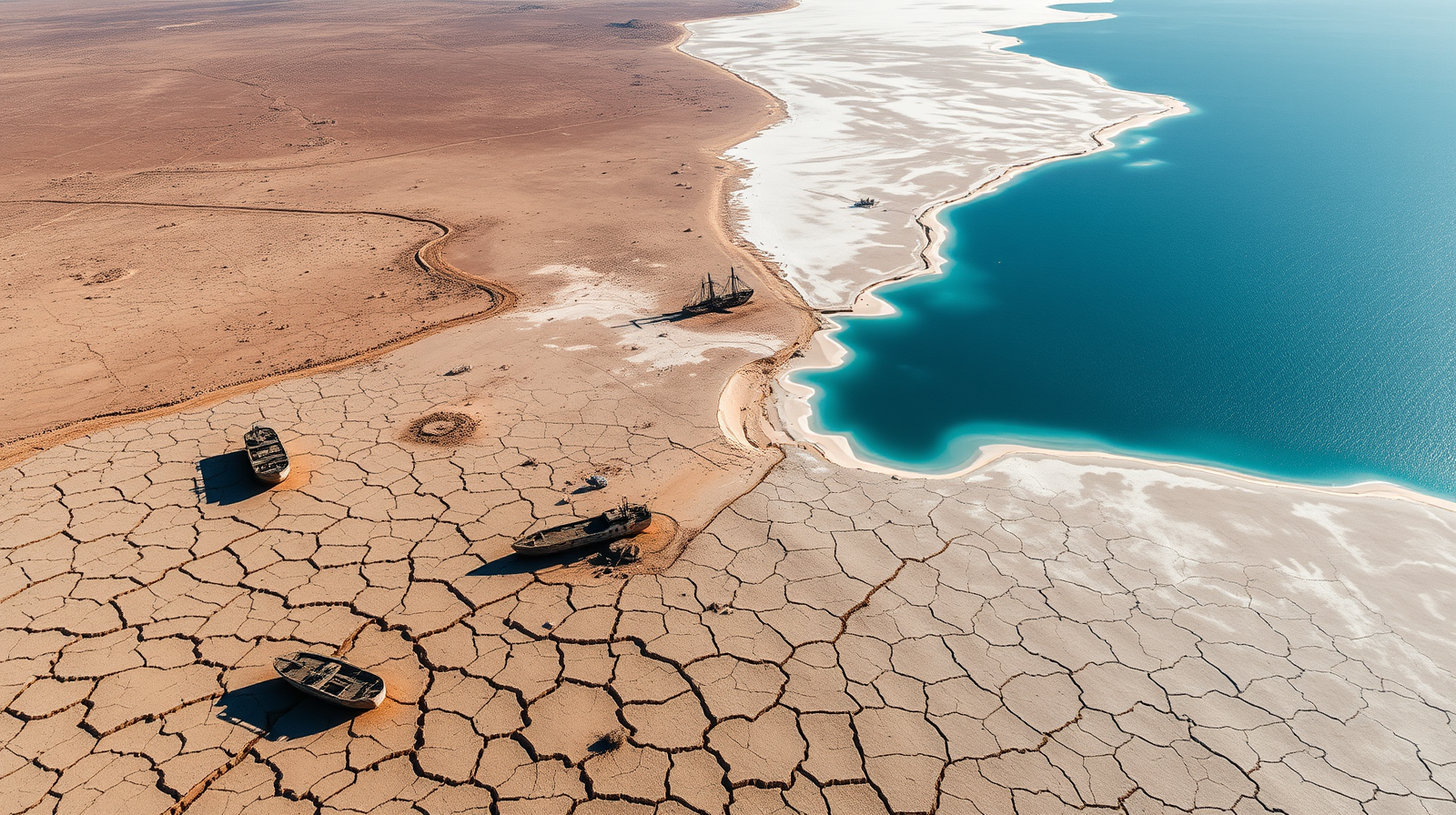
The rusted hull of a fishing trawler does not belong in the middle of a desert.
Yet, if you stand in Muynak, Uzbekistan, you will see dozens of them. They sit upright in the sand, casting long, skeletal shadows over earth that is white with salt. Camels wander past them, seeking shade beneath bowsprits that once cut through deep blue waves. There is no water for a hundred miles.
This is the Aral Sea, or what is left of it. To understand how the fourth-largest lake on the planet—an inland sea spanning over 26,000 square miles—vanished in a single human lifetime, you have to look past the satellite images. You have to look at the people who watched the water walk away.
The Mirage of Total Control
In the middle of the twentieth century, Soviet planners looked at the map of Central Asia and saw a flaw in nature. Two great rivers, the Amu Darya and the Syr Darya, flowed from the distant mountains, snaking through the Kyzylkum Desert to feed the Aral Sea. To the central planners in Moscow, this water was being wasted on a lake. They wanted white gold.
Cotton.
Beginning in the 1960s, the Soviet state engineered one of the most aggressive irrigation projects in human history. They dug thousands of miles of canals, diverting the lifelines of the Aral Sea to transform arid steppes into sprawling cotton fields. It worked, at least on paper. Uzbekistan became one of the world’s leading exporters of cotton.
But nature does not keep double-entry bookkeeping. The price of the cotton was the sea itself.
Imagine a bathtub where the tap has been turned down to a drip, but the drain remains wide open. The Aral Sea depended entirely on those two rivers to counteract the fierce desert evaporation. When the river water stopped arriving, the sea began to shrink. Rapidly. By the 1980s, the shoreline was receding by dozens of meters every year.
The Shoreline That Kept Moving
Consider a boy growing up in Muynak during that era. Let us call him Yerbol, a composite of the fishermen who lived through the collapse.
In Yerbol’s childhood, Muynak was a bustling port city. The air smelled of low tide, diesel fuel, and frying fish. The local cannery processed thousands of tons of fish annually, supplying the entire Soviet Union. Yerbol’s father was a fisherman, proud of his catch, confident that the sea would always provide.
Then, the water began to pull back.
At first, the townspeople built longer docks. They thought it was a temporary cycle, a dry spell that would pass. But the water kept retreating. The docks ended in mud, then in wet sand, and finally, in nothing at all. The harbor turned into a swamp, and the swamp turned into a salt flat. Within a few decades, the Aral Sea had lost up to 90% of its volume. It split into two main bodies of water: the Small Aral in the north (Kazakhstan) and the Large Aral in the south (Uzbekistan).
The fishing fleet was stranded. For a few desperate years, workers tried to dig channels through the sand to keep the boats connected to the receding water. Eventually, the distance became too vast. The ships were abandoned where they sat, monuments to an economy that died of thirst.
A Toxic Wind
The disappearance of the water was only the first act of the tragedy. What the sea left behind was far more dangerous.
For decades, the runoff from the cotton fields upstream washed into the Aral Sea. This water was heavily laden with chemical fertilizers, industrial pesticides, and defoliants. Because the lake had no outlet, these toxins accumulated in the sediment at the bottom. As the water evaporated, it exposed a vast, encrusted plain of salt and chemical residue—a new desert called the Aralkum.
The climate changed almost immediately. The massive body of water had once acted as a thermal regulator, softening the harsh Siberian winters and cooling the fierce summer heat. Without it, summers became blistering and winters grew agonizingly cold.
Then came the dust storms.
High winds sweep across the exposed seabed, picking up millions of tons of toxic salt and dust every year. This chemical haze carries across Central Asia and beyond; traces of Aral salt have been found as far away as the glaciers of the Himalayas and the fields of Europe.
For the people living in the Karakalpakstan region of Uzbekistan, this wind is a slow poison. Respiratory illnesses, throat cancers, and kidney diseases skyrocketed. The regional infant mortality rate became one of the highest in the former Soviet Union. The water they drink is frequently brackish and contaminated with heavy metals.
The sea did not just vanish; it turned on the people who lived beside it.
The Divide and the Dam
For a long time, the narrative surrounding the Aral Sea was one of absolute despair. It was taught in universities as the quintessential ecological warning tale, a permanent scar on the earth.
But geography is dictated by politics, and politics changed when the Soviet Union dissolved. The Aral Sea was split between two newly independent nations: Kazakhstan to the north and Uzbekistan to the south. Each took a fundamentally different approach to the disaster.
Uzbekistan, burdened by economic reliance on the very cotton fields that caused the crisis, largely accepted the loss of its portion of the sea. The southern Aral continued to dry up, fracturing into smaller, hypersaline pools where no fish can survive.
Kazakhstan, however, decided to fight for the northern remnant.
In the early 2000s, the Kazakh government, with funding from the World Bank, embarked on a massive engineering project: the Kokaral Dam. Completed in 2005, this eight-mile-long concrete barrier was built to separate the northern and southern sections of the sea. The goal was simple yet audacious: trap the waters of the Syr Darya river in the northern basin, allowing the Small Aral to refill, even if it meant cutting off the southern section completely.
It was a brutal calculation, an environmental triage. To save a part, they had to let the rest go.
The Return of the Blue
The results of the Kokaral Dam were immediate and stunning.
Water levels in the Small Aral rose by over ten meters in just a few years. The surface area expanded, and the salinity dropped drastically, returning to levels that could support aquatic life.
The fish came back.
In towns like Aralsk, which had been stranded miles from the shore just like Muynak, the water began to edge closer again. Indigenous fish species, reintroduced from hatcheries, thrived. Today, fresh fish is once again processed in local plants and exported to Europe. The microclimate around the northern lake has begun to stabilize, bringing rain back to a parched region.
For the younger generation in northern Kazakhstan, the sea is no longer a myth told by their grandfathers. It is a workplace, a source of pride, and a living ecosystem.
Yet, this victory comes with a profound sense of irony. The revival of the northern sea has effectively sealed the fate of the southern part. The Large Aral in Uzbekistan continues to wither, a vast expanse of dust and salt that may never recover. Travelers who visit the region today witness two entirely different realities separated by a concrete wall: a fragile resurrection on one side, and a quiet post-apocalyptic expanse on the other.
The Lesson in the Sand
We often treat major environmental disasters as sudden, uncontrollable events—like earthquakes or volcanic eruptions. The Aral Sea collapse was different. It was a slow, deliberate demolition, executed by degrees, approved by committees, and driven by an unwavering belief that human engineering could override planetary boundaries without consequence.
Standing among the rusted ships of Muynak, the silence is heavy. The wind carries the faint scent of salt and dry earth, a reminder of the massive ecosystem that once breathed here.
The Aral Sea taught the world that water is not an infinite commodity, and that ecosystems, once broken, cannot always be put back together. The Kokaral Dam proved that we can heal some of the wounds we inflict, but the scar left on the southern desert reminds us that the cure is often bittersweet, incomplete, and paid for by those who had no say in the destruction.