Rain on asphalt smells like dust settling. In London, that scent carries history, echoing off stone facades that have witnessed centuries of empire, protest, and shifting moral tides.
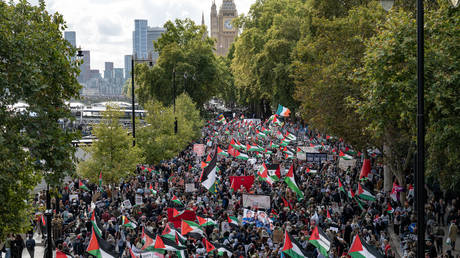
On a gray afternoon, thousands gathered. They did not come for a festival or a football match. They came because of paperwork. Bureaucratic codes, export licenses, signatures on manifests sealed in Whitehall filing cabinets. To the average passerby, an arms export license is just a number on a spreadsheet—a bureaucratic authorization approving a transaction between nations.
To the people filling Parliament Square, that number had a pulse.
Consider a hypothetical scenario, one mirrored in countless living rooms across the globe. Imagine sitting at a kitchen table, looking at a cracked smartphone screen, watching grainy footage of a skyline fracturing under smoke. Now, imagine knowing that a component inside that descending payload might have been manufactured in an industrial park just a few hours' drive away. That realization changes the texture of the air. It turns a distant geopolitical crisis into a deeply personal reckoning.
That is why the placards were held high. That is why the chants rattled the damp air.
For decades, the mechanics of international defense trade have operated in the shadows of technical jargon. Words like materiel, end-use monitoring, and strategic licensing serve a specific purpose: they distance the consequence from the cause. They create a linguistic buffer zone. When a government authorizes the sale of military hardware, the transaction is framed through the cold lens of diplomacy, alliance obligations, and economic stability.
But crowds do not speak in acronyms.
The demonstrators marching past the Home Office weren't political scientists; they were teachers, nurses, students, and grandparents. They looked at the UK's ongoing export of military components to Israel not as an abstract diplomatic chess move, but as a moral hemorrhage. They argued a simple premise: if a weapon system uses parts forged or licensed under British jurisdiction, then the responsibility for its deployment does not evaporate upon export. It stays right here.
Justice is rarely a straight line. It is a tug-of-war between legal obligations and ethical imperatives.
International law operates on frameworks built decades ago, designed for an era when supply chains were linear and borders were absolute. Today, a single targeting system or jet component relies on a web of transnational manufacturing. A microchip here, a fuselage bolt there. Halting that flow isn't as simple as flipping a switch. It requires untangling a knot woven over generations of military-industrial integration.
Yet, the protesters maintained that complexity is not an excuse for complicity.
Listen closely to the sound of a protest. It isn't just noise. It is a collective heartbeat trying to synchronize with a system that feels increasingly deaf. Megaphones crackle. Footsteps echo in unison. Banners snap in the wind. These sensory details matter because they ground the weighty politics of foreign policy in human breath and physical endurance.
Critics of the arms embargo movement often point to strategic alliances. They argue that cutting off supply lines damages diplomatic leverage and destabilizes delicate regional balances. They speak of deterrence, security architecture, and the necessity of supporting allies in volatile regions. These are not trivial arguments. They are the bedrock of traditional statecraft.
And yet, the counter-argument strikes at a different core. What happens to a nation's soul when its economic prosperity is tethered to the machinery of distant devastation?
History is watching. We look back at past conflicts, asking how ordinary citizens permitted atrocities to unfold under their watch. The answer is almost always the same: normalization. Bureaucracy. The quiet compliance of looking away because the paperwork was in order.
The rally in London was an explicit rejection of that quiet compliance.
As dusk settled over the Thames, the crowds began to disperse, swallowed by the subterranean depths of the Underground or walking off down rain-slicked side streets. The banners were rolled up. The megaphones were switched off. The politicians inside the stone buildings returned to their briefs.
Nothing changed by midnight. The export licenses remained under review; the machinery of state continued its quiet hum.
But the air had shifted. The illusion of invisible complicity had been punctured. Somewhere in the quiet aftermath, a single question remained hanging in the damp London air, waiting for an answer that Whitehall cannot ignore forever.