The air in the Situation Room doesn’t move. It sits heavy, filtered through thick vents, carrying the faint scent of ozone and expensive wool. Men and women with stars on their shoulders and ivy-league degrees in their pockets stare at glowing screens, watching the digital pulse of the world. On these screens, Iran is not a country of ancient poetry, bustling bazaars, or children playing soccer in Isfahan. It is a series of heat signatures, naval coordinates, and enrichment percentages.
Then comes the message. Read more on a connected subject: this related article.
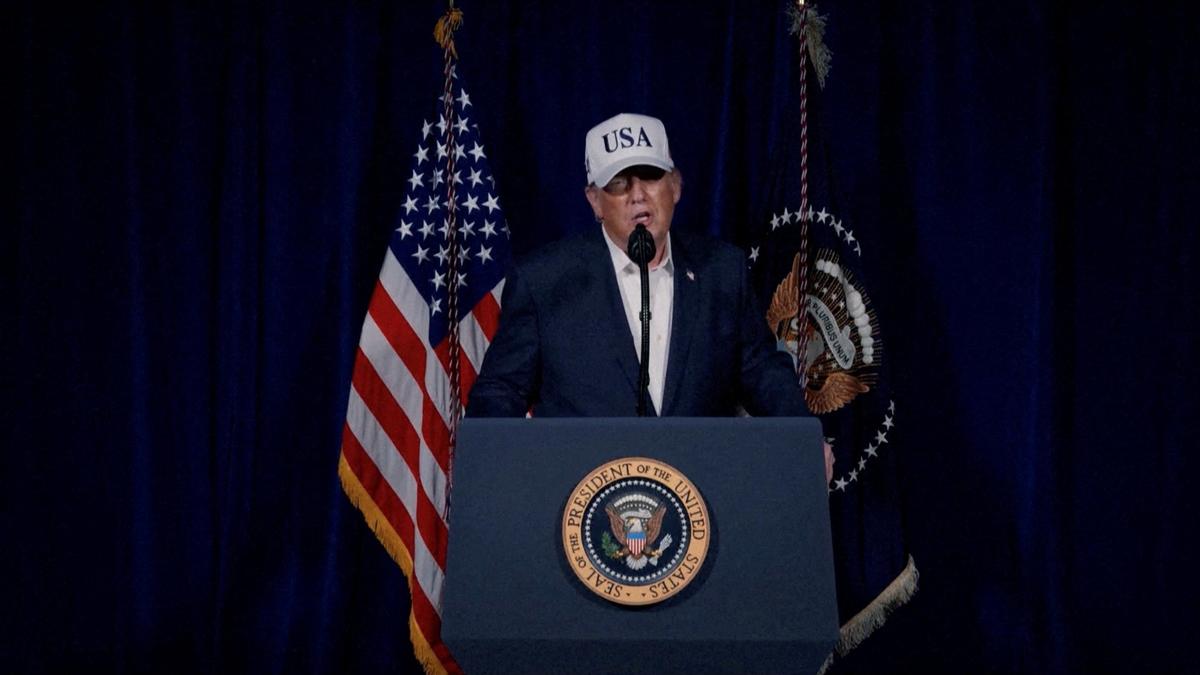
It isn't delivered in a diplomatic pouch. It doesn't arrive via a secure backchannel in Switzerland. It flashes across a smartphone screen in capital letters, a jagged lightning bolt thrown into a dry forest. Donald Trump has issued a warning. If they retaliate, if they strike back for the killing of their general, the response will be a force "never been seen before."
The words hang there. Heavy. Absolute. Further journalism by The Guardian highlights comparable perspectives on this issue.
To the strategist, this is "deterrence." To the historian, it is a echoes of 1914. To the family sitting in a dimly lit apartment in Tehran, or the sailor on a U.S. destroyer in the Persian Gulf, it is the sound of a closing door.
The Calculus of Pride and Gunpowder
War is rarely started by a single bullet. It is started by the fear of looking weak.
In Washington, the logic is a straight line. You hit us, we hit you harder. If you think about hitting us again, we will show you an inferno so bright it will blind your future. This is the "madman theory" polished for a digital age. The goal is to make the cost of resistance so unimaginably high that the opponent chooses the slow rot of sanctions over the sudden fire of kinetic war.
But across the water, the view changes.
Imagine a mid-level officer in the Islamic Revolutionary Guard Corps. Let’s call him Abbas. He isn't a monster in a movie; he is a man who grew up on stories of Persian greatness and the scars of the Iran-Iraq war. He sees the "never seen before" threat and he doesn't feel cowed. He feels the suffocating pressure of a cornered animal. If he does nothing, he is a coward in the eyes of his subordinates. If he strikes, he invites the lightning.
This is the "security dilemma" in its purest, most terrifying form. Every move made to feel safe makes the other side feel endangered.
The Architecture of the "Never Seen Before"
What does that phrase actually mean?
In the sterile language of the Pentagon, it refers to "overwhelming conventional superiority." It means the B-2 Spirit bombers that cost two billion dollars apiece, gliding through the dark like high-tech origami. It means the cyber-attacks that can turn off a city’s lights with a few lines of code. It means the hypersonic missiles that move so fast the air around them turns to plasma.
The technology is breathtaking. It is precise. It is clean on a briefing slide.
Yet, there is a lie hidden in the precision. You can map every bunker in the Iranian desert. You can track every centrifuge. You can even predict the path of a missile within a few inches. But you cannot map the human heart. You cannot predict what a population does when it feels its sovereignty is being erased by a voice from across the ocean.
History is a graveyard of "unseen" forces. The British thought the Maxim gun would end colonial resistance forever. The architects of the Vietnam War thought "Rolling Thunder" would break the will of a nation. They all had the facts. They all had the statistics. They all lacked the soul.
The Ghost in the Machine
Consider the "invisible stakes."
When a superpower threatens a regional power with total destruction, the global economy flinches. Oil traders in London stare at their monitors, their pulses jumping with every tick of the price per barrel. If the Strait of Hormuz—the world's most important chokepoint—is even whispered about, the price of gasoline in a small town in Ohio creeps up.
A single tweet can change the cost of a loaf of bread in Cairo.
This isn't just about two leaders shouting across a geographic divide. It is about a global nervous system that is wired too tight. We have built a world where everything is connected, which means a spark in the Middle East travels at the speed of light to your doorstep.
The threat of "never seen before" force is meant to stop a war. But often, it simply builds the scaffolding for one. It forces the opponent to stop thinking about diplomacy and start thinking about survival. When you tell a regime that you are ready to use unprecedented force, you give them a binary choice: total submission or total defiance.
There is no middle ground in an ultimatum.
The Silence After the Scream
In the hours following the threat, the world held its breath.
There is a specific kind of silence that happens when two giants are staring each other down. It’s the silence of a playground right before the first punch is thrown, magnified a million times over.
We often think of power as the ability to destroy. We measure it in megatons and carrier strike groups. But true power—the kind that actually changes the world for the better—is often the ability to stay the hand. It is the ability to speak clearly without shouting. It is the understanding that once the "never seen before" force is unleashed, the person who unleashed it loses control of the story.
The bombs may hit their targets. The bunkers may crumble. The "enemy" may be set back decades.
But what rises from the smoke is never what the planners intended. It is a generation of orphans with long memories. It is a shifted geopolitical alignment where old allies look at the aggressor with new eyes. It is the realization that while you can destroy a building with "never seen before" force, you cannot build a peace with it.
The threat was a gamble.
It was a bet that the fear of the unknown would outweigh the pride of the known. It was a play based on the idea that the world is a chessboard, and the pieces move only when they are pushed.
But the world isn't a chessboard. It’s a forest. And in a forest, when you threaten to burn it all down to catch a single wolf, you shouldn't be surprised when the fire eventually finds your own home.
The lights in the Situation Room stayed on all night. The satellites continued their silent orbits, capturing the grainy reality of a world on the brink. Somewhere, a thumb hovered over a send button. Somewhere else, a finger hovered over a trigger.
The "never seen before" force remained in its silos and its hangars, a dark promise kept behind glass. For now, the world remains in the "before." We are still in the quiet space where words are the only weapons being used.
But words have a weight.
And once you have threatened the unimaginable, the ordinary becomes impossible to return to. The air in the room remains heavy. The ozone lingers. The screens continue to pulse, waiting for the next jagged line to break the silence.


