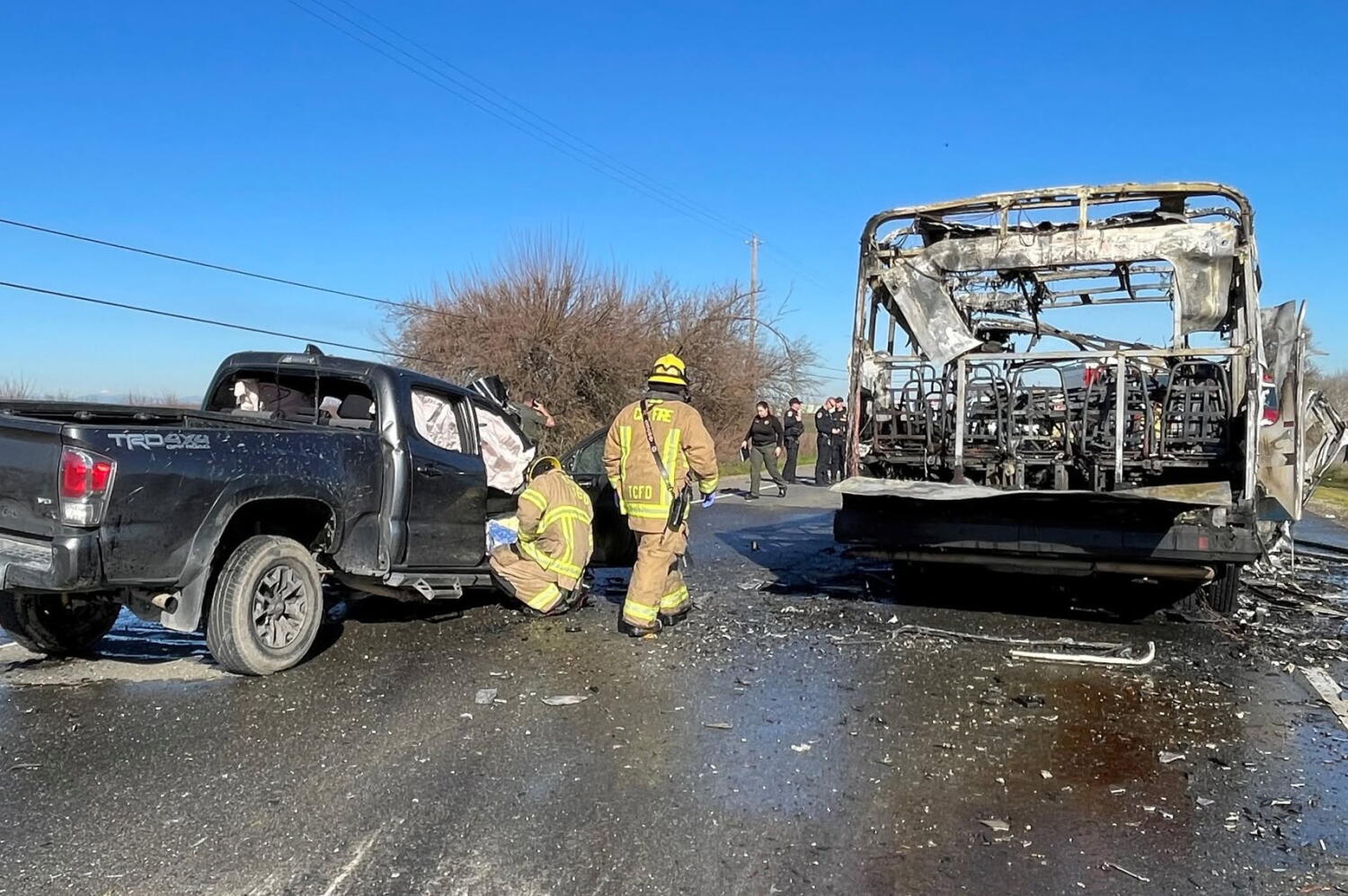
The asphalt does not remember. Asphalt takes the weight of a speeding semi, the slow crawl of a commuter sedan, or the sudden, violent trajectory of a vehicle leaving the lanes, and it simply cools in the rain. It bears no memory of malice.
Yet, there are moments when a stretch of highway transforms from a ribbon of transit into a theater of calculated ruin.
Consider the stillness of a Tuesday on a California highway, far from the coastal fog, where the air smells of sun-baked scrub and diesel exhaust. Passengers board buses every single day with a quiet, transactional trust. They carry crossword puzzles, folded jackets, worn paperback books, and headphones that play muffled music. They trust the collective momentum of society: the driver’s license checked, the brakes inspected, the steel frame engineered to withstand the ordinary turbulence of travel.
Then, the ordinary shatters.
Authorities would later speak in measured, clinical tones. They would parse the language of disaster with words like deliberate, intentional, and collision. But behind those official briefings lies an abyss that statistics cannot measure. Six lives snuffed out not by the unpredictable fury of a blowout or the sudden slickness of black ice, but by the conscious steering hand of another human being.
It is a chilling thought. We spend our lives surrounded by strangers, delegating our safety to bus drivers, pilots, and engineers, assuming a baseline contract of self-preservation. When someone shatters that contract, the shockwave hits deeper than grief. It strikes terror.
Let us walk backward through the mechanics of such tragedies, not to sensationalize the gore, but to confront the fragile machinery of human sanity under pressure.
The Geometry of Impact
Physics is indifferent to motive. When a multi-ton vehicle leaves its lane at highway speed, the kinetic energy involved is staggering. It is measured in joules, in foot-pounds, in the brutal math of mass multiplied by velocity squared.
Imagine sitting in the fourth row from the front. The seat upholstery is a nondescript blue-grey synthetic blend, worn smooth by thousands of anonymous shoulders. The hum of the diesel engine is a steady white noise, lulling the cabin into a collective trance. People are staring out windows, watching the agricultural fields blur into a smear of green and brown.
In a fraction of a second, the horizon tilts.
The bus doesn't just crash; it yields to an unnatural force. The steering wheel, normally a tool of correction, becomes a weapon of divergence. The passengers do not have time to scream in sequence. There is only a collective intake of breath, a sudden violent lurch that decouples gravity from the floorboards, and then the crushing noise of tearing metal.
When investigators arrive, they bring flashlights and tape measures. They look at skid marks—or the absence of them. They check the tachometer, the electronic control modules, the mechanical integrity of the steering column. When brakes are untouched and steering inputs are sharp and purposeful, the investigation pivots away from mechanical failure. It enters the dark, labyrinthine corridors of human intent.
How does a mind arrive at such a destination?
The Anatomy of a Breaking Point
We like to think of mass violence or self-destruction as anomalies, aberrations that belong to a different species of human. But history and behavioral psychology tell a different story. The breaking point is rarely a sudden lightning strike. It is an accumulation of micro-fractures.
Financial ruin, isolation, the quiet erosion of hope, the unbearable weight of untreated mental anguish—these are the invisible pressures that accumulate behind a person's eyes. To the outside world, a man or woman might appear entirely ordinary. They pay rent, buy groceries, and nod to their neighbors. Inside, however, a quiet detonation is underway.
When an individual decides to weaponize a vehicle, they are often crossing an invisible psychological Rubicon. It is an act born of profound alienation. The self is already dead; the physical body is merely operating on autopilot, fueled by a dark, final clarity. In that warped state of consciousness, the lives of strangers cease to be human stories. They become variables in a catastrophic equation, tools for a final, catastrophic exit.
And yet, for the six souls who boarded that bus in Northern California, none of this mattered. Their universe was entirely local. They were thinking about what to cook for dinner, whom to call when they arrived, or whether it would rain tomorrow.
That is the true tragedy of intentional crashes: the absolute asymmetry between the perpetrator's internal theater and the victims' ordinary lives.
The Ripple Effect
Grief has a geography. It starts at the epicenter—the crumpled steel, the wailing sirens, the white sheets spread across the asphalt—and it radiates outward in concentric circles.
It reaches the children waiting by a front window. It reaches the aging parents whose phones ring in the middle of the night with news that freezes time. It reaches the first responders, seasoned men and women who have seen wrecked cars before, yet find themselves unmoored when the geometry of the crash reveals deliberate malice.
We must ask ourselves what kind of society we are building when our public transit systems—our buses, our trains, our airplanes—must contend not only with mechanical wear and tear, but with the unpredictable volatility of the human spirit.
Security checkpoints at airports are a daily reminder that we live in fear of external terror. But how do you screen for a broken soul stepping onto a regional bus on a Tuesday morning? You cannot. To build a society entirely free from such vulnerability would require a surveillance state so suffocating that it would destroy the very freedom of movement we cherish.
So we live in the tension. We board the bus. We take our seats, look out the window at the passing landscape, and trust the stranger behind the wheel.
When that trust is violently betrayed, as it was on that fateful California highway, we are forced to look into the abyss. We are forced to acknowledge that civilization is a thin veneer stretched over a turbulent ocean of human emotion.
The investigation eventually concludes. The reports are filed in manila folders, stamped and archived. The debris is cleared, the asphalt is patched, and traffic resumes its relentless flow.
The road forgets.
The living, however, carry the weight. They look at a bus rumbling down the highway, and for a split second, they see not just a vehicle of transit, but a vessel carrying the entire, fragile mystery of human vulnerability.