The air inside the Waltham training camp smelled of cut grass and heavy East Coast humidity. It was the kind of heat that sticks to the back of your neck, making every breath feel earned. On the pitch, the young millionaires of French football were laughing, chasing a ball under the pale Massachusetts sun. They looked untethered. Free.
Then the black sedan pulled up.
Didier Deschamps stepped out. His face was a map of exhaustion, his eyes shadowed by the kind of grief that doesn’t care about tournament brackets or tactical press conferences. Just days earlier, after a commanding victory over Iraq that sealed France’s progression into the World Cup knockout rounds, the manager had received the call. His mother had passed away. He had immediately boarded a plane back across the Atlantic, leaving his squad in the hands of his assistant, Guy Stéphan, while he buried the woman who had watched him grow from a muddy kid in Bayonne to the patriarch of French sport.
He missed the 4-1 thrashing of Norway. He missed the sight of Ousmane Dembélé bagging a historic hat-trick in Boston. But on this Monday evening, before a daunting Round of 32 clash with Sweden in New Jersey, the boss was back.
"I’m here," Deschamps told reporters, his voice quiet but steady. "I’m good, and it’s good to be busy."
It was a staggering reminder of the invisible tax exacted on the people who lead. We treat international football managers as chess grandmasters or corporate autocrats, forgetting that beneath the sharp suits and the tactical binders, they are merely human beings navigating the same fragile, heartbreaking world as the rest of us.
Yet, what Deschamps is doing right now in North America isn’t just a masterclass in personal resilience. It is an act of tactical courage that flies in the face of everything that made him a legend.
The Prisoner of Pragmatism
For over a decade, Deschamps was the high priest of utilitarian football. He did not care if you were entertained. He cared if you won.
During the 2018 triumph in Russia and the agonizing run to the final in Qatar, France was a monolith. They sat deep. They compressed space. They suffocated the life out of matches, trusting that a single flash of lightning from Kylian Mbappé or a moment of Antoine Griezmann magic would suffice. It wasn't beautiful, but it was terrifyingly efficient.
But something shifted. Perhaps it was the turgid, suffocating display at Euro 2024, where a hyper-conservative France crawled to the semi-finals scoring just four goals in six matches. It felt like a team driving a Ferrari in first gear. The public grew restless. The players looked shackled.
So, Deschamps did something older men rarely do. He changed his mind.
In this World Cup, France has thrown off the weights. They scored ten goals in just three group games—an attacking return the nation hasn’t witnessed at a major tournament since Raymond Kopa and Just Fontaine were tearing through defenses in 1958. They are averaging over three goals a game. They are playing with a breathless, high-wire audacity that is as exhilarating as it is perilous.
"We have a capacity for danger," Deschamps said, a slight glint returning to his eyes. "And I want us to keep it."
Consider the tactical math. In previous tournaments, France’s defensive block was a fortress. Now, they are leaving the back door unlocked in exchange for total creative freedom up front. Michael Olise is operating as a puppet master, racking up three assists without even needing to find the net himself. Bradley Barcola and Désiré Doué are playing with the fearless arrogance of youth.
It is a terrifying gamble. When you attack with six players, you leave your central defenders exposed to the counter. Against Norway, there were moments of genuine panic in the French box.
But bravery isn't the absence of fear. It is the realization that something else is more important. Deschamps realized that this generation of French superstars—men raised on the hyper-speed, transition-heavy diet of modern club football—could no longer be contained in a cage of caution. To let them thrive, he had to accept the chaos.
The Captain and the Shield
To understand why this works, you have to look at the relationship between Deschamps and his captain.
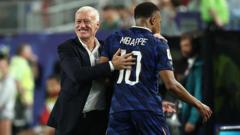
Kylian Mbappé carries the expectations of an entire republic on his shoulders. From the outside, he is often painted as an isolated mega-celebrity, a businessman who happens to play football. But watch him on the training pitch under Deschamps’ gaze.
When the manager returned from France, grieving and hollowed out, Mbappé was the first to tighten the circle around him. On the field, the superstar forward has transformed. He is tracking back. He is pressing. He has provided two assists for Dembélé, sacrificing his own hunt for the Golden Boot to feed his childhood friend.
"Kylian defends," Deschamps noted defensively, shielding his talisman from the inevitable media critiques. "Perhaps not as much as the others, but he scores more goals than the others too. He fully embraces his role as captain. The image people might have of him from the outside doesn't match who he really is."
This is the true genius of Didier Deschamps. His bravery isn't just found in a tactical spreadsheet that pushes his full-backs higher up the pitch. It is found in his ability to create a human sanctuary within the pressure cooker of a World Cup. He absorbs the media flak, handles his personal tragedies in the quiet shadows, and gives his players the absolute freedom to be imperfect.
The French have won three group games on the bounce for the first time since 1998—the year Deschamps himself hoisted the trophy as captain on home soil. The historical echoes are deafening.
But history offers no guarantees against a disciplined, physical Sweden side with nothing to lose in East Rutherford. The knockout rounds are a cruel, sudden-death environment where one misplaced pass can destroy four years of preparation. The easy move for Deschamps right now would be to retreat. To tighten the screws. To revert to the safe, boring defensive shell that brought him gold before.
Instead, he is doubling down on the beautiful danger.
Tomorrow, the whistle will blow at MetLife Stadium. The noise will be deafening, the lights blinding. But for Didier Deschamps, the loudest silence has already passed. He will stand on the touchline, a man carrying a heavy heart, watching the young men he protected run wildly into the attack, completely unafraid of the dark.